Sugiura Yusaku, Sakuma Kazuhiko, Sakuraba Keishoku, Sato Yamato
Laboratory of Sports Science, Meikai University, Chiba, Japan.
Department of Health and Sports Science, Juntendo University, Chiba, Japan.
Orthop J Sports Med. 2017 Jan 17;5(1):2325967116681524. doi: 10.1177/2325967116681524. eCollection 2017 Jan.
No studies have been reported on how strength, agility, and flexibility training reduce the occurrence of hamstring injuries in sprinters. Therefore, a program for preventing hamstring injury in these athletes has not been established.
To document the incidence of hamstring injuries during times when different prevention strategies were employed to see whether a particular prevention program reduced their occurrence.
Descriptive epidemiology study.
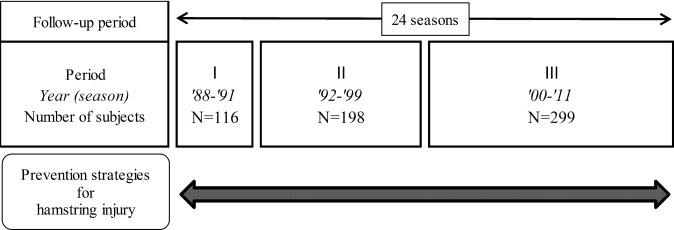
The study subjects were a total of 613 collegiate male sprinters trained by the same coach over 24 seasons. Tow training was used throughout the research period as a normal sprint training method. The hamstring injury prevention program evolved over time. From 1988 to 1991 (period 1), prevention focused on strength training alone; from 1992 to 1999 (period 2), a combination of strength and agility training was used; and from 2000 to 2011 (period 3), the program incorporated strength, agility, and flexibility training. The incidence of hamstring injuries was compared for each of the 3 prevention strategies.
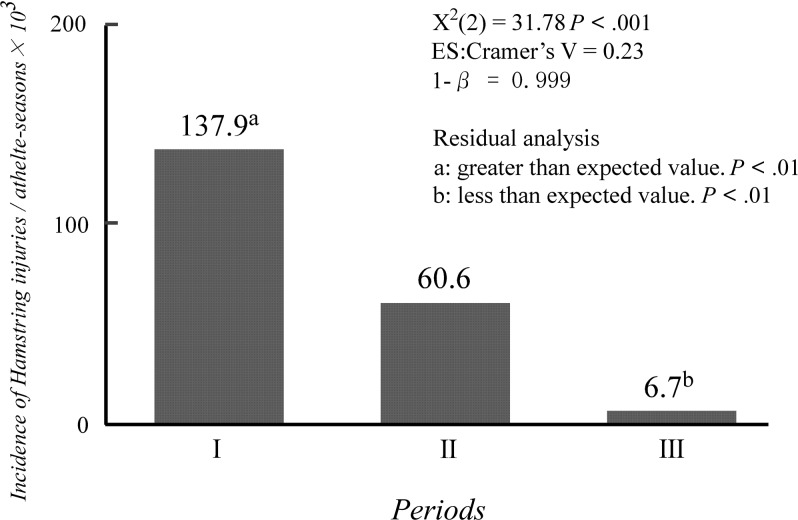
The incidence of hamstring injuries per athlete-seasons was 137.9 for period 1, 60.6 for period 2, and 6.7 for period 3. A significant difference was observed in the incidence of hamstring injury according to the different prevention programs (χ(2) = 31.78, < .001, effect size: Cramer = 0.23, 1 - β = 0.999). Residual analysis showed that the number of hamstring injuries for period 1 was significantly greater than the expected value ( < .01), whereas that for period 3 was significantly lower than the expected value ( < .01).
The incidence of hamstring injuries in sprinters decreased as agility and flexibility were added to strength training.
尚无关于力量、敏捷性和柔韧性训练如何降低短跑运动员腘绳肌损伤发生率的研究报道。因此,尚未建立针对这些运动员预防腘绳肌损伤的方案。
记录在采用不同预防策略期间腘绳肌损伤的发生率,以观察特定的预防方案是否能降低其发生率。
描述性流行病学研究。
研究对象为在24个赛季中由同一位教练训练的613名大学男子短跑运动员。在整个研究期间,采用传统训练作为常规的短跑训练方法。腘绳肌损伤预防方案随时间演变。1988年至1991年(第1阶段),预防仅侧重于力量训练;1992年至1999年(第2阶段),采用力量和敏捷性训练相结合的方法;2000年至2011年(第3阶段),该方案纳入了力量、敏捷性和柔韧性训练。比较了三种预防策略中每种策略的腘绳肌损伤发生率。
第1阶段每名运动员每赛季的腘绳肌损伤发生率为137.9,第2阶段为60.6,第3阶段为6.7。根据不同的预防方案,观察到腘绳肌损伤发生率存在显著差异(χ(2)=31.78,P<.001,效应量:克莱默V=0.23,检验效能:1-β=0.999)。残差分析表明,第1阶段的腘绳肌损伤数量显著高于预期值(P<.01),而第3阶段的则显著低于预期值(P<.01)。
随着力量训练中增加了敏捷性和柔韧性训练,短跑运动员腘绳肌损伤的发生率降低。