Wetzels Suzan, Wouters Kristiaan, Schalkwijk Casper G, Vanmierlo Tim, Hendriks Jerome J A
Department of Internal Medicine, Cardiovascular Research Institute Maastricht, Maastricht University, 6229 Maastricht, The Netherlands.
Department of Immunology and Biochemistry, Biomedical Research Institute, Hasselt University, Martelarenlaan 42, 3500 Hasselt, Belgium.
Int J Mol Sci. 2017 Feb 15;18(2):421. doi: 10.3390/ijms18020421.
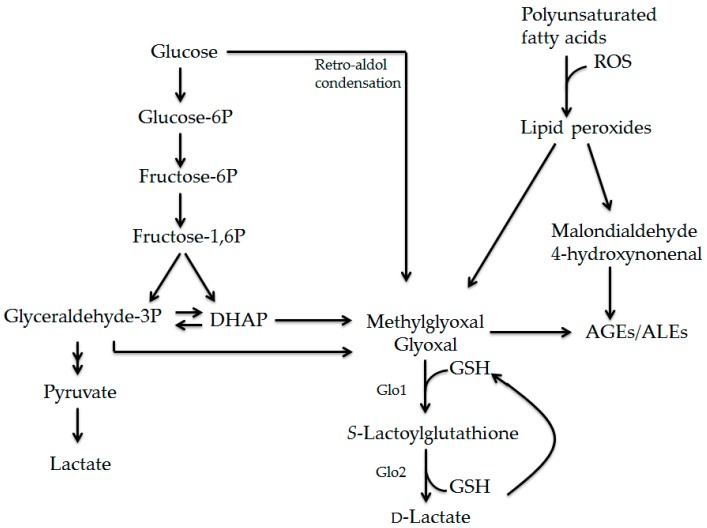
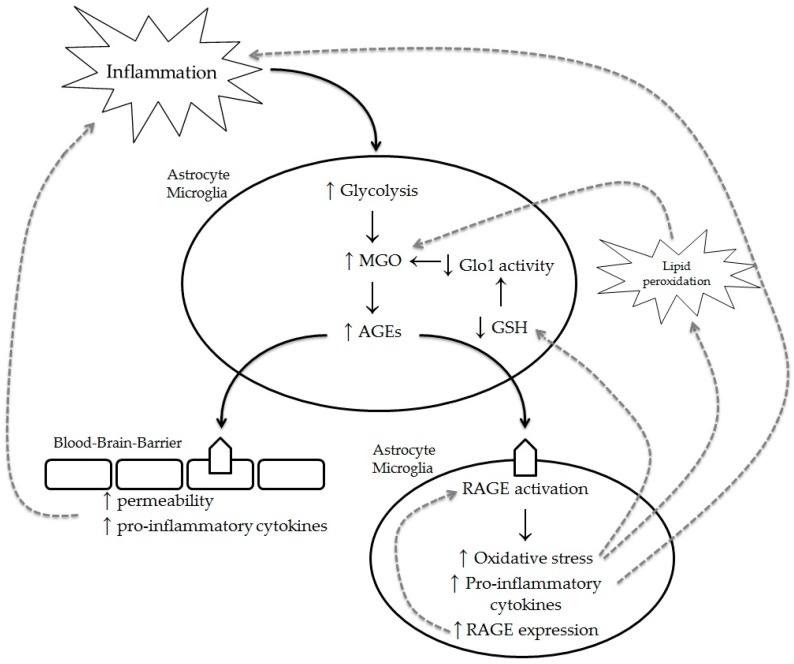
Multiple sclerosis (MS) is a demyelinating disease of the central nervous system (CNS). The activation of inflammatory cells is crucial for the development of MS and is shown to induce intracellular glycolytic metabolism in pro-inflammatory microglia and macrophages, as well as CNS-resident astrocytes. Advanced glycation endproducts (AGEs) are stable endproducts formed by a reaction of the dicarbonyl compounds methylglyoxal (MGO) and glyoxal (GO) with amino acids in proteins, during glycolysis. This suggests that, in MS, MGO-derived AGEs are formed in glycolysis-driven cells. MGO and MGO-derived AGEs can further activate inflammatory cells by binding to the receptor for advanced glycation endproducts (RAGE). Recent studies have revealed that AGEs are increased in the plasma and brain of MS patients. Therefore, AGEs might contribute to the inflammatory status in MS. Moreover, the main detoxification system of dicarbonyl compounds, the glyoxalase system, seems to be affected in MS patients, which may contribute to high MGO-derived AGE levels. Altogether, evidence is emerging for a contributing role of AGEs in the pathology of MS. In this review, we provide an overview of the current knowledge on the involvement of AGEs in MS.
多发性硬化症(MS)是一种中枢神经系统(CNS)的脱髓鞘疾病。炎症细胞的激活对MS的发展至关重要,并且已表明其可诱导促炎性小胶质细胞、巨噬细胞以及中枢神经系统驻留星形胶质细胞内的糖酵解代谢。晚期糖基化终产物(AGEs)是在糖酵解过程中,由二羰基化合物甲基乙二醛(MGO)和乙二醛(GO)与蛋白质中的氨基酸反应形成的稳定终产物。这表明,在MS中,源自MGO的AGEs在糖酵解驱动的细胞中形成。MGO和源自MGO的AGEs可通过与晚期糖基化终产物受体(RAGE)结合来进一步激活炎症细胞。最近的研究表明,MS患者血浆和大脑中的AGEs增加。因此,AGEs可能导致MS中的炎症状态。此外,二羰基化合物的主要解毒系统——乙二醛酶系统,在MS患者中似乎受到影响,这可能导致源自MGO的AGE水平升高。总之,越来越多的证据表明AGEs在MS病理过程中发挥作用。在本综述中,我们概述了目前关于AGEs参与MS的知识。