Xue Feng, Nie Xiaobo, Shi Jianping, Liu Qingxue, Wang Ziwei, Li Xiting, Zhou Jinqiu, Su Jia, Xue Mingming, Chen Wei-Dong, Wang Yan-Dong
Key Laboratory of Molecular Pathology, School of Basic Medical Science, Inner Mongolia Medical University Hohhot, China.
Key Laboratory of Receptors-Mediated Gene Regulation and Drug Discovery, School of Medicine, Henan University Kaifeng, China.
Front Pharmacol. 2017 Feb 3;8:40. doi: 10.3389/fphar.2017.00040. eCollection 2017.
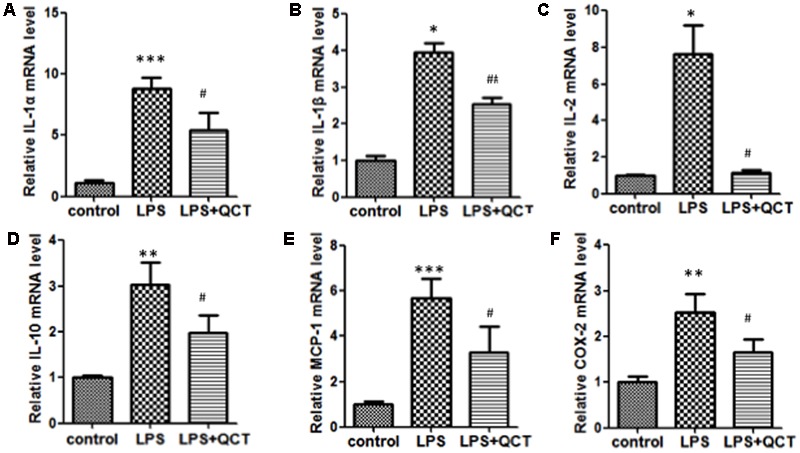
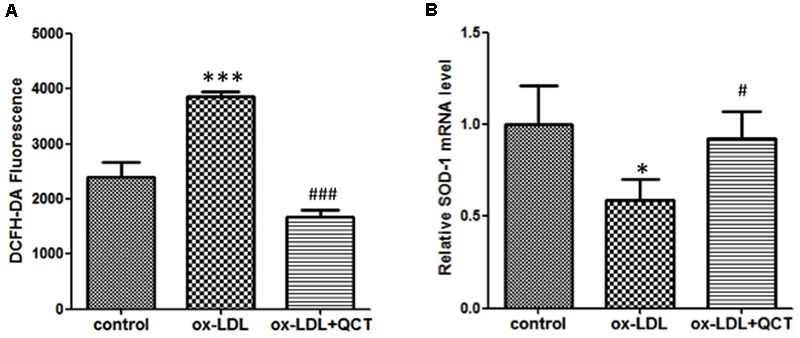
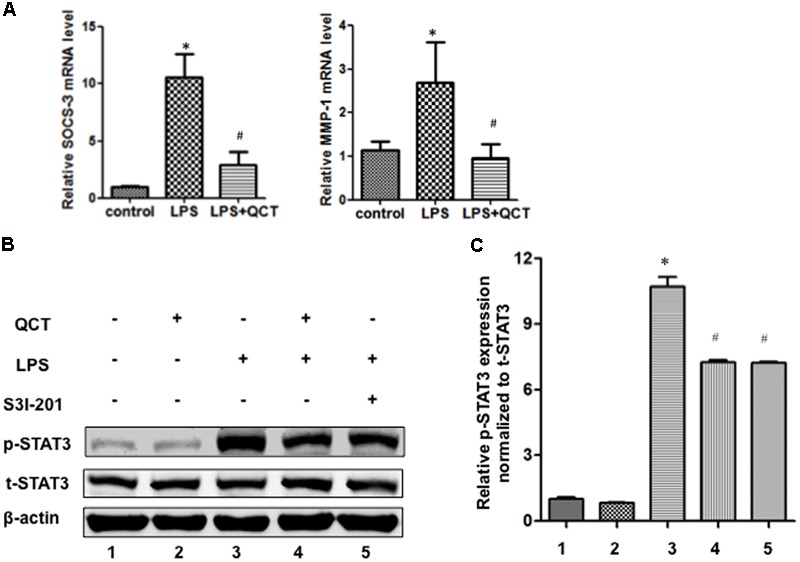
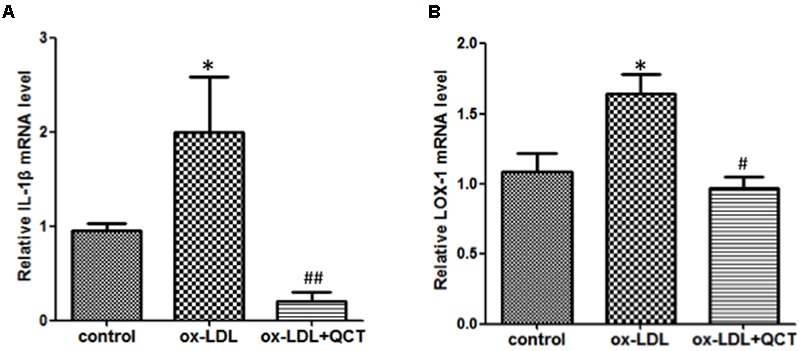
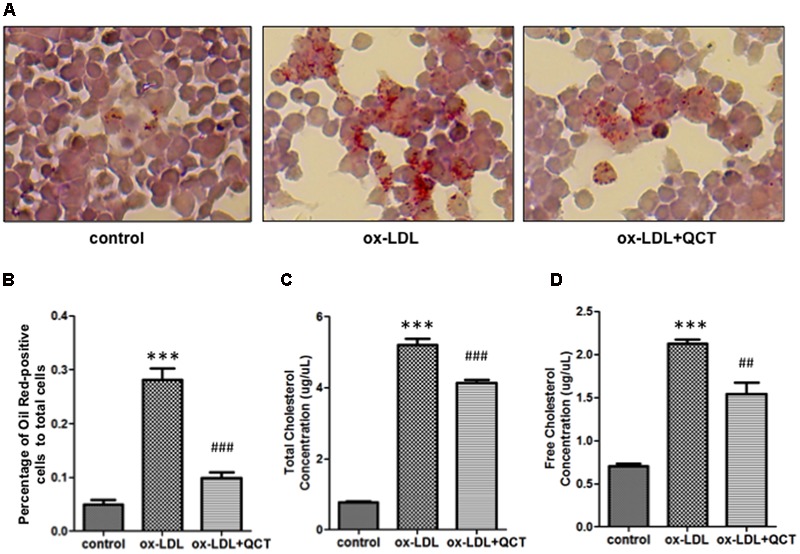
Aberrant activation of inflammation and excess accumulation of lipids play crucial role in the occurrence and progression of atherosclerosis (AS). Quercetin (QCT) has been tested effectively to cure AS. It is widely distributed in plant foods and has been proved to have potential antioxidative and anticancer activities. However, the underlying molecular mechanisms of OCT in AS are not completely understood. In the present study, we stimulated murine RAW264.7 cells with lipopolysaccharide (LPS) or oxidized low-density lipoproteins (ox-LDL) to mimic the development of AS. The data show that QCT treatment leads to an obvious decrease of multiple inflammatory cytokines in transcript level, including interleukin (IL)-1α, IL-1β, IL-2, IL-10, macrophage chemoattractant protein-1 (MCP-1), and cyclooxygenase-2 (COX-2) induced by LPS. Moreover, expressions of other factors that contribute to the AS development, such as matrix metalloproteinase-1 (MMP-1) and suppressor of cytokine signaling 3 (SOCS3) induced by LPS are also downregulated by QCT. Furthermore, we found that QCT suppressed LPS-induced the phosphorylation of STAT3. Meanwhile, QCT could ameliorate lipid deposition and overproduction of reactive oxygen species induced by ox-LDL, and block the expression of lectin-like oxidized LDL receptor-1 (LOX-1) in cultured macrophages. Taken together, our data reveal that QCT has obvious anti-inflammatory and antioxidant virtues and could be a therapeutic agent for the prevention and treatment of AS.
炎症的异常激活和脂质的过度积累在动脉粥样硬化(AS)的发生和发展中起关键作用。槲皮素(QCT)已被有效测试用于治疗AS。它广泛分布于植物性食物中,并且已被证明具有潜在的抗氧化和抗癌活性。然而,OCT在AS中的潜在分子机制尚未完全明确。在本研究中,我们用脂多糖(LPS)或氧化低密度脂蛋白(ox-LDL)刺激小鼠RAW264.7细胞以模拟AS的发展。数据表明,QCT处理导致多种炎症细胞因子的转录水平明显降低,包括LPS诱导的白细胞介素(IL)-1α、IL-1β、IL-2、IL-10、巨噬细胞趋化蛋白-1(MCP-1)和环氧合酶-2(COX-2)。此外,QCT还下调了其他有助于AS发展的因子的表达,如LPS诱导的基质金属蛋白酶-1(MMP-1)和细胞因子信号转导抑制因子3(SOCS3)。此外,我们发现QCT抑制LPS诱导的STAT3磷酸化。同时,QCT可改善ox-LDL诱导的脂质沉积和活性氧的过量产生,并阻断培养巨噬细胞中凝集素样氧化LDL受体-1(LOX-1)的表达。综上所述,我们的数据表明QCT具有明显的抗炎和抗氧化特性,可能是预防和治疗AS的一种治疗剂。