Voshol Gerben P, Vijgenboom Erik, Punt Peter J
Molecular Microbiology and Health, Institute of Biology Leiden, Leiden University, Leiden, The Netherlands.
Dutch DNA Biotech B.V., Utrechtseweg 48, 3703HE, Zeist, The Netherlands.
BMC Res Notes. 2017 Feb 21;10(1):105. doi: 10.1186/s13104-017-2429-8.
Renewable biopolymers, such as cellulose, starch and chitin are highly resistance to enzymatic degradation. Therefore, there is a need to upgrade current degradation processes by including novel enzymes. Lytic polysaccharide mono-oxygenases (LPMOs) can disrupt recalcitrant biopolymers, thereby enhancing hydrolysis by conventional enzymes. However, novel LPMO families are difficult to identify using existing methods. Therefore, we developed a novel profile Hidden Markov model (HMM) and used it to mine genomes of ascomycetous fungi for novel LPMOs.
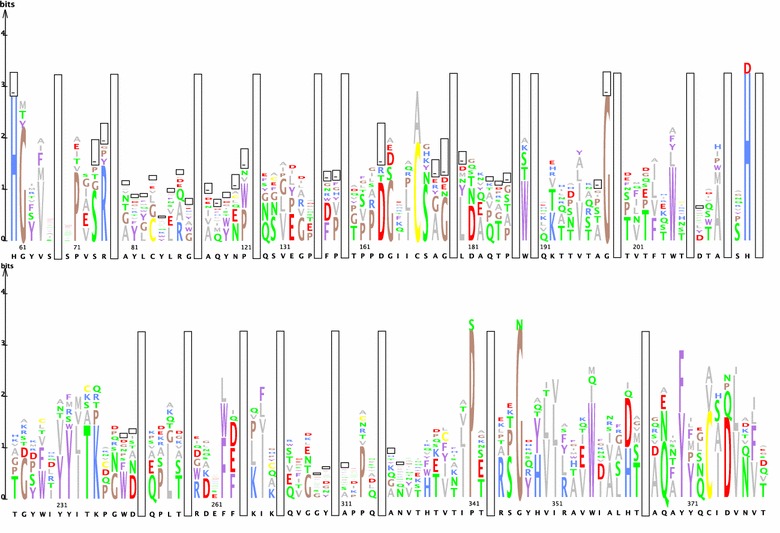
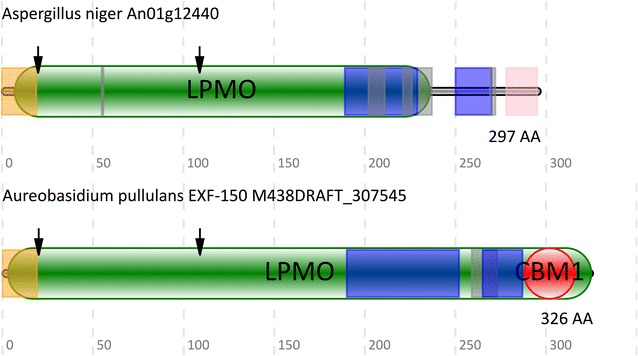
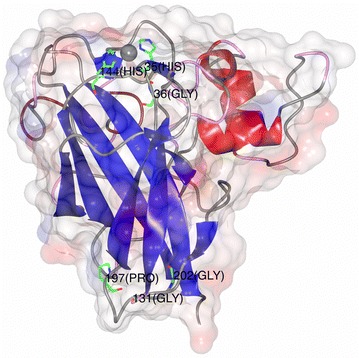
We constructed a structural alignment and verified that the alignment was correct. In the alignment we identified several known conserved features, such as the histidine brace and the N/Q/E-X-F/Y motif and previously unidentified conserved proline and glycine residues. These residues are distal from the active site, suggesting a role in structure rather than activity. The multiple protein alignment was subsequently used to build a profile Hidden Markov model. This model was initially tested on manually curated datasets and proved to be both sensitive (no false negatives) and specific (no false positives). In some of the genomes analyzed we identified a yet unknown LPMO family. This new family is mostly confined to the phyla of Ascomycota and Basidiomycota and the class of Oomycota. Genomic clustering indicated that at least some members might be involved in the degradation of β-glucans, while transcriptomic data suggested that others are possibly involved in the degradation of pectin.
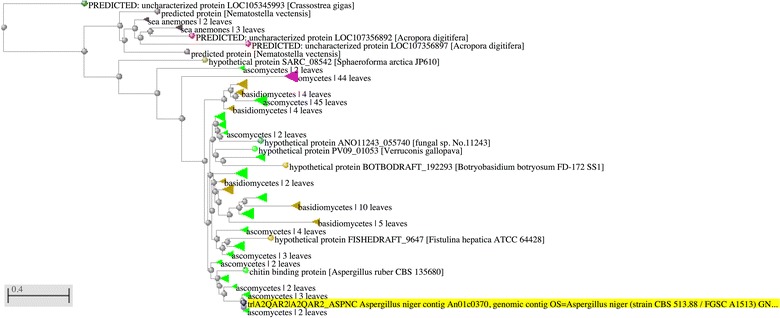
The newly developed profile hidden Markov Model was successfully used to mine fungal genomes for a novel family of LPMOs. However, the model is not limited to bacterial and fungal genomes. This is illustrated by the fact that the model was also able to identify another new LPMO family in Drosophila melanogaster. Furthermore, the Hidden Markov model was used to verify the more distant blast hits from the new fungal family of LPMOs, which belong to the Bivalves, Stony corals and Sea anemones. So this Hidden Markov model (Additional file 3) will help the broader scientific community in identifying other yet unknown LPMOs.
可再生生物聚合物,如纤维素、淀粉和几丁质,对酶促降解具有高度抗性。因此,有必要通过纳入新型酶来改进当前的降解工艺。裂解多糖单加氧酶(LPMO)可以破坏顽固的生物聚合物,从而增强传统酶的水解作用。然而,使用现有方法很难鉴定新型LPMO家族。因此,我们开发了一种新型的轮廓隐马尔可夫模型(HMM),并使用它来挖掘子囊菌真菌基因组中的新型LPMO。
我们构建了一个结构比对,并验证了该比对是正确的。在比对中,我们鉴定出了几个已知的保守特征,如组氨酸支架和N/Q/E-X-F/Y基序,以及先前未鉴定的保守脯氨酸和甘氨酸残基。这些残基远离活性位点,表明其在结构而非活性方面发挥作用。随后,多蛋白比对被用于构建轮廓隐马尔可夫模型。该模型最初在人工筛选的数据集中进行测试,结果证明它既敏感(无假阴性)又特异(无假阳性)。在一些分析的基因组中,我们鉴定出了一个未知的LPMO家族。这个新家族主要局限于子囊菌门、担子菌门和卵菌纲。基因组聚类表明,至少一些成员可能参与β-葡聚糖的降解,而转录组数据表明其他成员可能参与果胶的降解。
新开发的轮廓隐马尔可夫模型成功用于挖掘真菌基因组中的一个新型LPMO家族。然而,该模型并不局限于细菌和真菌基因组。这一点从该模型还能够在黑腹果蝇中鉴定出另一个新的LPMO家族这一事实中得到了说明。此外,隐马尔可夫模型被用于验证来自新的真菌LPMO家族的更远距离的blast匹配结果,这些匹配结果属于双壳类、石珊瑚和海葵。因此,这个隐马尔可夫模型(附加文件3)将有助于更广泛的科学界识别其他未知的LPMO。