Wierup Martin, Wahlström Helene, Lahti Elina, Eriksson Helena, Jansson Désirée S, Odelros Åsa, Ernholm Linda
Department of Biomedical Sciences and Veterinary Public Health, Swedish University of Agricultural Sciences, P.O. Box 7028, SE-75007, Uppsala, Sweden.
Department of Disease Control and Epidemiology, National Veterinary Institute, SVA, SE-751 89, Uppsala, Sweden.
Acta Vet Scand. 2017 Feb 21;59(1):13. doi: 10.1186/s13028-017-0281-4.
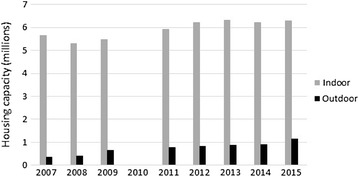
Outdoor production of poultry is rapidly increasing, which could be associated with increased risks for exposure to different environmental sources of Salmonella. We report a comparison on the occurrence of Salmonella during 2007-2015 in broilers and laying hens in outdoor and indoor production subjected to the same requirements for the prevention and control of Salmonella as applied in Sweden.
Our results give no indication that, during the period studied, the exposure to Salmonella in outdoor poultry production was higher than in the indoor production. The annual incidence of Salmonella infected flocks in outdoor production remained at a very low and at a similar level as for indoor production. For laying hens the annual proportion of birds in test positive flocks ranged from 0 to 1.3% for indoor production from 0 to 2.0% for outdoor production. For broilers the proportion of Salmonella infected flocks (2013-2015) was 0.16% for indoor, and 0% in outdoor production. The difference was not statistically significant and was further reduced when flocks infected due to vertical transmission or from a hatchery source were excluded. It should, however, be considered that the number of outdoor flocks included in this evaluation is very small and continuous evaluation is needed.
New animal production systems, including those driven by consumer and welfare demands, may be associated with a higher risk for the exposure of potential pathogens to food animals and possibly also subsequent outbreaks of food borne infections. In this study no increase in the risk for exposure of flocks to Salmonella in outdoor poultry production was found. The situation may well change and the possibility of Salmonella contamination in outdoor poultry production requires continuous attention.
家禽户外养殖正在迅速增加,这可能与接触不同环境来源沙门氏菌的风险增加有关。我们报告了2007年至2015年期间,在瑞典对肉鸡和蛋鸡进行户外和室内养殖时沙门氏菌的发生情况比较,两种养殖方式都遵循相同的沙门氏菌防控要求。
我们的结果表明,在研究期间,户外家禽养殖中沙门氏菌的暴露情况并不高于室内养殖。户外养殖中沙门氏菌感染鸡群的年发病率一直很低,与室内养殖水平相近。对于蛋鸡,室内检测呈阳性鸡群中鸡的年比例为0%至1.3%,户外为0%至2.0%。对于肉鸡,沙门氏菌感染鸡群的比例(2013 - 2015年)室内为0.16%,户外为0%。差异无统计学意义,排除因垂直传播或来自孵化场感染的鸡群后,差异进一步缩小。然而,应该考虑到本评估中纳入的户外鸡群数量非常少,需要持续评估。
新的动物生产系统,包括那些受消费者和福利需求驱动的系统,可能会使食用动物接触潜在病原体的风险增加,也可能导致随后食源性感染的爆发。在本研究中,未发现户外家禽养殖中鸡群接触沙门氏菌的风险增加。情况很可能会发生变化,户外家禽生产中沙门氏菌污染的可能性需要持续关注。