Keven John B, Reimer Lisa, Katusele Michelle, Koimbu Gussy, Vinit Rebecca, Vincent Naomi, Thomsen Edward, Foran David R, Zimmerman Peter A, Walker Edward D
Papua New Guinea Institute of Medical Research, Vector Borne Diseases Unit, Madang, 511, Madang, Papua New Guinea.
Department of Microbiology and Molecular Genetics, Michigan State University, 48824, East Lansing, MI, USA.
Parasit Vectors. 2017 Feb 21;10(1):95. doi: 10.1186/s13071-017-2038-3.
Host selection is an important determinant of vectorial capacity because malaria transmission increases when mosquitoes feed more on humans than non-humans. Host selection also affects the outcome of long-lasting insecticidal nets (LLIN). Despite the recent nationwide implementation of LLIN-based malaria control program in Papua New Guinea (PNG), little is known about the host selection of the local Anopheles vectors. This study investigated the host selection of Anopheles vectors in PNG.
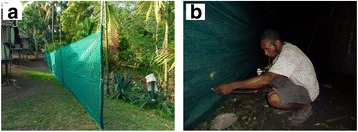
Blood-engorged mosquitoes were sampled using the barrier screen method and blood meals analyzed for vertebrate host source with PCR-amplification of the mitochondrial cytochrome b gene. Abundance of common hosts was estimated in surveys. The test of homogeneity of proportions and the Manly resource selection ratio were used to determine if hosts were selected in proportion to their abundance.
Two thousand four hundred and forty blood fed Anopheles females of seven species were sampled from five villages in Madang, PNG. Of 2,142 samples tested, 2,061 (96.2%) yielded a definitive host source; all were human, pig, or dog. Hosts were not selected in proportion to their abundance, but rather were under-selected or over-selected by the mosquitoes. Four species, Anopheles farauti (sensu stricto) (s.s.), Anopheles punctulatus (s.s.), Anopheles farauti no. 4 and Anopheles longirostris, over-selected humans in villages with low LLIN usage, but over-selected pigs in villages with high LLIN usage. Anopheles koliensis consistently over-selected humans despite high LLIN usage, and Anopheles bancroftii over-selected pigs.
The plasticity of host selection of an Anopheles species depends on its opportunistic, anthropophilic or zoophilic behavior, and on the extent of host availability and LLIN usage where the mosquitoes forage for hosts. The high anthropophily of An. koliensis increases the likelihood of contacting the LLIN inside houses. This allows its population size to be reduced to levels insufficient to support transmission. In contrast, by feeding on alternative hosts the likelihood of the opportunistic species to contact LLIN is lower, making them difficult to control. By maintaining high population size, the proportion that feed on humans outdoors can sustain residual transmission despite high LLIN usage in the village.
宿主选择是媒介能量的一个重要决定因素,因为当蚊子吸食人类血液多于非人类血液时,疟疾传播就会增加。宿主选择还会影响长效驱虫蚊帐(LLIN)的效果。尽管巴布亚新几内亚(PNG)最近在全国范围内实施了基于LLIN的疟疾控制项目,但对于当地按蚊媒介的宿主选择情况却知之甚少。本研究调查了PNG按蚊媒介的宿主选择情况。
采用屏障筛网法采集饱血蚊子,并通过线粒体细胞色素b基因的PCR扩增分析血餐的脊椎动物宿主来源。在调查中估计常见宿主的数量。使用比例同质性检验和曼利资源选择比率来确定宿主是否按照其数量比例被选择。
从PNG马当省的五个村庄采集了2440只吸食了血液的七种按蚊雌性。在检测的2142个样本中,2061个(96.2%)获得了明确的宿主来源;均为人类、猪或狗。宿主并非按照其数量比例被选择,而是被蚊子选择不足或过度选择。四种按蚊,即严格意义上的法氏按蚊(Anopheles farauti (sensu stricto) (s.s.))、点滴按蚊(Anopheles punctulatus (s.s.))、四号法氏按蚊(Anopheles farauti no. 4)和长喙按蚊(Anopheles longirostris),在LLIN使用率低的村庄过度选择人类,但在LLIN使用率高的村庄过度选择猪。尽管LLIN使用率高,科氏按蚊(Anopheles koliensis)始终过度选择人类,而班氏按蚊(Anopheles bancroftii)过度选择猪。
按蚊物种宿主选择的可塑性取决于其机会主义、嗜人或嗜动物行为,以及蚊子寻找宿主时宿主的可获得性和LLIN的使用程度。科氏按蚊的高嗜人性增加了在房屋内接触LLIN的可能性。这使其种群数量减少到不足以支持传播的水平。相比之下,机会主义物种通过吸食替代宿主,接触LLIN的可能性较低,使其难以控制。通过维持高种群数量,尽管村庄LLIN使用率高,但在户外吸食人类血液的比例仍可维持残余传播。