Slotman Anne, Cramm Jane M, Nieboer Anna P
Department of Socio-Medical Sciences, Institute of Health Policy and Management, Erasmus University Rotterdam, P.O. Box 1738, 3000, DR, Rotterdam, The Netherlands.
Health Qual Life Outcomes. 2017 Feb 21;15(1):42. doi: 10.1186/s12955-017-0619-7.
Aging perceptions have been found to be major contributors to health in old age. To quantitatively explore aging perceptions among elderly Turkish migrants, valid and reliable Turkish-language instruments are needed. The objective of the current study was to examine the construct validity and reliability of the Turkish-language version of the seven-dimension Aging Perceptions Questionnaire Short version (APQ-S) in a sample of community-dwelling elderly Turkish migrants in the Netherlands.
A questionnaire including the Turkish-language APQ-S was administered to 438 community-dwelling Turkish migrants aged 65-99 years who resided in Rotterdam, the Netherlands. The APQ-S includes 21 items in seven dimensions (timeline chronic and cyclical, consequence positive and negative, control positive and negative, and emotional representations). The questionnaire also contained items measuring well-being, physical and mental health-related quality of life, and number of chronic conditions.
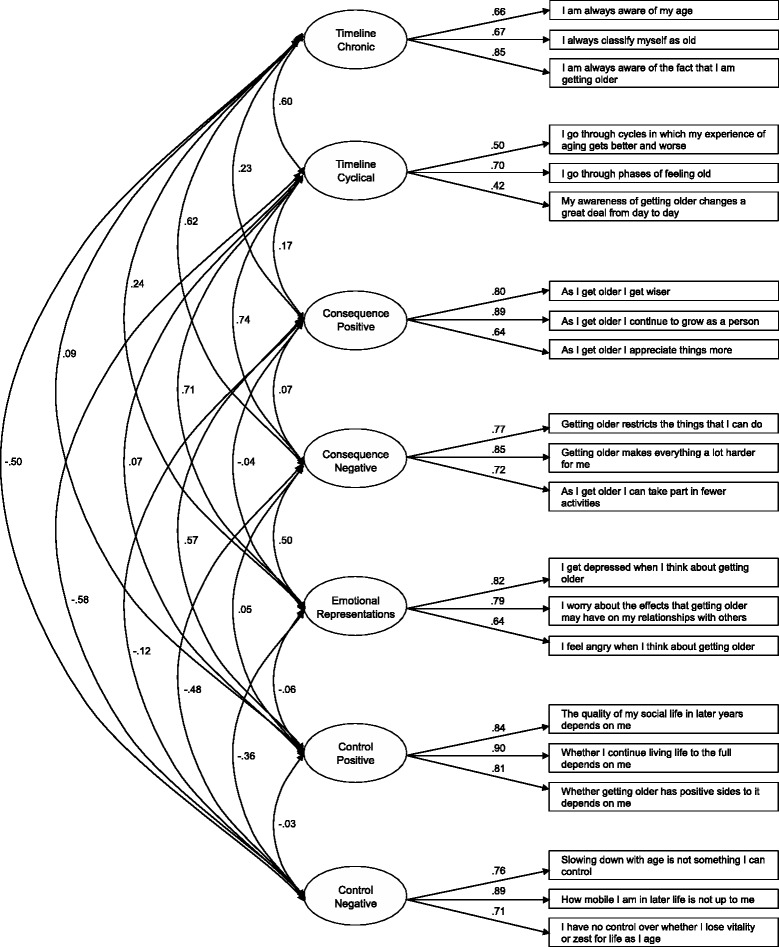
The latent factor model of the Turkish APQ-S was found to have an acceptable fit (root mean square error of approximation = .06; standardized root mean square residual = .07; comparative fit index = .90). Each indicator loaded significantly on its corresponding latent factor, and standardized factor loadings > .40 supported the convergent validity of the Turkish APQ-S dimensions. The APQ-S was also found to have acceptable construct validity in terms of its inter-factor structure and its expected associations with various health measures and age, gender, educational level, and marital status. Contrary to expectations, income level was not associated with any APQ-S dimension. With the exception of timeline cyclical (α = .56), each APQ-S dimension had acceptable reliability, with Cronbach's alpha values ranging from .75 (timeline chronic) to .88 (control positive). Most APQ-S dimension scores differed significantly between elderly Turkish migrants and a general population of elderly Rotterdam residents, with Turkish elders having more negative and less positive aging perceptions.
The Turkish-language version of the APQ-S is a psychometrically valid and reliable instrument for the assessment of aging perceptions among elderly Turkish migrants. Further research is needed to gain insight into aging perceptions and their health and sociodemographic correlates in this population.
人们发现对衰老的认知是老年健康的主要影响因素。为了定量探究土耳其老年移民的衰老认知,需要有效且可靠的土耳其语工具。本研究的目的是在荷兰社区居住的土耳其老年移民样本中,检验七维度衰老认知问卷简版(APQ-S)土耳其语版本的结构效度和信度。
对居住在荷兰鹿特丹的438名年龄在65至99岁的社区居住土耳其移民进行了一项包含土耳其语APQ-S的问卷调查。APQ-S包括七个维度的21个项目(时间线慢性和周期性、后果积极和消极、控制积极和消极以及情感表征)。问卷还包含了测量幸福感、身心健康相关生活质量以及慢性病数量的项目。
发现土耳其语APQ-S的潜在因子模型拟合度可接受(近似均方根误差 = 0.06;标准化均方根残差 = 0.07;比较拟合指数 = 0.90)。每个指标在其相应的潜在因子上有显著载荷,标准化因子载荷 > 0.40支持了土耳其语APQ-S维度的收敛效度。就其因子间结构及其与各种健康指标以及年龄、性别、教育水平和婚姻状况的预期关联而言,APQ-S也具有可接受的结构效度。与预期相反,收入水平与任何APQ-S维度均无关联。除了时间线周期性(α = 0.56)外,每个APQ-S维度都具有可接受的信度,克朗巴哈系数值范围从0.75(时间线慢性)到0.88(控制积极)。土耳其老年移民与鹿特丹老年居民总体人群之间的大多数APQ-S维度得分存在显著差异,土耳其老年人对衰老的认知更消极且积极程度更低。
APQ-S的土耳其语版本是评估土耳其老年移民衰老认知的一种心理测量学上有效且可靠的工具。需要进一步研究以深入了解该人群的衰老认知及其与健康和社会人口学的相关性。