Ludwig Robert, Teran Francisco J, Teichgraeber Ulf, Hilger Ingrid
Department of Experimental Radiology, Institute for Diagnostic and Interventional Radiology, Jena University Hospital - Friedrich Schiller University Jena, Jena, Germany.
iMdea-Nanociencia, Campus Universitario de Cantoblanco; Nanobiotecnología (iMdea-Nanociencia), Unidad Asociada al Centro Nacional de Biotecnología (CSIC), Madrid, Spain.
Int J Nanomedicine. 2017 Feb 7;12:1009-1018. doi: 10.2147/IJN.S108577. eCollection 2017.
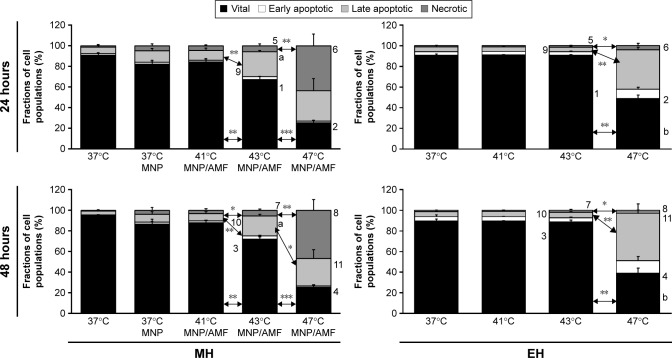
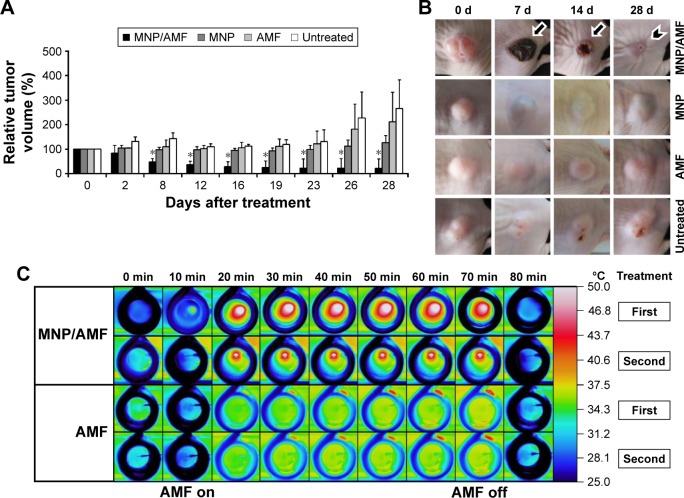
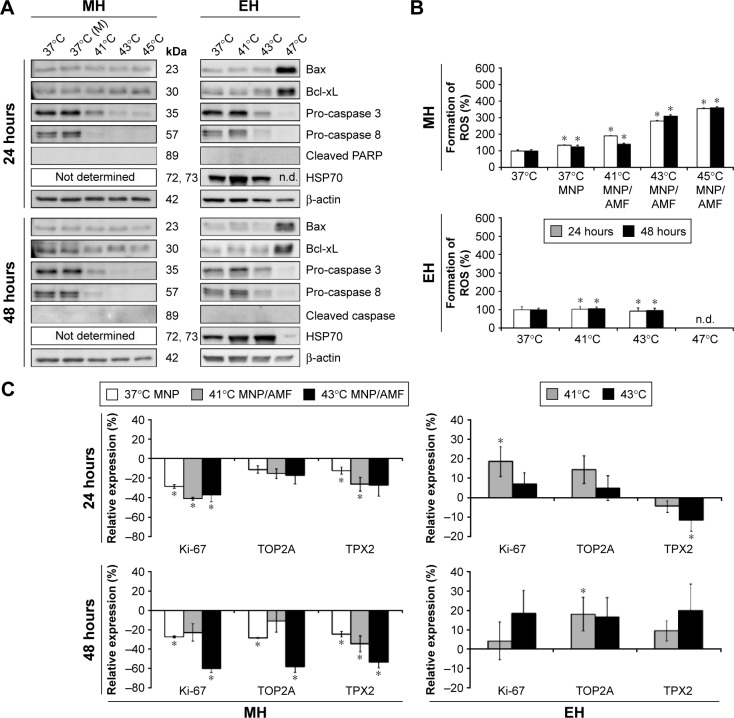
So far, the therapeutic outcome of hyperthermia has shown heterogeneous responses depending on how thermal stress is applied. We studied whether extrinsic heating (EH, hot air) and intrinsic heating (magnetic heating [MH] mediated by nanoparticles) induce distinct effects on pancreatic cancer cells (PANC-1 and BxPC-3 cells). The impact of MH (100 µg magnetic nanoparticles [MNP]/mL; H=23.9 kA/m; f=410 kHz) was always superior to that of EH. The thermal effects were confirmed by the following observations: 1) decreased number of vital cells, 2) altered expression of pro-caspases, and 3) production of reactive oxygen species, and 4) altered mRNA expression of Ki-67, TOP2A, and TPX2. The MH treatment of tumor xenografts significantly (≤0.05) reduced tumor volumes. This means that different therapeutic outcomes of hyperthermia are related to the different responses cells exert to thermal stress. In particular, intratumoral MH is a valuable tool for the treatment of pancreatic cancers.
到目前为止,热疗的治疗效果因热应激的施加方式而异,呈现出不同的反应。我们研究了外部加热(EH,热风)和内部加热(由纳米颗粒介导的磁热疗[MH])对胰腺癌细胞(PANC-1和BxPC-3细胞)是否会产生不同的影响。磁热疗(100μg磁性纳米颗粒[MNP]/mL;H=23.9 kA/m;f=410 kHz)的影响总是优于外部加热。通过以下观察结果证实了热效应:1)活细胞数量减少;2)前半胱天冬酶表达改变;3)活性氧的产生;4)Ki-67、TOP2A和TPX2的mRNA表达改变。对肿瘤异种移植瘤进行磁热疗显著(≤0.05)减小了肿瘤体积。这意味着热疗的不同治疗效果与细胞对热应激的不同反应有关。特别是,肿瘤内磁热疗是治疗胰腺癌的一种有价值的工具。