Ludwig Robert, Stapf Marcus, Dutz Silvio, Müller Robert, Teichgräber Ulf, Hilger Ingrid
Department of Experimental Radiology, Division of Diagnostic and Interventional Radiology, University Hospital Jena - Friedrich Schiller University Jena, Forschungszentrum Lobeda, Erlanger Allee 101, D-07747 Jena, Germany.
Institute of Biomedical Engineering and Informatics, University of Technology Ilmenau, D-98684 Ilmenau, Germany.
Nanoscale Res Lett. 2014 Nov 5;9(1):602. doi: 10.1186/1556-276X-9-602. eCollection 2014.
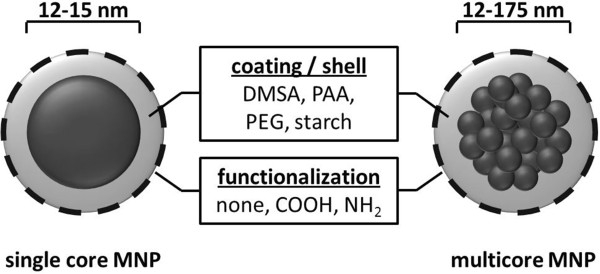
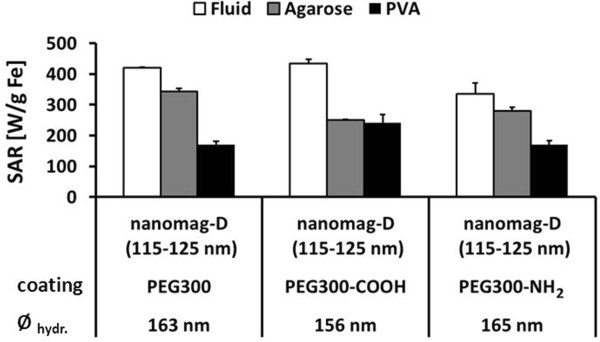
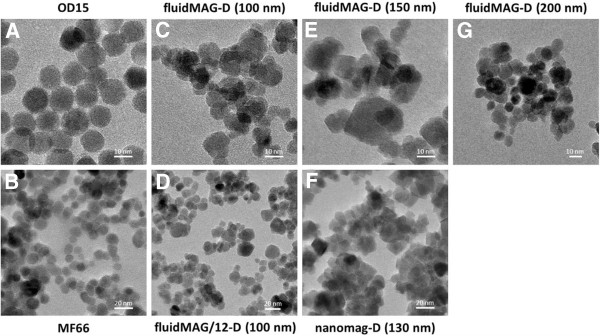
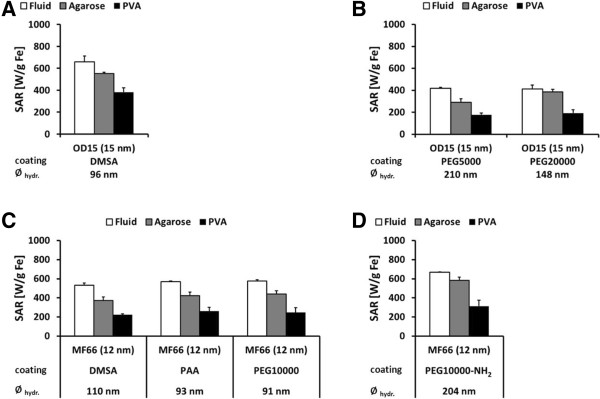
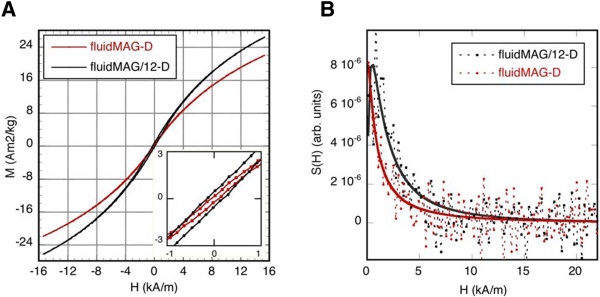
Magnetically induced heating of magnetic nanoparticles (MNP) in an alternating magnetic field (AMF) is a promising minimally invasive tool for localized tumor treatment by sensitizing or killing tumor cells with the help of thermal stress. Therefore, the selection of MNP exhibiting a sufficient heating capacity (specific absorption rate, SAR) to achieve satisfactory temperatures in vivo is necessary. Up to now, the SAR of MNP is mainly determined using ferrofluidic suspensions and may distinctly differ from the SAR in vivo due to immobilization of MNP in tissues and cells. The aim of our investigations was to study the correlation between the SAR and the degree of MNP immobilization in dependence of their physicochemical features. In this study, the included MNP exhibited varying physicochemical properties and were either made up of single cores or multicores. Whereas the single core MNP exhibited a core size of approximately 15 nm, the multicore MNP consisted of multiple smaller single cores (5 to 15 nm) with 65 to 175 nm diameter in total. Furthermore, different MNP coatings, including dimercaptosuccinic acid (DMSA), polyacrylic acid (PAA), polyethylenglycol (PEG), and starch, wereinvestigated. SAR values were determined after the suspension of MNP in water. MNP immobilization in tissues was simulated with 1% agarose gels and 10% polyvinyl alcohol (PVA) hydrogels. The highest SAR values were observed in ferrofluidic suspensions, whereas a strong reduction of the SAR after the immobilization of MNP with PVA was found. Generally, PVA embedment led to a higher immobilization of MNP compared to immobilization in agarose gels. The investigated single core MNP exhibited higher SAR values than the multicore MNP of the same core size within the used magnetic field parameters. Multicore MNP manufactured via different synthesis routes (fluidMAG-D, fluidMAG/12-D) showed different SAR although they exhibited comparable core and hydrodynamic sizes. Additionally, no correlation between ζ-potential and SAR values after immobilization was observed. Our data show that immobilization of MNP, independent of their physicochemical properties, can distinctly affect their SAR. Similar processes are supposed to take place in vivo, particularly when MNP are immobilized in cells and tissues. This aspect should be adequately considered when determining the SAR of MNP for magnetic hyperthermia.
在交变磁场(AMF)中,磁纳米颗粒(MNP)的磁诱导加热是一种很有前景的微创工具,可通过热应力使肿瘤细胞敏感或杀死肿瘤细胞,从而实现局部肿瘤治疗。因此,有必要选择具有足够加热能力(比吸收率,SAR)以在体内达到满意温度的MNP。到目前为止,MNP的SAR主要通过铁磁流体悬浮液来测定,由于MNP在组织和细胞中的固定化,其SAR可能与体内的SAR明显不同。我们研究的目的是研究SAR与MNP固定化程度之间的相关性,该相关性取决于它们的物理化学特征。在本研究中,所包含的MNP表现出不同的物理化学性质,并且由单核或多核组成。单核MNP的核尺寸约为15nm,而多核MNP由多个较小的单核(5至15nm)组成,总直径为65至175nm。此外,还研究了不同的MNP涂层,包括二巯基琥珀酸(DMSA)、聚丙烯酸(PAA)、聚乙二醇(PEG)和淀粉。在MNP悬浮于水中后测定SAR值。用1%琼脂糖凝胶和10%聚乙烯醇(PVA)水凝胶模拟MNP在组织中的固定化。在铁磁流体悬浮液中观察到最高的SAR值,而在用PVA固定MNP后发现SAR有显著降低。一般来说,与固定在琼脂糖凝胶中相比,PVA包埋导致MNP的固定化程度更高。在所使用的磁场参数范围内,所研究的单核MNP比相同核尺寸的多核MNP表现出更高的SAR值。通过不同合成路线(fluidMAG-D、fluidMAG/12-D)制造的多核MNP尽管表现出相当的核尺寸和流体动力学尺寸,但显示出不同的SAR。此外,在固定化后未观察到ζ电位与SAR值之间的相关性。我们的数据表明,MNP的固定化,无论其物理化学性质如何,都能明显影响其SAR。类似的过程在体内也可能发生,特别是当MNP固定在细胞和组织中时。在确定用于磁热疗的MNP的SAR时,应充分考虑这一方面。