Institute for Work & Health, 481 University Ave, Toronto, ON, M5G 2E9, Canada.
Institute for Safety Compensation and Recovery Research, Monash University, Melbourne, VIC, Australia.
J Occup Rehabil. 2018 Mar;28(1):1-15. doi: 10.1007/s10926-016-9690-x.
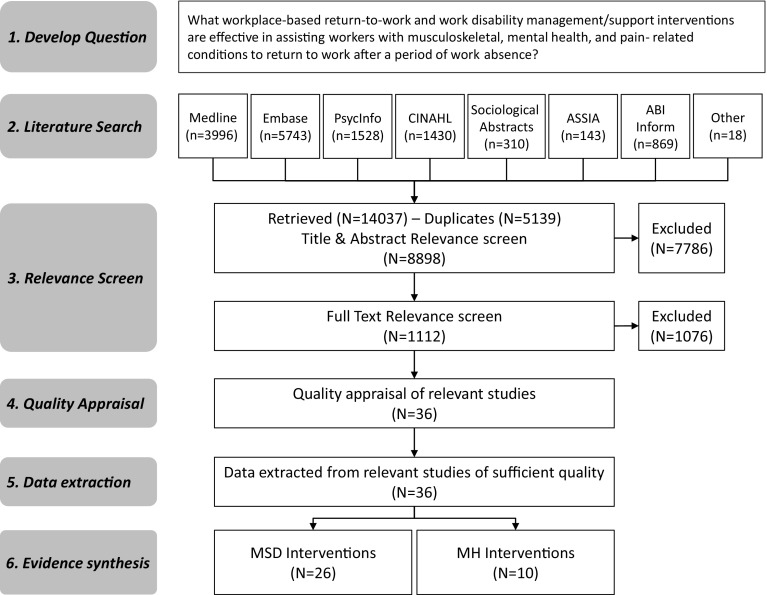
Purpose The objective of this systematic review was to synthesize evidence on the effectiveness of workplace-based return-to-work (RTW) interventions and work disability management (DM) interventions that assist workers with musculoskeletal (MSK) and pain-related conditions and mental health (MH) conditions with RTW. Methods We followed a systematic review process developed by the Institute for Work & Health and an adapted best evidence synthesis that ranked evidence as strong, moderate, limited, or insufficient. Results Seven electronic databases were searched from January 1990 until April 2015, yielding 8898 non-duplicate references. Evidence from 36 medium and high quality studies were synthesized on 12 different intervention categories across three broad domains: health-focused, service coordination, and work modification interventions. There was strong evidence that duration away from work from both MSK or pain-related conditions and MH conditions were significantly reduced by multi-domain interventions encompassing at least two of the three domains. There was moderate evidence that these multi-domain interventions had a positive impact on cost outcomes. There was strong evidence that cognitive behavioural therapy interventions that do not also include workplace modifications or service coordination components are not effective in helping workers with MH conditions in RTW. Evidence for the effectiveness of other single-domain interventions was mixed, with some studies reporting positive effects and others reporting no effects on lost time and work functioning. Conclusions While there is substantial research literature focused on RTW, there are only a small number of quality workplace-based RTW intervention studies that involve workers with MSK or pain-related conditions and MH conditions. We recommend implementing multi-domain interventions (i.e. with healthcare provision, service coordination, and work accommodation components) to help reduce lost time for MSK or pain-related conditions and MH conditions. Practitioners should also consider implementing these programs to help improve work functioning and reduce costs associated with work disability.
本系统评价的目的是综合有关帮助患有肌肉骨骼(MSK)和与疼痛相关的疾病以及精神健康(MH)疾病的工人重返工作岗位(RTW)的基于工作场所的 RTW 干预措施和工作残疾管理(DM)干预措施的有效性的证据。
我们遵循了由工作与健康研究所制定的系统评价流程,并采用了适应性最佳证据综合方法,将证据评为强、中、有限或不足。
从 1990 年 1 月至 2015 年 4 月,对 7 个电子数据库进行了搜索,得到了 8898 个非重复参考文献。综合了三个广泛领域(以健康为重点,服务协调和工作修改干预措施)的 12 种不同干预类别的 36 项中高质量研究的证据。有强有力的证据表明,多领域干预措施至少包含三个领域中的两个领域,可以显著减少因 MSK 或与疼痛相关的疾病和 MH 疾病而导致的工作时间损失。有中等强度的证据表明,这些多领域干预措施对成本结果有积极影响。有强有力的证据表明,不包括工作场所修改或服务协调内容的认知行为疗法干预措施对帮助患有 MH 疾病的工人重返工作岗位并不有效。其他单领域干预措施的有效性证据混杂,一些研究报告有积极影响,而另一些研究则报告对工作时间损失和工作功能没有影响。
虽然有大量的研究文献集中在 RTW 上,但只有少数高质量的基于工作场所的 RTW 干预研究涉及患有 MSK 或与疼痛相关的疾病和 MH 疾病的工人。我们建议实施多领域干预措施(即提供医疗保健、服务协调和工作适应组件),以帮助减少因 MSK 或与疼痛相关的疾病和 MH 疾病而导致的工作时间损失。从业人员还应考虑实施这些计划,以帮助改善工作功能并降低与工作残疾相关的成本。