State Key Laboratory of Optoelectronic Materials and Technologies, Guangdong Province Key Laboratory of Display Material and Technology, School of Electronics and Information Technology, Sun Yat-sen University, Guangzhou, China.
State Key Laboratory of Optoelectronic Materials and Technologies, Sun Yat-Sen University, Guangzhou, China.
Sci Rep. 2017 Feb 22;7:43110. doi: 10.1038/srep43110.
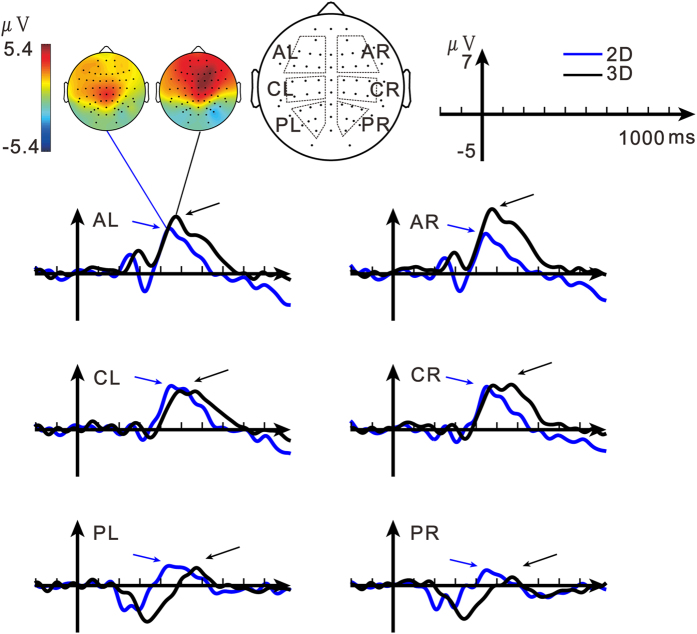
The horizontal binocular disparity is a critical factor for the visual fatigue induced by watching stereoscopic TVs. Stereoscopic images that possess the disparity within the 'comfort zones' and remain still in the depth direction are considered comfortable to the viewers as 2D images. However, the difference in brain activities between processing such comfortable stereoscopic images and 2D images is still less studied. The DP3 (differential P3) signal refers to an event-related potential (ERP) component indicating attentional processes, which is typically evoked by odd target stimuli among standard stimuli in an oddball task. The present study found that the DP3 signal elicited by the comfortable 3D images exhibits the delayed peak latency and enhanced peak amplitude over the anterior and central scalp regions compared to the 2D images. The finding suggests that compared to the processing of the 2D images, more attentional resources are involved in the processing of the stereoscopic images even though they are subjectively comfortable.
水平双眼视差是观看立体电视引起视觉疲劳的一个关键因素。具有在“舒适区”内的视差且在深度方向上保持静止的立体图像被视为与 2D 图像一样舒适的观看者。然而,处理这种舒适的立体图像和 2D 图像之间的大脑活动差异仍较少研究。DP3(差 P3)信号是指事件相关电位(ERP)成分,表示注意过程,通常在奇偶任务中由标准刺激中的奇数目标刺激引发。本研究发现,与 2D 图像相比,舒适的 3D 图像诱发的 DP3 信号在前额和中央头皮区域表现出延迟的峰值潜伏期和增强的峰值幅度。这一发现表明,与处理 2D 图像相比,即使主观上舒适,处理立体图像也需要更多的注意力资源。