Henry Molly J, Herrmann Björn, Grahn Jessica A
Brain and Mind Institute, Department of Psychology The University of Western Ontario, London, ON, Canada.
PLoS One. 2017 Feb 22;12(2):e0172454. doi: 10.1371/journal.pone.0172454. eCollection 2017.
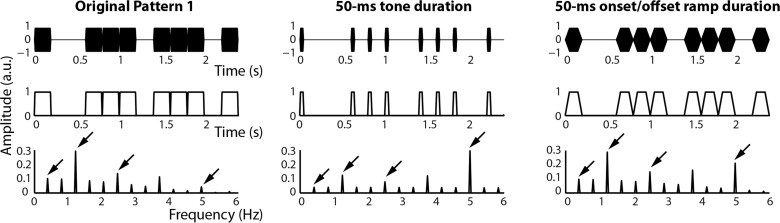
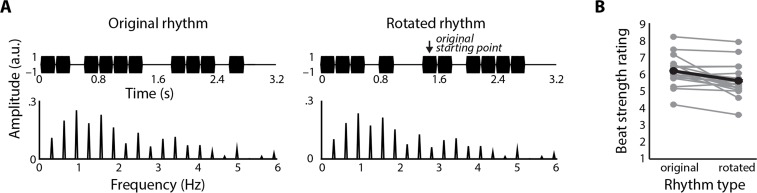
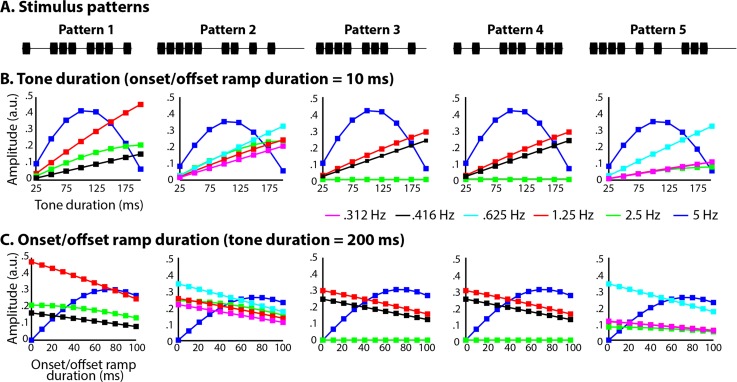
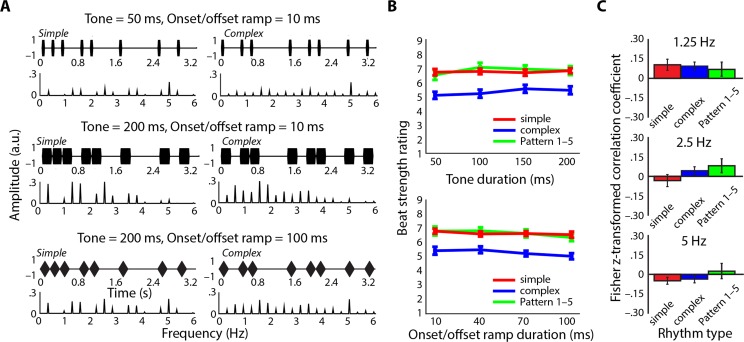
Entrainment of neural oscillations on multiple time scales is important for the perception of speech. Musical rhythms, and in particular the perception of a regular beat in musical rhythms, is also likely to rely on entrainment of neural oscillations. One recently proposed approach to studying beat perception in the context of neural entrainment and resonance (the "frequency-tagging" approach) has received an enthusiastic response from the scientific community. A specific version of the approach involves comparing frequency-domain representations of acoustic rhythm stimuli to the frequency-domain representations of neural responses to those rhythms (measured by electroencephalography, EEG). The relative amplitudes at specific EEG frequencies are compared to the relative amplitudes at the same stimulus frequencies, and enhancements at beat-related frequencies in the EEG signal are interpreted as reflecting an internal representation of the beat. Here, we show that frequency-domain representations of rhythms are sensitive to the acoustic features of the tones making up the rhythms (tone duration, onset/offset ramp duration); in fact, relative amplitudes at beat-related frequencies can be completely reversed by manipulating tone acoustics. Crucially, we show that changes to these acoustic tone features, and in turn changes to the frequency-domain representations of rhythms, do not affect beat perception. Instead, beat perception depends on the pattern of onsets (i.e., whether a rhythm has a simple or complex metrical structure). Moreover, we show that beat perception can differ for rhythms that have numerically identical frequency-domain representations. Thus, frequency-domain representations of rhythms are dissociable from beat perception. For this reason, we suggest caution in interpreting direct comparisons of rhythms and brain signals in the frequency domain. Instead, we suggest that combining EEG measurements of neural signals with creative behavioral paradigms is of more benefit to our understanding of beat perception.
在多个时间尺度上对神经振荡的同步化对于言语感知很重要。音乐节奏,尤其是对音乐节奏中规律节拍的感知,也可能依赖于神经振荡的同步化。最近提出的一种在神经同步化和共振背景下研究节拍感知的方法(“频率标记”方法)得到了科学界的热烈响应。该方法的一个特定版本涉及将声学节奏刺激的频域表示与对这些节奏的神经反应的频域表示(通过脑电图,EEG测量)进行比较。将特定EEG频率下的相对振幅与相同刺激频率下的相对振幅进行比较,EEG信号中与节拍相关频率处的增强被解释为反映了节拍的内部表示。在这里,我们表明节奏的频域表示对构成节奏的音调的声学特征(音调持续时间、起始/结束斜坡持续时间)敏感;事实上,通过操纵音调声学特性,与节拍相关频率处的相对振幅可以完全反转。至关重要的是,我们表明这些音调声学特征的变化,进而节奏的频域表示的变化,不会影响节拍感知。相反,节拍感知取决于起始模式(即节奏是否具有简单或复杂的韵律结构)。此外,我们表明对于具有数值相同频域表示的节奏,节拍感知可能不同。因此,节奏的频域表示与节拍感知是可分离的。出于这个原因,我们建议在解释频域中节奏与脑信号的直接比较时要谨慎。相反,我们建议将神经信号的EEG测量与创造性行为范式相结合,对我们理解节拍感知更有益。