St. Michael's Hospital, 30 Bond Street, Toronto, ON, M5B 1W8, Canada.
Institute of Medical Science, University of Toronto, Toronto, ON, Canada.
Crit Care. 2017 Feb 23;21(1):37. doi: 10.1186/s13054-017-1620-6.
Elevated catecholamine levels might be associated with unfavorable outcome after traumatic brain injury (TBI). We investigated the association between catecholamine levels in the first 24 h post-trauma and functional outcome in patients with isolated moderate-to-severe TBI.
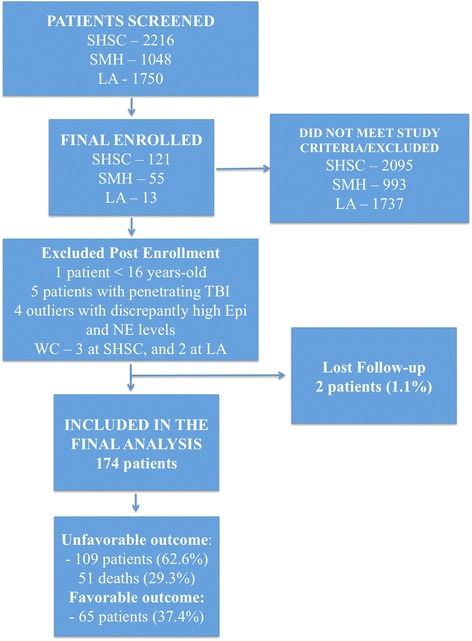
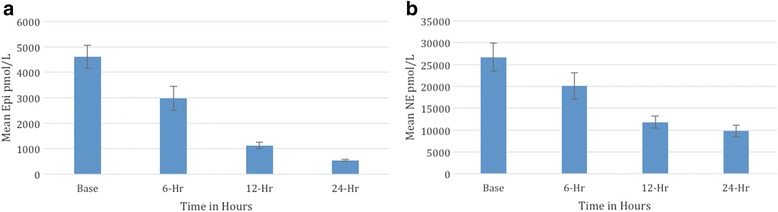
A cohort of 174 patients who sustained isolated blunt TBI was prospectively enrolled from three Level-1 Trauma Centers. Epinephrine (Epi) and norepinephrine (NE) concentrations were measured at admission (baseline), 6, 12 and 24 h post-injury. Outcome was assessed at 6 months by the extended Glasgow Outcome Scale (GOSE) score. Fractional polynomial plots and logistic regression models (fixed and random effects) were used to study the association between catecholamine levels and outcome. Effect size was reported as the odds ratio (OR) associated with one logarithmic change in catecholamine level.
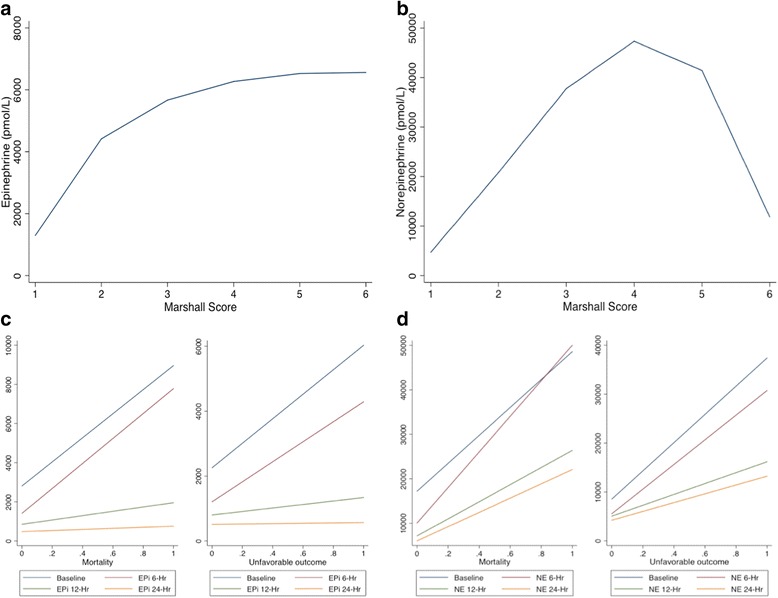
At 6 months, 109 patients (62.6%) had an unfavorable outcome (GOSE 5-8 vs. 1-4), including 51 deaths (29.3%). Higher admission levels of Epi were associated with a higher risk of unfavorable outcome (OR, 2.04, 95% CI: 1.31-3.18, p = 0.002) and mortality (OR, 2.86, 95% CI: 1.62-5.01, p = 0.001). Higher admission levels of NE were associated with higher risk of unfavorable outcome (OR, 1.59, 95% CI: 1.07-2.35, p = 0.022) but not mortality (OR, 1.45, 95% CI: 0.98-2.17, p = 0.07). There was no relationship between the changes in Epi levels over time and mortality or unfavorable outcome. Changes in NE levels with time were statistically associated with a higher risk of mortality, but the changes had no relation to unfavorable outcome.
Elevated circulating catecholamines, especially Epi levels on hospital admission, are independently associated with functional outcome and mortality after isolated moderate-to-severe TBI.
儿茶酚胺水平升高可能与创伤性脑损伤(TBI)后的不良预后有关。我们研究了创伤后 24 小时内儿茶酚胺水平与单纯中重度 TBI 患者功能预后的关系。
前瞻性纳入了来自三个 1 级创伤中心的 174 例单纯性钝性 TBI 患者。在入院时(基线)、受伤后 6、12 和 24 小时测量肾上腺素(Epi)和去甲肾上腺素(NE)浓度。使用扩展格拉斯哥结局量表(GOSE)评分在 6 个月时评估预后。分数多项式图和逻辑回归模型(固定和随机效应)用于研究儿茶酚胺水平与结局之间的关系。报告效应大小为儿茶酚胺水平每对数变化的比值比(OR)。
6 个月时,109 例(62.6%)患者预后不良(GOSE 5-8 比 1-4),包括 51 例死亡(29.3%)。入院时 Epi 水平升高与不良预后(OR,2.04,95%CI:1.31-3.18,p=0.002)和死亡率(OR,2.86,95%CI:1.62-5.01,p=0.001)的风险增加相关。入院时 NE 水平升高与不良预后(OR,1.59,95%CI:1.07-2.35,p=0.022)的风险增加相关,但与死亡率无关(OR,1.45,95%CI:0.98-2.17,p=0.07)。Epi 水平随时间的变化与死亡率或不良预后无关。NE 水平随时间的变化与死亡率的风险增加具有统计学意义,但与不良预后无关。
循环儿茶酚胺升高,尤其是入院时 Epi 水平升高,与单纯中重度 TBI 后的功能预后和死亡率独立相关。