Department of Biochemistry and Human Nutrition, Pomeranian Medical University in Szczecin, Broniewskiego 24 Street, 71-460, Szczecin, Poland.
Faculty of Applied Social Sciences and Resocialisation at Warsaw University, 00-503, Warsaw, Poland.
Biol Trace Elem Res. 2017 Oct;179(2):327-333. doi: 10.1007/s12011-017-0963-9. Epub 2017 Feb 22.
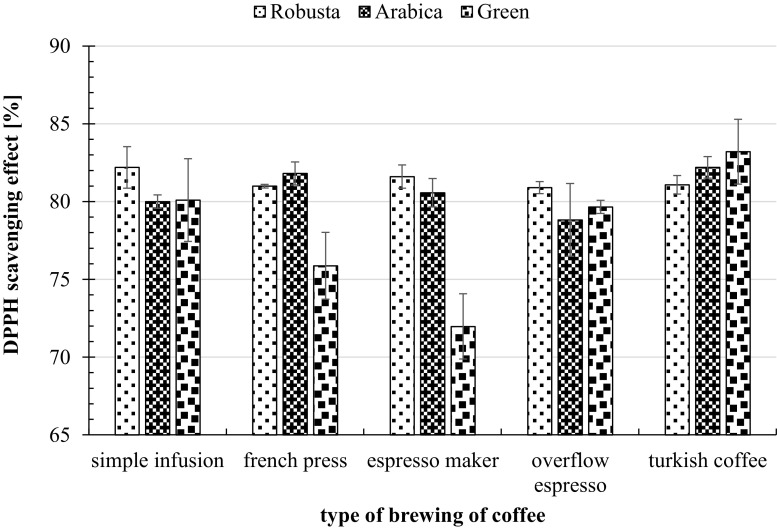
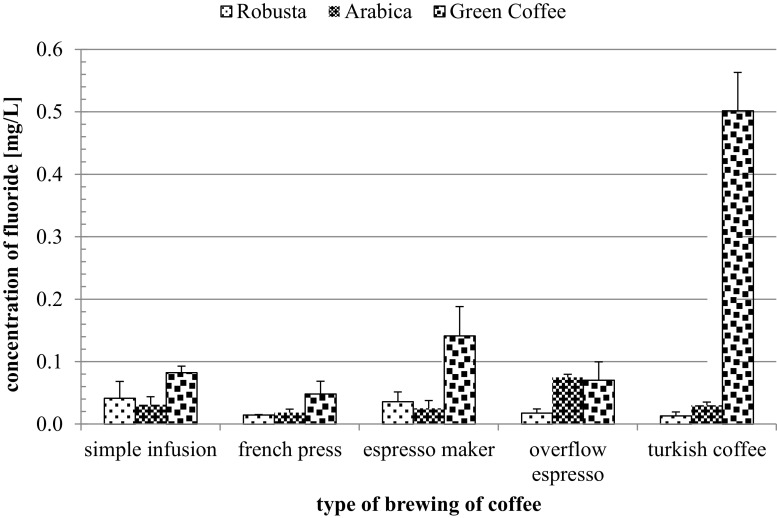
Coffee is a rich source of dietary antioxidants, and this property links with the fact that coffee is one of the world's most popular beverages. Moreover, it is a source of macro- and microelements, including fluoride. The aim of this work was to determine antioxidant activity of coffee beverages and fluoride content depending on different coffee species and conditions of brewing. Three species of coffee, arabica, robusta and green coffee beans obtained from retail stores in Szczecin (Poland) were analyzed. Five different techniques of preparing drink were used: simple infusion, french press, espresso maker, overflow espresso and Turkish coffee. Antioxidant potential of coffee beverages was investigated spectrophotometrically by DPPH method. Fluoride concentrations were measured by potentiometric method with a fluoride ion-selective electrode. Statistical analysis was performed using Stat Soft Statistica 12.5. Antioxidant activity of infusions was high (71.97-83.21% inhibition of DPPH) depending on coffee species and beverage preparing method. It has been shown that the method of brewing arabica coffee and green coffee significantly affects the antioxidant potential of infusions. The fluoride concentration in the coffee infusions changed depending, both, on the species and conditions of brewing, too (0.013-0.502 mg/L). Methods of brewing didn't make a difference to the antioxidant potential of robusta coffee, which had also the lowest level of fluoride among studied species. Except overflow espresso, the fluoride content was the highest in beverages from green coffee. The highest fluoride content was found in Turkish coffee from green coffee beans.
咖啡是膳食抗氧化剂的丰富来源,这一特性使其成为世界上最受欢迎的饮料之一。此外,咖啡还含有宏量和微量元素,包括氟化物。本研究旨在根据不同的咖啡品种和冲泡条件,确定咖啡饮料的抗氧化活性和氟化物含量。分析了来自波兰什切青零售店的三种咖啡,即阿拉比卡咖啡、罗布斯塔咖啡和绿咖啡豆。使用了五种不同的冲泡技术:简单冲泡、法式压滤壶、浓缩咖啡机、滴滤式浓缩咖啡机和土耳其咖啡。使用 DPPH 法通过分光光度法研究了咖啡饮料的抗氧化潜力。使用氟离子选择性电极通过电位法测量了氟化物浓度。使用 Stat Soft Statistica 12.5 进行了统计分析。冲泡液的抗氧化活性很高(DPPH 抑制率为 71.97-83.21%),这取决于咖啡品种和饮料冲泡方法。研究表明,冲泡阿拉比卡咖啡和绿咖啡的方法显著影响冲泡液的抗氧化潜力。咖啡冲泡液中的氟化物浓度也取决于品种和冲泡条件的变化(0.013-0.502 mg/L)。除了滴滤式浓缩咖啡机之外,研究品种中罗布斯塔咖啡的抗氧化活性最低,其氟化物含量也最低。除了滴滤式浓缩咖啡机之外,绿咖啡冲泡的饮料中氟化物含量最高。绿咖啡豆制成的土耳其咖啡中发现的氟化物含量最高。