McKnight J L, Kristie T M, Roizman B
Marjorie B. Kovler Viral Oncology Laboratories, University of Chicago, IL 60637.
Proc Natl Acad Sci U S A. 1987 Oct;84(20):7061-5. doi: 10.1073/pnas.84.20.7061.
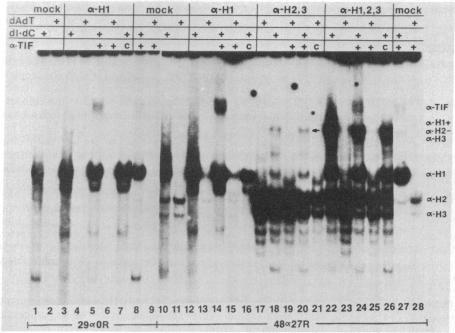
In herpes simplex virus 1-infected cells, the transcription of alpha genes, the first set of genes to be expressed, is induced by a virion component, the alpha-trans-induction factor, and requires a cis site. Homologs of the cis site are present in the promoter-regulatory domains of all alpha genes and bind two cellular proteins designated as alpha H1 and alpha H2-alpha H3. We report that alpha-trans-induction factor, synthesized in vitro or present in nuclear extracts of infected cells, forms complexes with viral DNA fragments containing its cis-acting site only in the presence of cellular proteins and only under conditions that also enable the binding of the alpha H1 protein to the DNA. The induction of alpha genes by alpha-trans-induction factor appears, therefore, to be mediated by the interaction of the viral protein with cellular proteins at its cis-acting site.
在单纯疱疹病毒1感染的细胞中,α基因是首批表达的基因,其转录由一种病毒体成分α反式诱导因子所诱导,并且需要一个顺式位点。顺式位点的同源物存在于所有α基因的启动子调控区域,并与两种被称为αH1和αH2 - αH3的细胞蛋白结合。我们报告称,在体外合成或存在于感染细胞的核提取物中的α反式诱导因子,仅在细胞蛋白存在的情况下,并且仅在能使αH1蛋白与DNA结合的条件下,才会与含有其顺式作用位点的病毒DNA片段形成复合物。因此,α反式诱导因子对α基因的诱导似乎是由病毒蛋白在其顺式作用位点与细胞蛋白的相互作用介导的。