Mosca J D, Bednarik D P, Raj N B, Rosen C A, Sodroski J G, Haseltine W A, Hayward G S, Pitha P M
Johns Hopkins University School of Medicine, Baltimore, MD 21205.
Proc Natl Acad Sci U S A. 1987 Nov;84(21):7408-12. doi: 10.1073/pnas.84.21.7408.
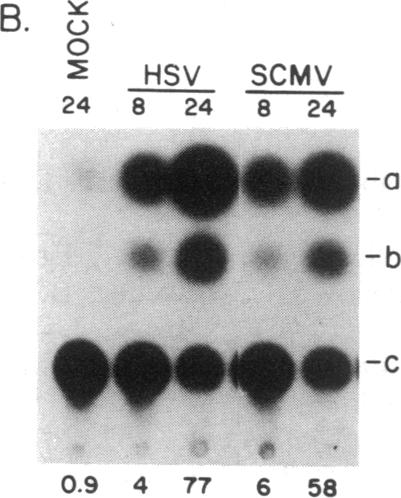
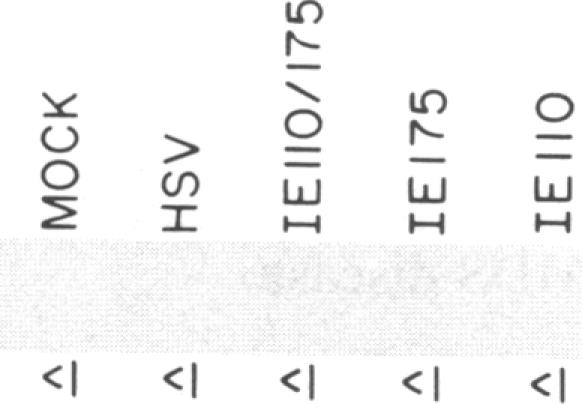
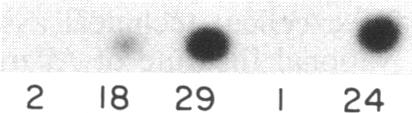
Herpes simplex virus 1 (HSV-1) infection induces transcription of the chloramphenicol acetyltransferase (CAT) gene directed by the long terminal repeat (LTR) of human immunodeficiency virus (HIV) in both transiently and permanently transfected cells containing the HIV-LTR/CAT hybrid gene. To define the mechanism by which HSV-1 stimulates the HIV LTR, we examined the effects of isolated regulatory genes from HSV-1. The results of cotransfection assays with the immediate-early (IE) genes of HSV-1, IE110 (ICP0) and IE175 (ICP4), showed that the IE110 protein, either alone or in combination with the IE175 protein, can activate the HIV LTR. Cotransfection with the IE175 gene alone or with the Vmw65 gene (coding for a virion transcription factor) alone did not lead to HIV-LTR activation. The lack of requirement for the IE175 or Vmw65 gene products in transient-expression assays was confirmed in permanent cell lines containing the HIV-LTR/CAT hybrid gene by using temperature-sensitive mutants defective in the IE175 gene product or in uncoating functions. By deletion analysis, we localized a 73-bp-long region (positions -104 to -32) from the HIV LTR that responded to HSV-1 activation; when this region, which is distinct from the previously identified trans-activating responsive (TAR) region, was ligated to a heterologous, HSV-1-nonresponsive gene (alpha 4-interferon/CAT), it conferred inducibility by both HSV-1 infection and IE110/175 cotransfection. Both simian and human cytomegalovirus also induced the HIV-LTR/CAT hybrid gene. However, we failed to detect specific upstream sequence requirements for induction by cytomegalovirus. Our results indicate that infection with unrelated viruses can alter the expression of HIV in an infected cell.
单纯疱疹病毒1型(HSV - 1)感染可在瞬时转染和稳定转染了含有人类免疫缺陷病毒(HIV)长末端重复序列(LTR)/氯霉素乙酰转移酶(CAT)杂交基因的细胞中,诱导HIV长末端重复序列指导的氯霉素乙酰转移酶(CAT)基因转录。为了确定HSV - 1刺激HIV LTR的机制,我们研究了HSV - 1分离的调控基因的作用。用HSV - 1的立即早期(IE)基因IE110(ICP0)和IE175(ICP4)进行共转染分析的结果表明,IE110蛋白单独或与IE175蛋白联合使用时,均可激活HIV LTR。单独用IE175基因或单独用Vmw65基因(编码一种病毒体转录因子)进行共转染不会导致HIV - LTR激活。通过使用在IE175基因产物或脱壳功能方面有缺陷的温度敏感突变体,在含有HIV - LTR/CAT杂交基因的永久细胞系中证实了瞬时表达分析中对IE175或Vmw65基因产物的需求缺失。通过缺失分析,我们在HIV LTR中定位了一个73碱基对长的区域(位置 - 104至 - 32),该区域对HSV - 1激活有反应;当这个与先前鉴定的反式激活应答(TAR)区域不同的区域与一个异源的、对HSV - 1无反应的基因(α4 - 干扰素/CAT)连接时,它赋予了HSV - 1感染和IE110/175共转染诱导性。猿猴和人巨细胞病毒也诱导HIV - LTR/CAT杂交基因。然而,我们未能检测到巨细胞病毒诱导所需的特定上游序列要求。我们的结果表明,感染无关病毒可改变感染细胞中HIV的表达。