Stott Christopher J, Temeeyasen Gun, Tripipat Thitima, Kaewprommal Pavita, Tantituvanont Angkana, Piriyapongsa Jittima, Nilubol Dachrit
Department of Veterinary Microbiology, Faculty of Veterinary Science, Chulalongkorn University, Thailand.
Genome Technology Research Unit, National Center for Genetic Engineering and Biotechnology, National Science and Technology Development Agency, Pathumthani, Thailand.
Infect Genet Evol. 2017 Jun;50:70-76. doi: 10.1016/j.meegid.2017.02.014. Epub 2017 Feb 21.
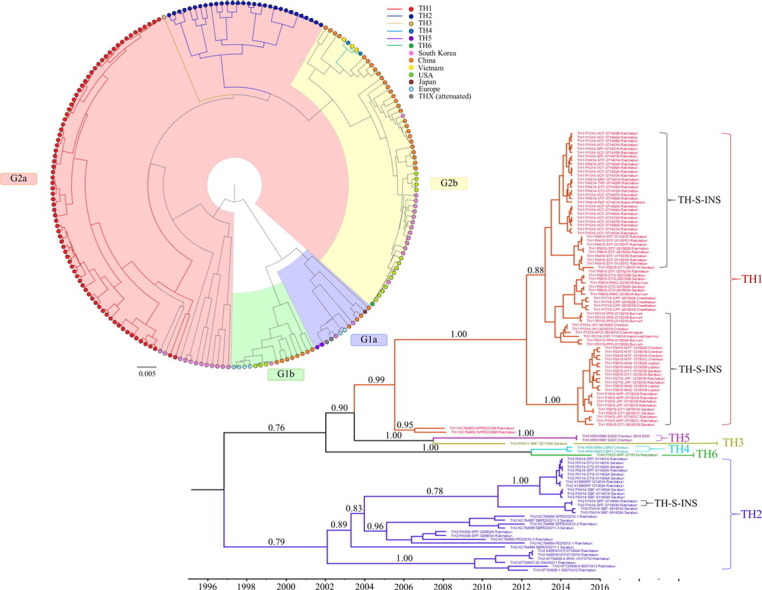
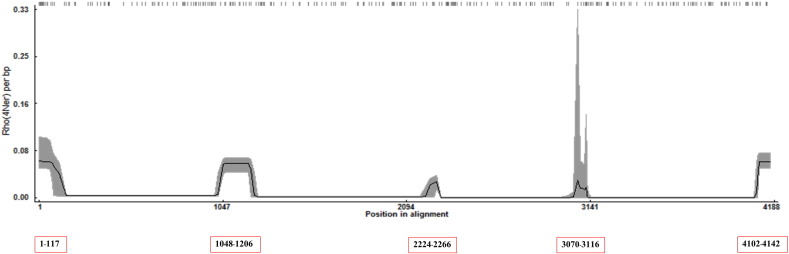
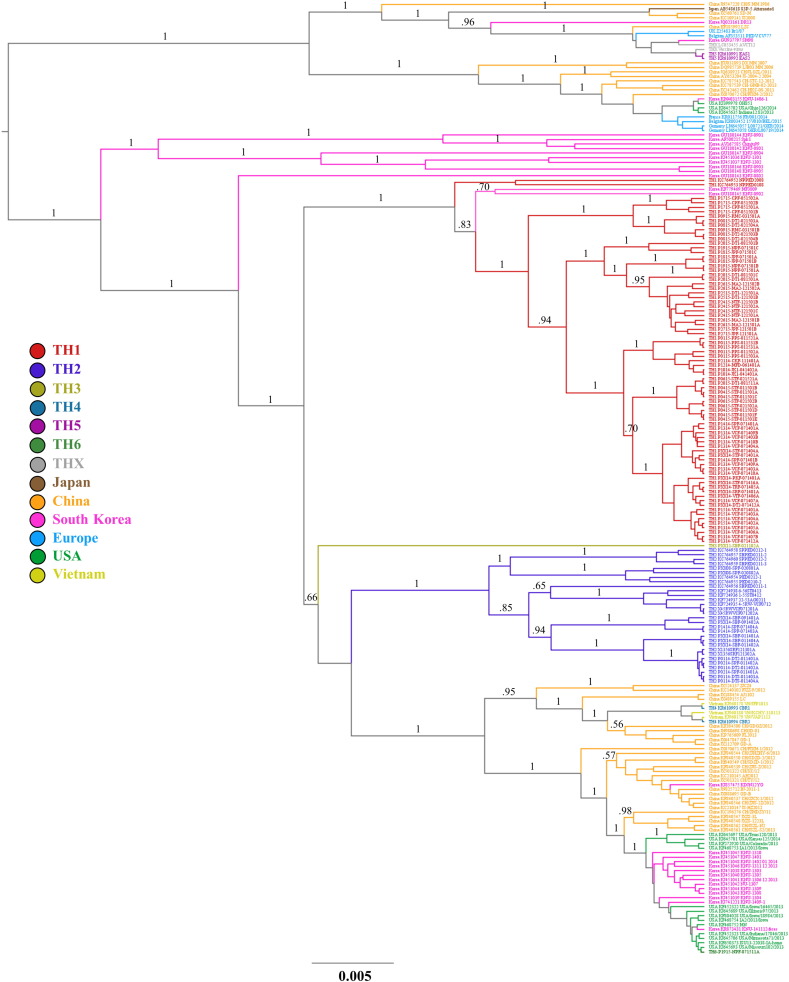
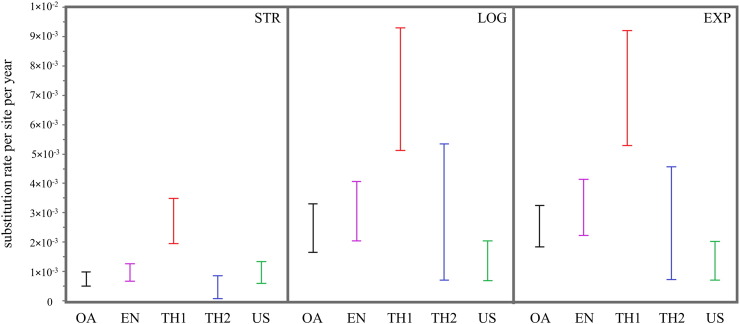
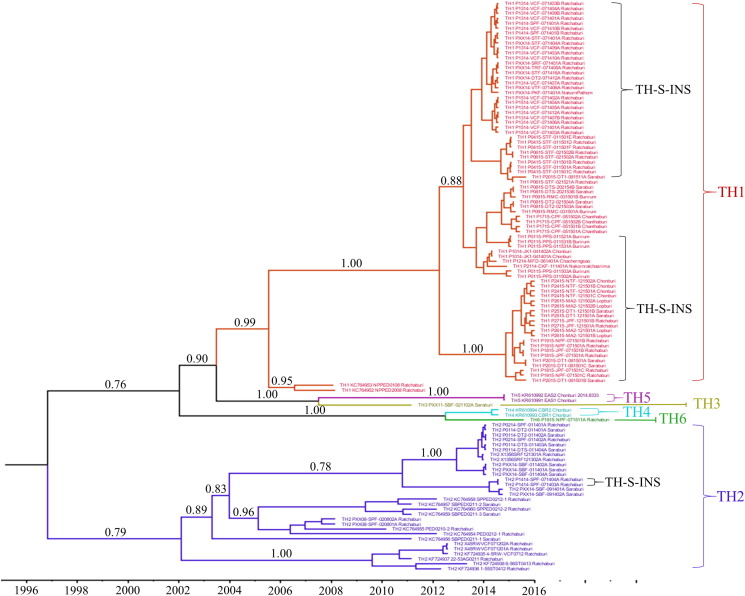
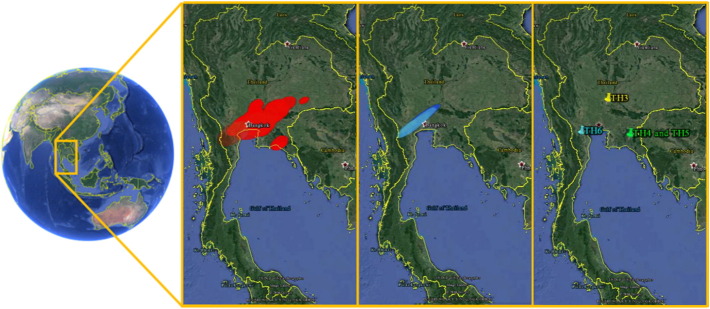
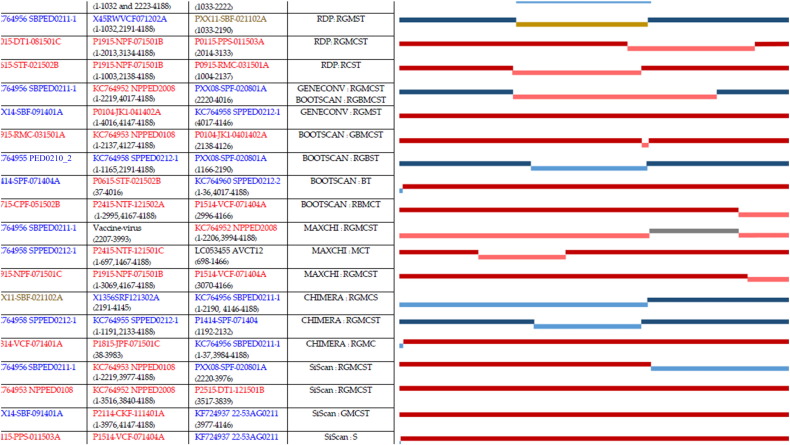
Porcine epidemic diarrhea (PED) has been endemic causing sporadic outbreaks in Thailand since 2007. In 2014-2015, several herds had experienced severe PED outbreaks and the reason of the re-current outbreaks was unknown. Whether or not the introduction of exotic strains or continual evolution of existing PEDV, genetic analyses would provide a more understanding in its evolutionary pattern. In the study, 117 complete spike gene sequences of Thai PED virus (PEDV) collected from 2008 to 2015 were clustered along with 95 references of PEDV spike sequences, and analyzed with the US sequences dataset (n=99). The phylogenetic analysis demonstrated that Thai PEDV spike sequences were genetically diverse and had been influenced by multiple introduction of exotic strains. Although Thai PEDV have been evolved into 6 subgroups (TH1-6), Subgroup TH1 strains with the unique 9 nucleotides (CAA GGG AAT) insertion between 688th-689th position of spike (changing amino acid from N to TREY) insertion has become the dominant subgroup since 2014. Thai PEDV spike gene have higher evolutionary rate compare to that of the US sequences. One contributing factor would be the intra-recombination between subgroups. Thailand endemic strain should be assigned into new subclade of G2 (Thai pandemic variant).
自2007年以来,猪流行性腹泻(PED)在泰国一直呈地方流行状态,导致零星暴发。在2014 - 2015年,数个猪群经历了严重的PED暴发,而反复暴发的原因尚不清楚。无论是否引入了外来毒株或现有猪流行性腹泻病毒(PEDV)持续进化,基因分析都将有助于更深入了解其进化模式。在本研究中,将2008年至2015年收集的117个泰国PED病毒(PEDV)的完整刺突基因序列与95个PEDV刺突序列参考序列进行聚类,并与美国序列数据集(n = 99)进行分析。系统发育分析表明,泰国PEDV刺突序列在基因上具有多样性,并受到外来毒株多次引入的影响。尽管泰国PEDV已进化为6个亚组(TH1 - 6),但自2014年以来,在刺突蛋白第688 - 689位之间具有独特的9个核苷酸(CAA GGG AAT)插入(使氨基酸从N变为TREY)的TH1亚组毒株已成为优势亚组。与美国序列相比,泰国PEDV刺突基因具有更高的进化速率。一个促成因素可能是亚组间的内部重组。泰国地方流行毒株应归入G2的新分支(泰国大流行变体)。