Suppr超能文献

丁丙诺啡治疗的持续率与丙型肝炎病毒(HCV)护理结果的改善相关。

Retention in buprenorphine treatment is associated with improved HCV care outcomes.

作者信息

Norton B L, Beitin A, Glenn M, DeLuca J, Litwin A H, Cunningham C O

机构信息

Montefiore Medical Center, Albert Einstein College of Medicine, Division of General Internal Medicine, Bronx, NY, United States.

Montefiore Medical Center, Albert Einstein College of Medicine, Division of General Internal Medicine, Bronx, NY, United States.

出版信息

J Subst Abuse Treat. 2017 Apr;75:38-42. doi: 10.1016/j.jsat.2017.01.015. Epub 2017 Jan 27.

Abstract

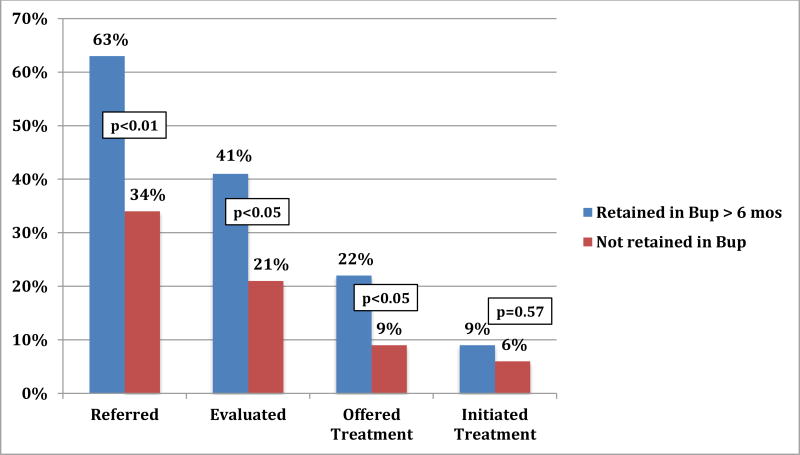
Persons who inject drugs, most of whom are opioid dependent, comprise the majority of the HCV infected in the United States. As the national opioid epidemic unfolds, increasing numbers of people are entering the medical system to access treatment for opioid use disorder, specifically with buprenorphine. Yet little is known about HCV care in patients accessing buprenorphine-based opioid treatment. We sought to determine the HCV prevalence, cascade of care, and the association between patient characteristics and completion of HCV cascade of care milestones for patients initiating buprenorphine treatment. We reviewed electronic health records of all patients who initiated buprenorphine treatment at a primary-care clinic in the Bronx, NY between January 2009 and January 2014. Of the 390 patients who initiated buprenorphine treatment, 123 were confirmed to have chronic HCV infection. The only patient characteristic associated with achieving HCV care milestones was retention in opioid treatment. Patients retained (vs. not retained) in buprenorphine treatment were more likely to be referred for HCV specialty care (63.1% vs. 34.0%, p<0.01), achieve an HCV-specific evaluation (40.8% vs. 21.3%, p<0.05), be offered HCV treatment (22.4% vs. 8.5%, p<0.05), and initiate HCV treatment (9.2% vs. 6.4%, p=0.6). Given the current opioid epidemic in the US and the growing number of people receiving buprenorphine treatment, there is an unprecedented opportunity to access and treat persons with HCV, reducing HCV transmission, morbidity and mortality. Retention in opioid treatment may improve linkage and retention in HCV care; innovative models of care that integrate opioid drug treatment with HCV treatment are essential.

摘要

注射毒品者(其中大多数对阿片类药物成瘾)占美国丙型肝炎病毒(HCV)感染者的大多数。随着全国性阿片类药物流行的发展,越来越多的人进入医疗系统以寻求阿片类药物使用障碍的治疗,特别是使用丁丙诺啡。然而,对于接受基于丁丙诺啡的阿片类药物治疗的患者的HCV护理情况知之甚少。我们试图确定开始丁丙诺啡治疗的患者的HCV患病率、护理流程以及患者特征与HCV护理流程各阶段完成情况之间的关联。我们回顾了2009年1月至2014年1月期间在纽约布朗克斯区一家初级保健诊所开始丁丙诺啡治疗的所有患者的电子健康记录。在开始丁丙诺啡治疗的390名患者中,有123人被确诊患有慢性HCV感染。与实现HCV护理各阶段目标相关的唯一患者特征是坚持接受阿片类药物治疗。坚持(与未坚持相比)接受丁丙诺啡治疗的患者更有可能被转诊至HCV专科护理(63.1%对34.0%,p<0.01)、接受HCV特异性评估(40.8%对21.3%,p<0.05)、获得HCV治疗(22.4%对8.5%,p<0.05)以及开始HCV治疗(9.2%对6.4%,p = 0.6)。鉴于美国当前的阿片类药物流行情况以及接受丁丙诺啡治疗的人数不断增加,存在前所未有的机会来诊治HCV患者,从而减少HCV传播、发病率和死亡率。坚持接受阿片类药物治疗可能会改善与HCV护理的联系及坚持程度;将阿片类药物治疗与HCV治疗相结合的创新护理模式至关重要。

相似文献

1
Retention in buprenorphine treatment is associated with improved HCV care outcomes.
J Subst Abuse Treat. 2017 Apr;75:38-42. doi: 10.1016/j.jsat.2017.01.015. Epub 2017 Jan 27.
2
Hepatitis C Virus Testing and Treatment Among Persons Receiving Buprenorphine in an Office-Based Program for Opioid Use Disorders.
J Subst Abuse Treat. 2016 Jul;66:54-9. doi: 10.1016/j.jsat.2016.01.009. Epub 2016 Feb 13.
3
Association between hepatitis C virus and opioid use while in buprenorphine treatment: preliminary findings.
Am J Drug Alcohol Abuse. 2015 Jan;41(1):88-92. doi: 10.3109/00952990.2014.983274.
4
Hepatitis C virus infection and pain sensitivity in patients on methadone or buprenorphine maintenance therapy for opioid use disorders.
Drug Alcohol Depend. 2015 Aug 1;153:286-92. doi: 10.1016/j.drugalcdep.2015.05.011. Epub 2015 May 22.
5
Hepatitis C Virus Incidence in a Cohort in Medication-Assisted Treatment for Opioid Use Disorder in New York City.
J Infect Dis. 2020 Sep 2;222(Suppl 5):S322-S334. doi: 10.1093/infdis/jiz659.
6
Examination of the Hepatitis C Virus care continuum among individuals with an opioid use disorder in substance use treatment.
J Subst Abuse Treat. 2017 May;76:77-80. doi: 10.1016/j.jsat.2017.01.017. Epub 2017 Feb 2.
8
Hepatic Safety of Buprenorphine in HIV-Infected and Uninfected Patients With Opioid Use Disorder: The Role of HCV-Infection.
J Subst Abuse Treat. 2016 Sep;68:62-7. doi: 10.1016/j.jsat.2016.06.002. Epub 2016 Jun 6.
10
A comparison of office-based buprenorphine treatment outcomes in Bronx community clinics before versus during the COVID-19 pandemic.
J Subst Abuse Treat. 2022 Apr;135:108641. doi: 10.1016/j.jsat.2021.108641. Epub 2021 Oct 27.

引用本文的文献

2
Bridging the gap: Addressing disparities in hepatitis C screening, access to care, and treatment outcomes.
World J Hepatol. 2024 Aug 27;16(8):1091-1098. doi: 10.4254/wjh.v16.i8.1091.
5
Exploring the Association of State Policies and the Trajectories of Buprenorphine Prescriber Patient Caseloads.
Subst Abus. 2023 Jul;44(3):136-145. doi: 10.1177/08897077231179824. Epub 2023 Jul 4.
6
State Policy and the Breadth of Buprenorphine-Prescriber Networks in Medicaid Managed Care.
Med Care Res Rev. 2023 Aug;80(4):423-432. doi: 10.1177/10775587231167514. Epub 2023 Apr 21.
8
Medicaid Managed Care: Access To Primary Care Providers Who Prescribe Buprenorphine.
Health Aff (Millwood). 2022 Jun;41(6):901-910. doi: 10.1377/hlthaff.2021.01719.
10
Buprenorphine prescriber monthly patient caseloads: An examination of 6-year trajectories.
Drug Alcohol Depend. 2021 Nov 1;228:109089. doi: 10.1016/j.drugalcdep.2021.109089. Epub 2021 Sep 22.

本文引用的文献

1
President Obama Proposes $1.1 Billion in New Funding to Address the Prescription Opioid Abuse and Heroin Use Epidemic.
J Pain Palliat Care Pharmacother. 2016 Jun;30(2):134-7. doi: 10.3109/15360288.2016.1173760.
2
Successful treatment of chronic hepatitis C with triple therapy in an opioid agonist treatment program.
Int J Drug Policy. 2015 Oct;26(10):1014-9. doi: 10.1016/j.drugpo.2015.08.008. Epub 2015 Aug 20.
5
Ombitasvir/paritaprevir/r and dasabuvir plus ribavirin in HCV genotype 1-infected patients on methadone or buprenorphine.
J Hepatol. 2015 Aug;63(2):364-9. doi: 10.1016/j.jhep.2015.03.029. Epub 2015 Apr 1.
6
Association between hepatitis C virus and opioid use while in buprenorphine treatment: preliminary findings.
Am J Drug Alcohol Abuse. 2015 Jan;41(1):88-92. doi: 10.3109/00952990.2014.983274.
7
The hepatitis C cascade of care: identifying priorities to improve clinical outcomes.
PLoS One. 2014 May 19;9(5):e97317. doi: 10.1371/journal.pone.0097317. eCollection 2014.
8
Models of care for the management of hepatitis C virus among people who inject drugs: one size does not fit all.
Clin Infect Dis. 2013 Aug;57 Suppl 2(Suppl 2):S56-61. doi: 10.1093/cid/cit271.
9
Recommendations for the management of hepatitis C virus infection among people who inject drugs.
Clin Infect Dis. 2013 Aug;57 Suppl 2:S129-37. doi: 10.1093/cid/cit302.
10
Concurrent group treatment for hepatitis C: implementation and outcomes in a methadone maintenance treatment program.
J Subst Abuse Treat. 2012 Dec;43(4):424-32. doi: 10.1016/j.jsat.2012.08.007. Epub 2012 Oct 2.

文献AI研究员

20分钟写一篇综述,助力文献阅读效率提升50倍。

立即体验

用中文搜PubMed

大模型驱动的PubMed中文搜索引擎

马上搜索

文档翻译

学术文献翻译模型,支持多种主流文档格式。

立即体验