Ye Suhui, Molloy Brian, Braña Alfredo F, Zabala Daniel, Olano Carlos, Cortés Jesús, Morís Francisco, Salas José A, Méndez Carmen
Departamento de Biología Funcional e Instituto Universitario de Oncología del Principado de Asturias, Universidad de Oviedo Oviedo, Spain.
EntreChem, S.L Oviedo, Spain.
Front Microbiol. 2017 Feb 10;8:194. doi: 10.3389/fmicb.2017.00194. eCollection 2017.
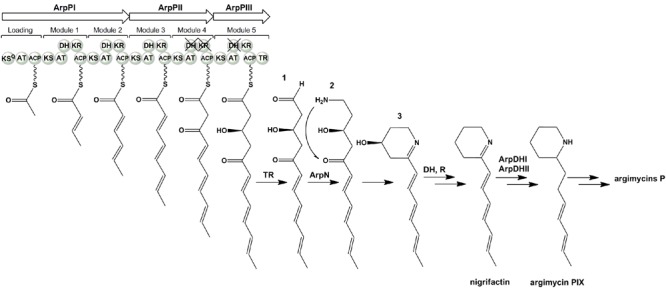
Genome mining of the mithramycin producer ATCC 12956 revealed 31 gene clusters for the biosynthesis of secondary metabolites, and allowed to predict the encoded products for 11 of these clusters. Cluster 18 (renamed cluster ) corresponded to a type I polyketide gene cluster related to the previously described coelimycin P1 and streptazone gene clusters. The cluster consists of fourteen genes, including genes coding for putative regulatory proteins (a SARP-like transcriptional activator and a TetR-like transcriptional repressor), genes coding for structural proteins (three PKSs, one aminotransferase, two dehydrogenases, two cyclases, one imine reductase, a type II thioesterase, and a flavin reductase), and one gene coding for a hypothetical protein. Identification of encoded compounds by this cluster was achieved by combining several strategies: (i) inactivation of the type I PKS gene ; (ii) inactivation of the putative TetR-transcriptional repressor ; (iii) cultivation of strains in different production media; and (iv) using engineered strains with higher intracellular concentration of malonyl-CoA. This has allowed identifying six new alkaloid compounds named argimycins P, which were purified and structurally characterized by mass spectrometry and nuclear magnetic resonance spectroscopy. Some argimycins P showed a piperidine ring with a polyene side chain (argimycin PIX); others contain also a fused five-membered ring (argimycins PIV-PVI). Argimycins PI-PII showed a pyridine ring instead, and an additional -acetylcysteinyl moiety. These compounds seem to play a negative role in growth and colony differentiation in , and some of them show weak antibiotic activity. A pathway for the biosynthesis of argimycins P is proposed, based on the analysis of proposed enzyme functions and on the structure of compounds encoded by the cluster.
对光神霉素产生菌ATCC 12956进行基因组挖掘,发现了31个次生代谢产物生物合成基因簇,并对其中11个基因簇的编码产物进行了预测。第18号基因簇(重新命名为基因簇 )对应于一个I型聚酮合酶基因簇,与先前描述的天蓝色菌素P1和链脲菌素基因簇相关。该基因簇由14个基因组成,包括编码假定调控蛋白的基因(一个类SARP转录激活因子和一个类TetR转录抑制因子)、编码结构蛋白的基因(三个聚酮合酶、一个氨基转移酶、两个脱氢酶、两个环化酶、一个亚胺还原酶、一个II型硫酯酶和一个黄素还原酶),以及一个编码假定蛋白的基因。通过组合几种策略实现了对该基因簇编码化合物的鉴定:(i)使I型聚酮合酶基因失活;(ii)使假定的TetR转录抑制因子失活;(iii)在不同生产培养基中培养菌株;(iv)使用丙二酰辅酶A细胞内浓度较高的工程菌株。这使得鉴定出了六种名为阿吉霉素P的新生物碱化合物,通过质谱和核磁共振光谱对其进行了纯化和结构表征。一些阿吉霉素P显示出带有多烯侧链的哌啶环(阿吉霉素PIX);其他的还含有一个稠合的五元环(阿吉霉素PIV - PVI)。阿吉霉素PI - PII则显示出一个吡啶环,以及一个额外的 - 乙酰半胱氨酰部分。这些化合物似乎在 的生长和菌落分化中起负面作用,其中一些显示出较弱的抗生素活性。基于对推测的酶功能和该基因簇编码化合物结构的分析,提出了阿吉霉素P的生物合成途径。