De Cosmo Salvatore, Mazzoccoli Gianluigi
Department of Medical Sciences, Division of Internal Medicine and Chronobiology Unit, IRCCS "Ospedale Casa Sollievo della Sofferenza" , San Giovanni Rotondo , Italy.
Front Endocrinol (Lausanne). 2017 Feb 13;8:24. doi: 10.3389/fendo.2017.00024. eCollection 2017.
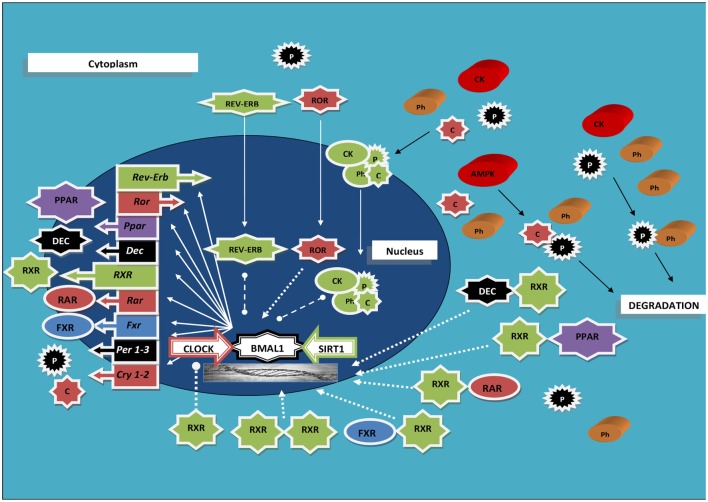
Liver metabolic pathways are driven by the biological clock, and appropriate timing of 24-h patterns of metabolic gene expression as well as anabolic/catabolic processes with wake-related activity/feeding and sleep-related resting/fasting cycles preserves hepatic healthiness. The interplay among the liver metabolic pathways and the molecular clockwork is geared by the nuclear receptors, and ligand-dependent transcription factors that gauge the cellular nutritional status and redox balance, bind hormones and metabolites, and modulate the transcription of thousands target genes through their DNA-binding domain. Several nuclear receptors in the liver oscillate with circadian rhythmicity, and among these, the retinoid X receptors play a key role in metabolism regulation, intersecting with the cogs of the molecular clockwork.
肝脏代谢途径受生物钟驱动,代谢基因表达的24小时模式以及与清醒相关的活动/进食和与睡眠相关的休息/禁食周期的合成代谢/分解代谢过程的适当时间安排可维持肝脏健康。肝脏代谢途径与分子生物钟之间的相互作用由核受体以及配体依赖性转录因子调节,这些因子可评估细胞营养状态和氧化还原平衡、结合激素和代谢物,并通过其DNA结合域调节数千个靶基因的转录。肝脏中的几种核受体以昼夜节律振荡,其中,视黄酸X受体在代谢调节中起关键作用,与分子生物钟的齿轮相互交叉。