Chalipa Javad, Jalali Yasamin Farajzadeh, Gorjizadeh Fatemeh, Baghaeian Pedram, Hoseini Mohammad Hashem, Mortezai Omid
Assistant Professor, Dental Research Center, Dentistry Research Institute, Tehran University of Medical Sciences, Tehran, Iran; Department of Orthodontics, School of Dentistry, Tehran University of Medical Sciences, Tehran, Iran.
Assistant Professor, Department of Orthodontics, School of Dentistry, Ilam University of Medical Sciences, Ilam, Iran.
J Dent (Tehran). 2016 Nov;13(6):423-430.
The aim of this study was to evaluate the effect of conventional and high-power light emitting diode (LED) light curing units on shear bond strength (SBS) of metal and ceramic brackets to tooth surface.
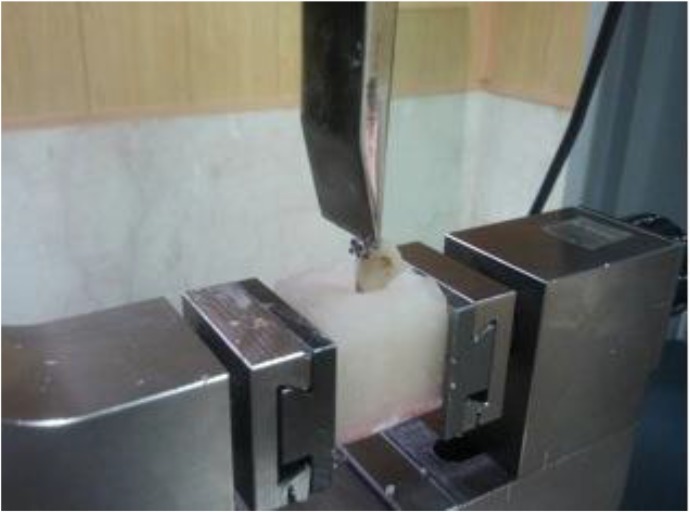
Forty sound bovine maxillary central incisors were used for the study. The teeth were divided into four groups (n=10). Teeth surfaces were etched with 37% phosphoric acid for 20 seconds. After applying a uniform layer of adhesive primer on the etched enamel, composite was placed on the base of brackets. The samples were light cured according to the manufacturer's instructions and thermocycled. The SBS was measured. The failure mode was scored using the adhesive remnant index (ARI).
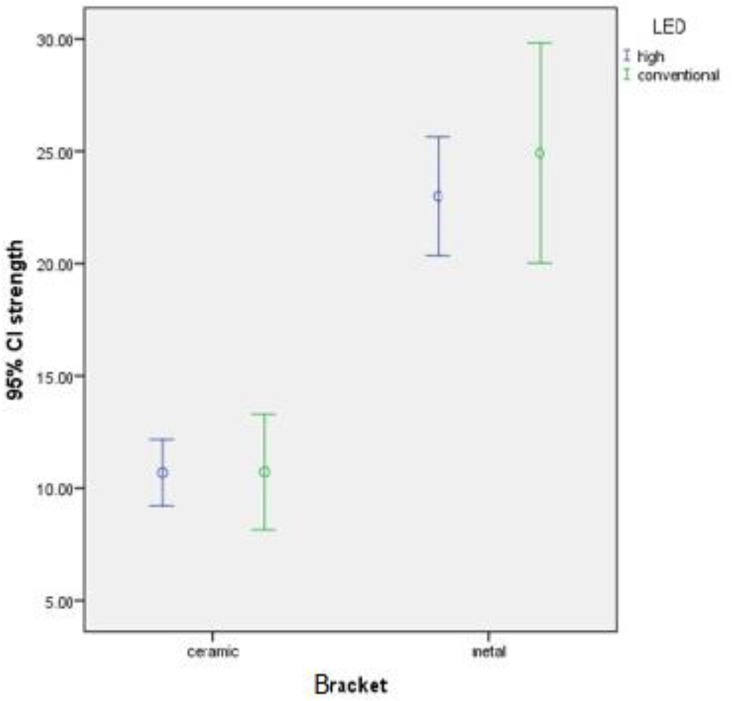
The mean SBS of samples in groups A (high-power LED, metal bracket), B (high-power LED, ceramic bracket), C (conventional LED, metal bracket) and D (conventional LED, ceramic bracket) was 23.1±3.69, 10.7±2.06, 24.92±6.37 and 10.74±3.18MPa, respectively. The interaction effect of type of LED unit (high-power/conventional) and bracket type on SBS was not statistically significant (P=0.483). In general, type of LED unit did not affect SBS. Type of bracket significantly affected SBS (P<0.001). The ARI score was not significantly influenced by the interaction between the type of LED unit and bracket.
The obtained SBS is the same for both bracket types by use of high-power and conventional LED light curing units. Regardless of the type of LED unit, SBS of ceramic brackets was significantly lower than that of metal brackets.
本研究旨在评估传统和高功率发光二极管(LED)光固化机对金属及陶瓷托槽与牙面间剪切粘结强度(SBS)的影响。
本研究使用了40颗健康的牛上颌中切牙。将牙齿分为四组(n = 10)。牙齿表面用37%磷酸酸蚀20秒。在酸蚀后的牙釉质上涂抹一层均匀的粘结剂底胶后,在托槽底部放置复合树脂。样本按照制造商的说明进行光固化并进行热循环处理。测量SBS。使用粘结剂残留指数(ARI)对失败模式进行评分。
A组(高功率LED,金属托槽)、B组(高功率LED,陶瓷托槽)、C组(传统LED,金属托槽)和D组(传统LED,陶瓷托槽)样本的平均SBS分别为23.1±3.69、10.7±2.06、24.92±6.37和10.74±3.18MPa。LED光固化机类型(高功率/传统)和托槽类型对SBS的交互作用无统计学意义(P = 0.483)。总体而言,LED光固化机类型不影响SBS。托槽类型对SBS有显著影响(P < 0.001)。ARI评分不受LED光固化机类型和托槽之间交互作用的显著影响。
使用高功率和传统LED光固化机时,两种托槽类型获得的SBS相同。无论LED光固化机类型如何,陶瓷托槽的SBS均显著低于金属托槽。