Zhou Qianling, Stewart Sunita M, Wan Alice, Leung Charles Sai-Cheong, Lai Agnes Y, Lam Tai Hing, Chan Sophia Siu-Chee
School of Public Health, The University of Hong Kong , Hong Kong , China.
Department of Psychiatry, University of Texas Southwestern, Medical Center at Dallas , Dallas, TX , USA.
Front Public Health. 2017 Feb 13;5:15. doi: 10.3389/fpubh.2017.00015. eCollection 2017.
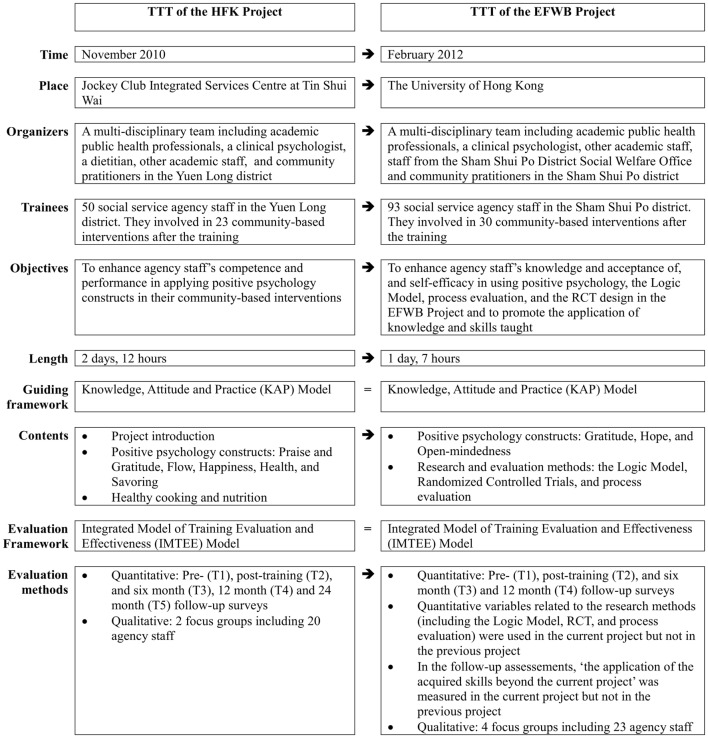
Capacity building approaches are useful in large-scale community-based health promotion interventions. However, models to guide and evaluate capacity building among social service agency staff in community settings are rare in the literature. This paper describes the development and evaluation of a 1-day (7 h) train-the-trainer (TTT) workshop for the "Enhancing Family Well-Being Project". The workshop aimed at equipping staff from different community agencies with the knowledge and skills to design, implement, and evaluate positive psychology-based interventions for their clients in Sham Shui Po, an over-crowded and low-income district in Hong Kong.
The current TTT extended and improved on our previous successful model by adding research and evaluation methods (including the Logic Model, process evaluation, and randomized controlled trial), which are important to plan and evaluate the community interventions. Evaluation of the TTT was guided by the Integrated Model of Training Evaluation and Effectiveness (IMTEE), with quantitative and qualitative methods. Quantitative data were collected from pretraining (T1), post-training (T2), and 6-month (T3) and 12-month (T4) follow-up surveys. Qualitative data were collected from four focus groups of agency staff after the intervention.
Ninety-three staff from 30 community agencies attended the training, and 90 completed the baseline survey. Eighty-eight, 63, and 57 staff performed the evaluations at T2, T3, and T4, respectively. Agency staff were satisfied with the TTT. Immediate enhancement of knowledge, self-efficacy, and positive attitudes toward the training content was found at T2 (Cohen's ranged from 0.24 to 1.22, all < 0.05). Enhancement of knowledge of all training contents persisted at T3 and T4 (Cohen's ranged from 0.34 to 0.63, all < 0.05). Enhancement of self-efficacy in the use of positive psychology in intervention design persisted at T3 (Cohen's = 0.22, = 0.04). The skills learned were utilized to plan and develop subsequent interventions. Twenty-nine interventions were successfully designed and implemented by the agency staff, and delivered to 1,586 participants. The agency staff indicated their intention to utilize the skills they had learned for other interventions (score ≥4 out of 6) and to share these skills with their colleagues. Qualitative feedbacks from 23 agency staff supported the quantitative results.
Our brief TTT was effectively delivered to a large number of agency staff and showed effects that persisted up to 12 months. Our training and evaluation models may offer a template for capacity building among social service agency staff for community brief, universal family health promotion interventions in diverse settings.
能力建设方法在大规模社区健康促进干预中很有用。然而,文献中很少有指导和评估社区环境下社会服务机构工作人员能力建设的模型。本文描述了为“增强家庭幸福感项目”开展的为期1天(7小时)的培训师培训(TTT)工作坊的开发与评估。该工作坊旨在让来自不同社区机构的工作人员掌握知识和技能,以便为香港深水埗区(一个人口密集的低收入地区)的客户设计、实施和评估基于积极心理学的干预措施。
当前的TTT在我们之前成功模型的基础上进行了扩展和改进,增加了研究和评估方法(包括逻辑模型、过程评估和随机对照试验),这些方法对规划和评估社区干预很重要。TTT的评估以培训评估与有效性综合模型(IMTEE)为指导,采用定量和定性方法。定量数据从培训前(T1)、培训后(T2)、6个月(T3)和12个月(T4)的随访调查中收集。定性数据在干预后从四个机构工作人员焦点小组中收集。
来自30个社区机构的93名工作人员参加了培训,90人完成了基线调查。分别有88名、63名和57名工作人员在T2、T3和T4进行了评估。机构工作人员对TTT感到满意。在T2时发现知识、自我效能感以及对培训内容的积极态度立即得到增强(科恩d值范围为0.24至1.22,均p<0.05)。在T3和T4时,所有培训内容的知识增强持续存在(科恩d值范围为0.34至0.63,均p<0.05)。在干预设计中运用积极心理学的自我效能感增强在T3时持续存在(科恩d值 = 0.22,p = 0.04)。所学技能被用于规划和开展后续干预措施。机构工作人员成功设计并实施了29项干预措施,并提供给1586名参与者。机构工作人员表示他们打算将所学技能用于其他干预措施(6分制中得分≥4分),并与同事分享这些技能。来自23名机构工作人员的定性反馈支持了定量结果。
我们简短的TTT有效地传授给了大量机构工作人员,并显示出持续长达12个月的效果。我们的培训和评估模型可能为社会服务机构工作人员在不同环境下开展社区简短、普遍的家庭健康促进干预的能力建设提供一个模板。
