Luzak Agnes, Heier Margit, Thorand Barbara, Laxy Michael, Nowak Dennis, Peters Annette, Schulz Holger
Institute of Epidemiology I, Helmholtz Zentrum München - German Research Center for Environmental Health, Neuherberg, Germany.
Institute of Epidemiology II, Helmholtz Zentrum München - German Research Center for Environmental Health, Neuherberg, Germany.
PLoS One. 2017 Feb 28;12(2):e0172503. doi: 10.1371/journal.pone.0172503. eCollection 2017.
Intensity and duration of physical activity are associated with the achievement of health benefits. Our aim was to characterize physical activity behavior in terms of intensity, duration pattern, and adherence to the WHO physical activity recommendations in a population-based sample of adults from southern Germany. Further, we investigated associations between physical activity and sex, age, and body mass index (BMI), considering also common chronic diseases.
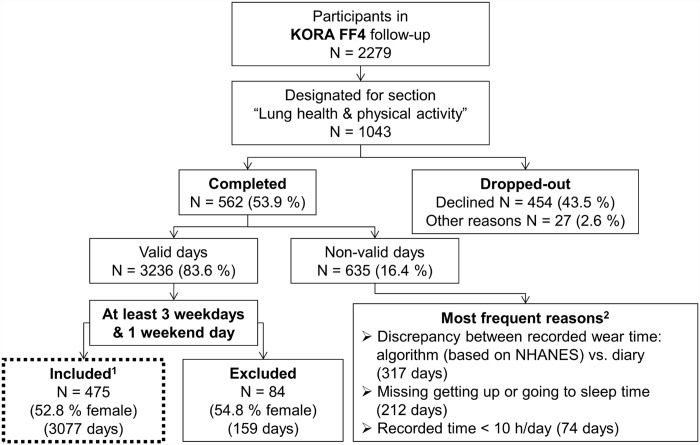
We analyzed 475 subjects (47% males, mean age 58 years, range 48-68 years) who wore ActiGraph accelerometers for up to seven days. Measured accelerations per minute obtained from the vertical axis (uniaxial) and the vector magnitude of all three axes (triaxial) were classified as sedentary, light or moderate-to-vigorous physical activity (MVPA) according to predefined acceleration count cut-offs. The average minutes/day spent in each activity level per subject served as outcome. Associations of sex, age, BMI, and seven chronic diseases or health limitations, with the activity levels were analyzed by negative binomial regression.
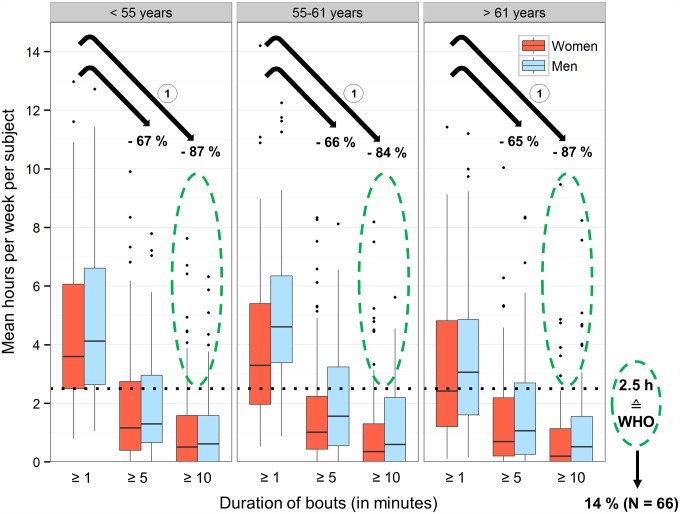
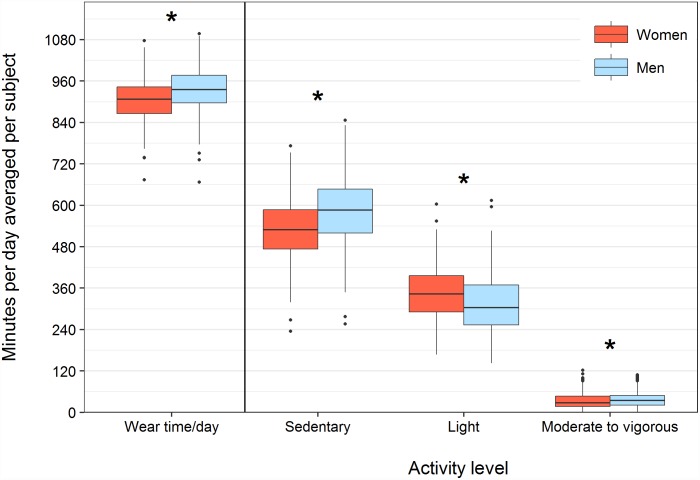
Most of the wear time was spent in sedentarism (median 61%/day), whereas the median time spent in MVPA was only 3%, with men achieving more MVPA than women (35 vs. 28 minutes/day, p<0.05). Almost two thirds of MVPA was achieved in short bouts of less than 5 minutes, and 35% of the subjects did not achieve a single 10-minute bout. Hence, only 14% adhered to the WHO recommendation of 2.5 hours of MVPA/week in at least 10-minute bouts. Females, older subjects and obese subjects spent less time in MVPA (p<0.05), but no clear association with hypertension, asthma, diabetes, chronic obstructive pulmonary disease, anxiety/depression, pain or walking difficulties was observed in regression analyses with MVPA as outcome.
Activity behavior among middle-aged German adults was highly insufficient, indicating a further need for physical activity promotion in order to gain health benefits.
身体活动的强度和持续时间与健康益处的实现相关。我们的目的是在来自德国南部的成年人群体样本中,根据强度、持续时间模式以及对世界卫生组织身体活动建议的遵循情况来描述身体活动行为。此外,我们还研究了身体活动与性别、年龄和体重指数(BMI)之间的关联,同时考虑常见的慢性疾病。
我们分析了475名受试者(47%为男性,平均年龄58岁,范围48 - 68岁),他们佩戴ActiGraph加速度计长达七天。根据预先定义的加速度计数阈值,将从垂直轴(单轴)获得的每分钟测量加速度以及所有三个轴的矢量大小(三轴)分类为久坐、轻度或中度至剧烈身体活动(MVPA)。每位受试者在每个活动水平上每天花费的平均分钟数作为结果。通过负二项回归分析性别、年龄、BMI以及七种慢性疾病或健康限制与活动水平之间的关联。
大部分佩戴时间都处于久坐状态(中位数为每天61%),而MVPA的中位数时间仅为3%,男性的MVPA时间比女性更多(分别为每天35分钟和28分钟,p<0.05)。几乎三分之二的MVPA是在短于5分钟的时间段内完成的,并且35%的受试者没有完成一次10分钟的活动。因此,只有14%的人至少以10分钟的时间段遵循了世界卫生组织每周2.5小时MVPA的建议。女性、年龄较大的受试者和肥胖受试者在MVPA上花费的时间较少(p<0.05),但在以MVPA为结果的回归分析中,未观察到与高血压、哮喘、糖尿病、慢性阻塞性肺疾病、焦虑/抑郁、疼痛或行走困难有明显关联。
德国中年成年人的活动行为严重不足,这表明为了获得健康益处,进一步促进身体活动的必要性。