Inserm U995, IFR114, Faculty of medicine, University Lille 2, Lille, France.
BMC Med Res Methodol. 2012 Mar 12;12:26. doi: 10.1186/1471-2288-12-26.
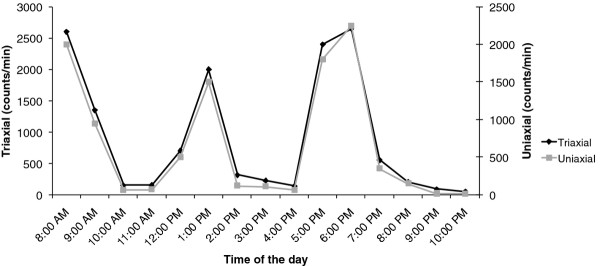
Different types of devices are available and the choice about which to use depends on various factors: cost, physical characteristics, performance, and the validity and intra- and interinstrument reliability. Given the large number of studies that have used uniaxial or triaxial devices, it is of interest to know whether the different devices give similar information about PA levels and patterns. The aim of this study was to compare physical activity (PA) levels and patterns obtained simultaneously by triaxial accelerometry and uniaxial accelerometry in adolescents in free-living conditions.
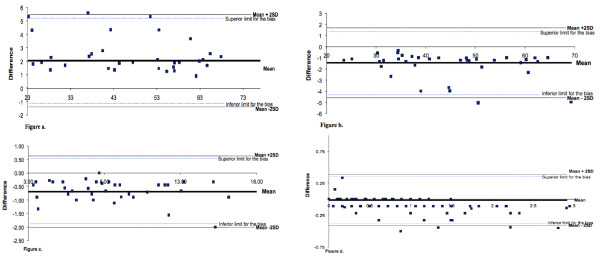
Sixty-two participants, aged 13-16 years, were recruited in this ancillary study, which is a part of the Healthy Lifestyle in Europe by Nutrition in Adolescence (HELENA). All participants wore a uniaxial accelerometer (ActiGraph GT1M®, Pensacola, FL) and a triaxial accelerometer (RT3®, Stayhealthy, Monrovia, CA) simultaneously for 7 days. The patterns were calculated by converting accelerometer data output as a percentage of time spent at sedentary, light, moderate, and vigorous PA per day. Analysis of output data from the two accelerometers were assessed by two different tests: Equivalence Test and Bland & Altman method.
The concordance correlation coefficient between the data from the triaxial accelerometer and uniaxial accelerometer at each intensity level was superior to 0.95. The ANOVA test showed a significant difference for the first three lower intensities while no significant difference was found for vigorous intensity. The difference between data obtained with the triaxial accelerometer and the uniaxial monitor never exceeded 2.1% and decreased as PA level increased. The Bland & Altman method showed good agreement between data obtained between the both accelerometers (p < 0.05).
Uniaxial and triaxial accelerometers do not differ in their measurement of PA in population studies, and either could be used in such studies.
有不同类型的设备可供选择,选择使用哪种设备取决于多种因素:成本、物理特性、性能以及有效性和仪器内及仪器间的可靠性。鉴于大量研究使用单轴或三轴设备,了解不同设备是否能提供关于 PA 水平和模式的相似信息是很有意义的。本研究旨在比较在自由生活条件下青少年同时使用三轴和单轴加速度计获得的体力活动(PA)水平和模式。
本辅助研究招募了 62 名年龄在 13-16 岁的参与者,该研究是“青少年欧洲营养健康生活方式(HELENA)”的一部分。所有参与者同时佩戴单轴加速度计(ActiGraph GT1M®,彭萨科拉,FL)和三轴加速度计(RT3®,Stayhealthy,Monrovia,CA),连续佩戴 7 天。通过将加速度计数据输出转换为每天久坐、轻度、中度和剧烈 PA 所花费的时间百分比来计算模式。使用两种不同的测试评估两种加速度计输出数据的一致性:等效性测试和 Bland & Altman 方法。
三轴加速度计和单轴加速度计在每个强度水平的数据之间的一致性相关系数均大于 0.95。方差分析(ANOVA)检验显示,前三个较低强度的差异显著,而剧烈强度的差异不显著。三轴加速度计和单轴监测器获得的数据之间的差异从未超过 2.1%,且随着 PA 水平的增加而减小。Bland & Altman 方法表明两种加速度计之间的数据具有良好的一致性(p < 0.05)。
在人群研究中,单轴和三轴加速度计在测量 PA 方面没有差异,两种都可以在这样的研究中使用。