Christensen Tina, Riis Anders H, Hatch Elizabeth E, Wise Lauren A, Nielsen Marie G, Rothman Kenneth J, Sørensen Henrik Toft, Mikkelsen Ellen M
Aarhus University Hospital, Department of Clinical Epidemiology, Aarhus N, Denmark.
Boston University School of Public Health, Department of Epidemiology, Boston, MA, United States.
J Med Internet Res. 2017 Mar 1;19(3):e58. doi: 10.2196/jmir.6716.
The Internet is widely used to conduct research studies on health issues. Many different methods are used to recruit participants for such studies, but little is known about how various recruitment methods compare in terms of efficiency and costs.
The aim of our study was to compare online and offline recruitment methods for Internet-based studies in terms of efficiency (number of recruited participants) and costs per participant.
We employed several online and offline recruitment methods to enroll 18- to 45-year-old women in an Internet-based Danish prospective cohort study on fertility. Offline methods included press releases, posters, and flyers. Online methods comprised advertisements placed on five different websites, including Facebook and Netdoktor.dk. We defined seven categories of mutually exclusive recruitment methods and used electronic tracking via unique Uniform Resource Locator (URL) and self-reported data to identify the recruitment method for each participant. For each method, we calculated the average cost per participant and efficiency, that is, the total number of recruited participants.
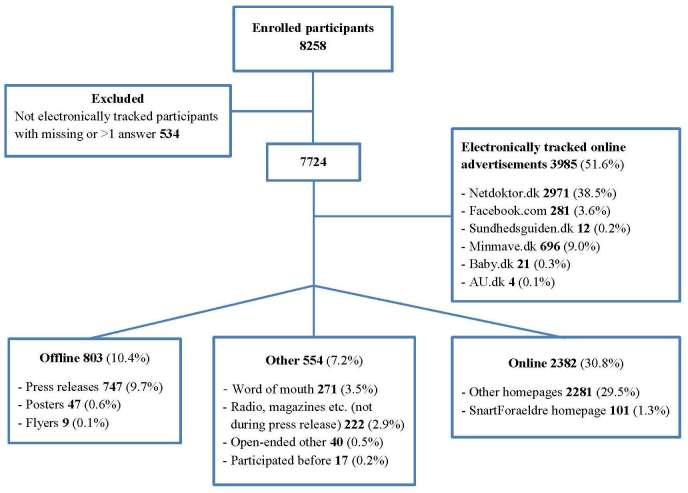
We recruited 8252 study participants. Of these, 534 were excluded as they could not be assigned to a specific recruitment method. The final study population included 7724 participants, of whom 803 (10.4%) were recruited by offline methods, 3985 (51.6%) by online methods, 2382 (30.8%) by online methods not initiated by us, and 554 (7.2%) by other methods. Overall, the average cost per participant was €6.22 for online methods initiated by us versus €9.06 for offline methods. Costs per participant ranged from €2.74 to €105.53 for online methods and from €0 to €67.50 for offline methods. Lowest average costs per participant were for those recruited from Netdoktor.dk (€2.99) and from Facebook (€3.44).
In our Internet-based cohort study, online recruitment methods were superior to offline methods in terms of efficiency (total number of participants enrolled). The average cost per recruited participant was also lower for online than for offline methods, although costs varied greatly among both online and offline recruitment methods. We observed a decrease in the efficiency of some online recruitment methods over time, suggesting that it may be optimal to adopt multiple online methods.
互联网被广泛用于开展有关健康问题的研究。人们使用多种不同方法为这类研究招募参与者,但对于各种招募方法在效率和成本方面如何比较却知之甚少。
我们研究的目的是就基于互联网的研究,比较在线和线下招募方法在效率(招募的参与者数量)和每位参与者成本方面的差异。
我们采用了多种在线和线下招募方法,以招募18至45岁的女性参与一项基于互联网的丹麦生育前瞻性队列研究。线下方法包括新闻稿、海报和传单。在线方法包括在五个不同网站(包括脸书和Netdoktor.dk)上投放广告。我们定义了七类相互排斥的招募方法,并通过唯一统一资源定位符(URL)进行电子追踪以及利用自我报告数据来确定每位参与者的招募方法。对于每种方法,我们计算了每位参与者的平均成本和效率,即招募的参与者总数。
我们招募了8252名研究参与者。其中,534名因无法归入特定招募方法而被排除。最终的研究人群包括7724名参与者,其中803名(10.4%)通过线下方法招募,3985名(51.6%)通过在线方法招募,2382名(30.8%)通过非我们发起的在线方法招募,554名(7.2%)通过其他方法招募。总体而言,我们发起的在线方法每位参与者的平均成本为6.22欧元,而线下方法为9.06欧元。在线方法每位参与者的成本从2.74欧元到105.53欧元不等,线下方法从0欧元到67.50欧元不等。每位参与者平均成本最低的是从Netdoktor.dk(2.99欧元)和脸书(3.44欧元)招募的参与者。
在我们基于互联网的队列研究中,就效率(招募的参与者总数)而言,在线招募方法优于线下方法。招募的每位参与者的平均成本在线上也低于线下方法,尽管线上和线下招募方法的成本差异都很大。我们观察到一些在线招募方法的效率随时间下降,这表明采用多种在线方法可能是最优选择。