Kim Bernard Y, Huber Christian D, Lohmueller Kirk E
Department of Ecology and Evolutionary Biology, University of California, Los Angeles, California 90095.
Department of Ecology and Evolutionary Biology, University of California, Los Angeles, California 90095
Genetics. 2017 May;206(1):345-361. doi: 10.1534/genetics.116.197145. Epub 2017 Mar 1.
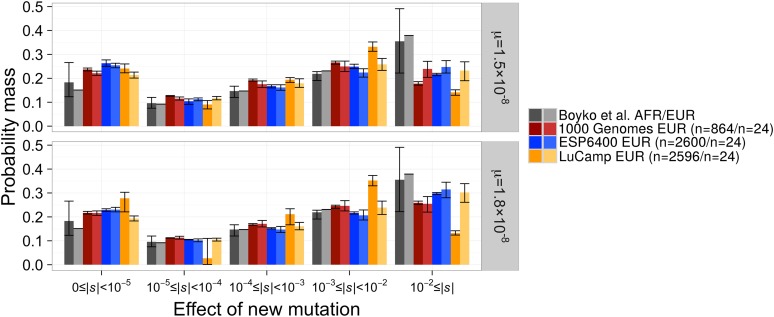
The distribution of fitness effects (DFE) has considerable importance in population genetics. To date, estimates of the DFE come from studies using a small number of individuals. Thus, estimates of the proportion of moderately to strongly deleterious new mutations may be unreliable because such variants are unlikely to be segregating in the data. Additionally, the true functional form of the DFE is unknown, and estimates of the DFE differ significantly between studies. Here we present a flexible and computationally tractable method, called Fit∂a∂i, to estimate the DFE of new mutations using the site frequency spectrum from a large number of individuals. We apply our approach to the frequency spectrum of 1300 Europeans from the Exome Sequencing Project ESP6400 data set, 1298 Danes from the LuCamp data set, and 432 Europeans from the 1000 Genomes Project to estimate the DFE of deleterious nonsynonymous mutations. We infer significantly fewer (0.38-0.84 fold) strongly deleterious mutations with selection coefficient || > 0.01 and more (1.24-1.43 fold) weakly deleterious mutations with selection coefficient || < 0.001 compared to previous estimates. Furthermore, a DFE that is a mixture distribution of a point mass at neutrality plus a gamma distribution fits better than a gamma distribution in two of the three data sets. Our results suggest that nearly neutral forces play a larger role in human evolution than previously thought.
适合度效应分布(DFE)在群体遗传学中具有相当重要的意义。迄今为止,DFE的估计来自使用少量个体的研究。因此,对中度至高度有害新突变比例的估计可能不可靠,因为此类变异不太可能在数据中分离。此外,DFE的真实函数形式未知,且不同研究对DFE的估计差异显著。在此,我们提出一种灵活且计算上易于处理的方法,称为Fit∂a∂i,用于使用来自大量个体的位点频率谱来估计新突变的DFE。我们将我们的方法应用于外显子组测序项目ESP6400数据集中1300名欧洲人的频率谱、LuCamp数据集中1298名丹麦人的频率谱以及千人基因组计划中432名欧洲人的频率谱,以估计有害非同义突变的DFE。与先前的估计相比,我们推断选择系数|| > 0.01的高度有害突变显著减少(0.38 - 0.84倍),而选择系数|| < 0.001的轻度有害突变更多(1.24 - 1.43倍)。此外,在三个数据集中的两个数据集中,中性点质量加伽马分布的混合分布形式的DFE比伽马分布拟合得更好。我们的结果表明,近中性力量在人类进化中所起的作用比先前认为的更大。