Lawson Rachael A, Yarnall Alison J, Duncan Gordon W, Breen David P, Khoo Tien K, Williams-Gray Caroline H, Barker Roger A, Burn David J
Institute of Neuroscience, Newcastle University, Newcastle upon Tyne, UK.
Centre for Clinical Brain Sciences, University of Edinburgh, Edinburgh, UK.
J Neurol Neurosurg Psychiatry. 2017 Aug;88(8):648-652. doi: 10.1136/jnnp-2016-315099. Epub 2017 Mar 1.
Mild cognitive impairment (MCI) is common in early Parkinson's disease (PD). We evaluated the stability of PD-MCI over time to determine its clinical utility as a marker of disease.
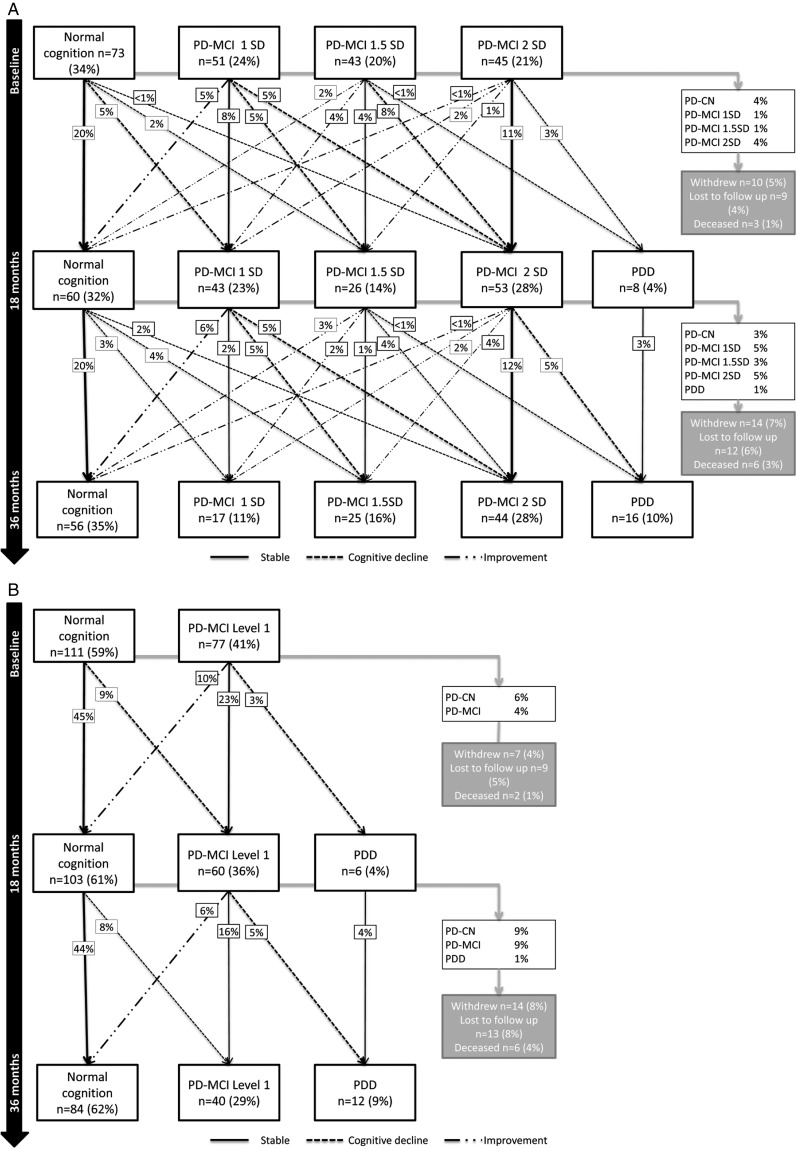
212 newly diagnosed participants with PD were recruited into a longitudinal study and reassessed after 18 and 36 months. Participants completed a range of clinical and neuropsychological assessments. PD-MCI was classified using Movement Disorders Society Task Force level I (Montreal Cognitive Assessment <26) and level II (using cut-offs of 1, 1.5 and 2SD) criteria.
After 36 months, 75% of participants returned; 8% of patients had developed a dementia all of which were previously PD-MCI. Applying level I criteria, 70% were cognitively stable, 19% cognitively declined and 11% improved over 36 months. Applying level II criteria (1, 1.5 and 2SD), 25% were cognitively stable, 41% cognitively declined, 15% improved and 19% fluctuated over 36 months. 18% of participants reverted to normal cognition from PD-MCI.
Cognitive impairment in PD is complex, with some individuals' function fluctuating over time and some reverting to normal cognition. PD-MCI level I criteria may have greater clinical convenience, but more comprehensive level II criteria with 2SD cut-offs may offer greater diagnostic certainty.
轻度认知障碍(MCI)在早期帕金森病(PD)中很常见。我们评估了PD-MCI随时间的稳定性,以确定其作为疾病标志物的临床效用。
212名新诊断的PD参与者被纳入一项纵向研究,并在18个月和36个月后重新评估。参与者完成了一系列临床和神经心理学评估。使用运动障碍协会工作组一级(蒙特利尔认知评估<26)和二级(使用1、1.5和2个标准差的临界值)标准对PD-MCI进行分类。
36个月后,75%的参与者返回;8%的患者发展为痴呆,所有这些患者之前均为PD-MCI。应用一级标准,70%的患者认知稳定,19%的患者认知下降,11%的患者在36个月内有所改善。应用二级标准(1、1.5和2个标准差),25%的患者认知稳定,41%的患者认知下降,15%的患者有所改善,19%的患者在36个月内波动。18%的参与者从PD-MCI恢复到正常认知。
PD中的认知障碍很复杂,一些个体的功能随时间波动,一些个体恢复到正常认知。PD-MCI一级标准可能具有更大的临床便利性,但采用2个标准差临界值的更全面的二级标准可能提供更大的诊断确定性。