Arbillaga-Etxarri Ane, Gimeno-Santos Elena, Barberan-Garcia Anael, Benet Marta, Borrell Eulàlia, Dadvand Payam, Foraster Maria, Marín Alicia, Monteagudo Mònica, Rodriguez-Roisin Robert, Vall-Casas Pere, Vilaró Jordi, Garcia-Aymerich Judith
Barcelona Institute of Global Health (ISGlobal), Barcelona, Spain.
Universitat Pompeu Fabra (UPF), Barcelona, Spain.
Thorax. 2017 Sep;72(9):796-802. doi: 10.1136/thoraxjnl-2016-209209. Epub 2017 Mar 1.
Study of the causes of the reduced levels of physical activity in patients with COPD has been scarce and limited to biological factors.
To assess the relationship between novel socio-environmental factors, namely dog walking, grandparenting, neighbourhood deprivation, residential surrounding greenness and residential proximity to green or blue spaces, and amount and intensity of physical activity in COPD patients.
This cross-sectional study recruited 410 COPD patients from five Catalan municipalities. Dog walking and grandparenting were assessed by questionnaire. Neighbourhood deprivation was assessed using the census Urban Vulnerability Index, residential surrounding greenness by the satellite-derived Normalized Difference Vegetation Index, and residential proximity to green or blue spaces as living within 300 m of such a space. Physical activity was measured during 1 week by accelerometer to assess time spent on moderate-to-vigorous physical activity (MVPA) and vector magnitude units (VMU) per minute.
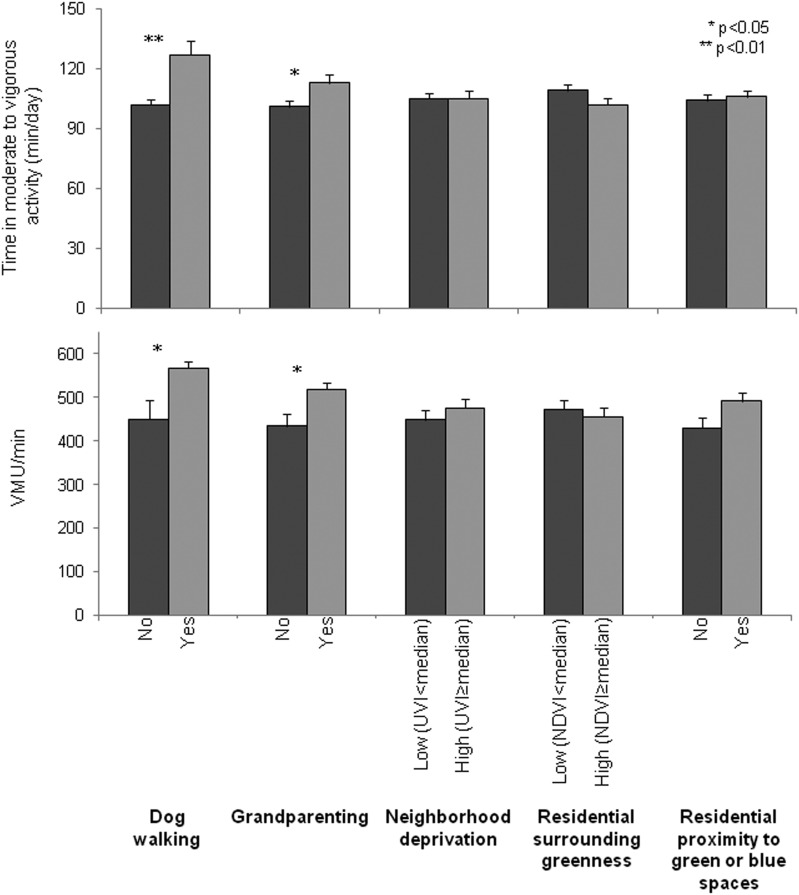
Patients were 85% male, had a mean (SD) age of 69 (9) years, and post-bronchodilator FEV of 56 (17) %pred. After adjusting for age, sex, socio-economic status, dyspnoea, exercise capacity and anxiety in a linear regression model, both dog walking and grandparenting were significantly associated with an increase both in time in MVPA (18 min/day (p<0.01) and 9 min/day (p<0.05), respectively) and in physical activity intensity (76 VMU/min (p=0.05) and 59 VMUs/min (p<0.05), respectively). Neighbourhood deprivation, surrounding greenness and proximity to green or blue spaces were not associated with physical activity.
Dog walking and grandparenting are associated with a higher amount and intensity of physical activity in COPD patients.
Pre-results, NCT01897298.
针对慢性阻塞性肺疾病(COPD)患者身体活动水平降低原因的研究较少,且仅限于生物学因素。
评估一些新的社会环境因素,即遛狗、照顾孙辈、社区贫困程度、居住环境绿化程度以及居住地点与绿地或蓝地的距离,与COPD患者身体活动量及强度之间的关系。
这项横断面研究从加泰罗尼亚的五个城市招募了410名COPD患者。通过问卷调查评估遛狗和照顾孙辈的情况。使用人口普查城市脆弱性指数评估社区贫困程度,利用卫星衍生的归一化植被指数评估居住环境绿化程度,将居住在距离此类空间300米范围内定义为居住地点与绿地或蓝地接近。通过加速度计测量1周内的身体活动情况,以评估中度至剧烈身体活动(MVPA)的时长以及每分钟的矢量大小单位(VMU)。
患者中85%为男性,平均(标准差)年龄为69(9)岁,支气管扩张剂后第一秒用力呼气容积(FEV)占预计值的56(17)%。在对年龄、性别、社会经济地位、呼吸困难、运动能力和焦虑进行线性回归模型校正后,遛狗和照顾孙辈均与MVPA时长增加(分别为每天18分钟(p<0.01)和9分钟(p<0.05))以及身体活动强度增加(分别为每分钟76 VMU(p=0.05)和59 VMU/分钟(p<0.05))显著相关。社区贫困程度、居住环境绿化程度以及与绿地或蓝地的距离与身体活动无关。
遛狗和照顾孙辈与COPD患者更高的身体活动量及强度相关。
结果前,NCT01897298。