Faculty of Physical Education and Physiotherapy, Opole University of Technology, 45-758 Opole, Poland.
Department of Biosystems, KU Leuven, 3001 Leuven, Belgium.
Sensors (Basel). 2021 Apr 13;21(8):2742. doi: 10.3390/s21082742.
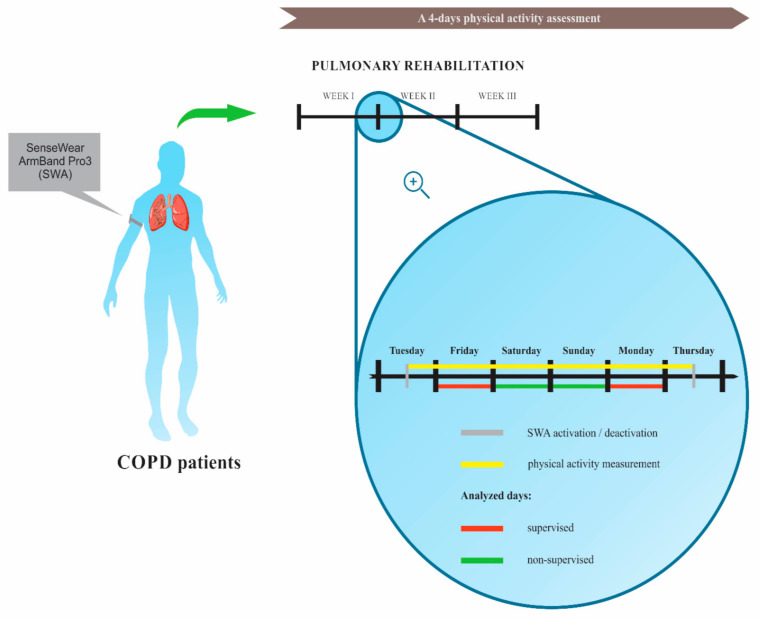
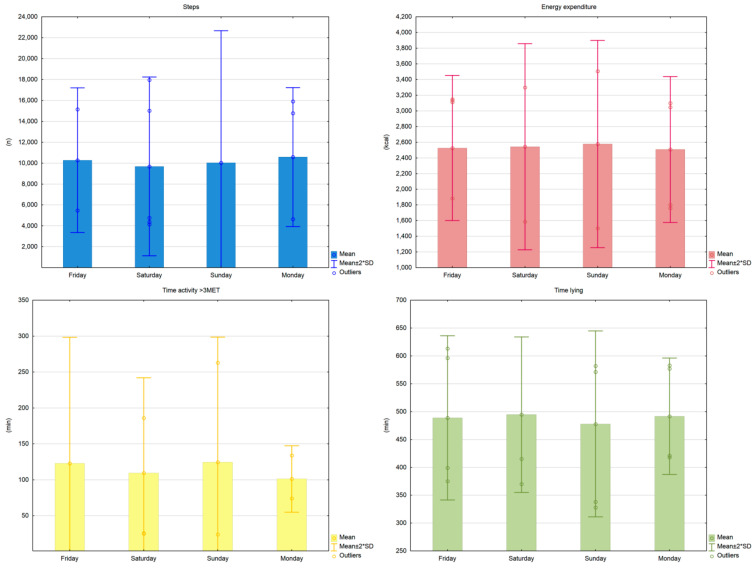
Accelerometers have become a standard method of monitoring physical activity in everyday life by measuring acceleration in one, two, or three axes. These devices provide reliable and objective measurements of the duration and intensity of physical activity. We aimed to investigate whether patients undertake physical activity during non-supervised days during stationary rehabilitation and whether patients adhere to the rigor of 24 h monitoring. The second objective was to analyze the strengths and weaknesses of such kinds of sensors. The research enrolled 13 randomly selected patients, qualified for in-patient, 3 week, high-intensity, 5 times a week pulmonary rehabilitation. The SenseWear armband was used for the assessment of physical activity. Participants wore the device 24 h a day for the next 4 days (Friday-Monday). The analysis of the number of steps per day, the time spent lying as well as undertaking moderate or vigorous physical activity (>3 metabolic equivalents of task (METs)), and the energy expenditure expressed in kcal showed no statistically significant difference between the training days and the days off. It seems beneficial to use available physical activity sensors in patients with chronic obstructive pulmonary disease (COPD); measurable parameters provide feedback that may increase the patient's motivation to be active to achieve health benefits.
加速度计已成为通过测量一个、两个或三个轴的加速度来监测日常生活中身体活动的标准方法。这些设备可提供可靠和客观的身体活动持续时间和强度的测量。我们旨在研究在固定康复期间非监督日患者是否进行身体活动,以及患者是否遵守 24 小时监测的严格要求。第二个目的是分析这种传感器的优缺点。该研究纳入了 13 名随机选择的患者,他们有资格接受为期 3 周、每周 5 次、高强度的住院肺康复治疗。使用 SenseWear 臂带评估身体活动。参与者在接下来的 4 天(星期五至星期一)每天 24 小时佩戴该设备。对每天的步数、躺着的时间以及进行中等或剧烈身体活动(>3 代谢当量任务(METs))的时间,以及以千卡表示的能量消耗进行分析,结果显示在训练日和休息日之间没有统计学上的显著差异。在慢性阻塞性肺疾病(COPD)患者中使用现有的身体活动传感器似乎是有益的;可测量的参数提供反馈,可能会增加患者积极活动以获得健康益处的动力。