Rocha-Ferreira Eridan, Kelen Dorottya, Faulkner Stuart, Broad Kevin D, Chandrasekaran Manigandan, Kerenyi Áron, Kato Takenori, Bainbridge Alan, Golay Xavier, Sullivan Mark, Kramer Boris W, Robertson Nicola J
Institute for Women's Health, University College London, 74 Huntley Street, London, WC1E 6AU, UK.
First Department of Pediatrics, Semmelweis University, Budapest, Hungary.
J Neuroinflammation. 2017 Mar 3;14(1):44. doi: 10.1186/s12974-017-0821-x.
Inflammatory cytokines are implicated in the pathogenesis of perinatal hypoxia-ischemia (HI). The influence of hypothermia (HT) on cytokines after HI is unclear. Our aim was to assess in a piglet asphyxia model, under normothermic (NT) and HT conditions: (i) the evolution of serum cytokines over 48 h and (ii) cerebrospinal fluid (CSF) cytokine levels at 48 h; (iii) serum pro/anti-inflammatory cytokine profile over 48 h and (iv) relation between brain injury measured by magnetic resonance spectroscopy (MRS) and brain TUNEL positive cells with serum cytokines, serum pro/anti-inflammatory cytokines and CSF cytokines.
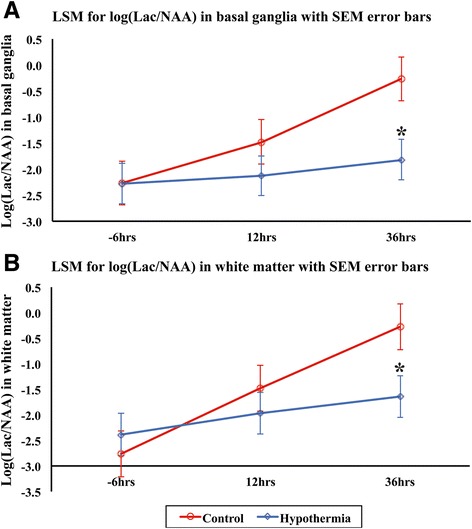
Newborn piglets were randomized to NT (n = 5) or HT (n = 6) lasting 2-26 h after HI. Serum samples were obtained 4-6 h before, during and at 6-12 h intervals after HI; CSF was obtained at 48 h. Concentrations of interleukin (IL)-1β, -4, -6, -8, -10 and TNF-α were measured and pro/anti-inflammatory status compared between groups. White matter and thalamic voxel lactate/N-acetyl aspartate (Lac/NAA) (a measure of both oxidative metabolism and neuronal loss) were acquired at baseline, after HI and at 24 and 36 h.
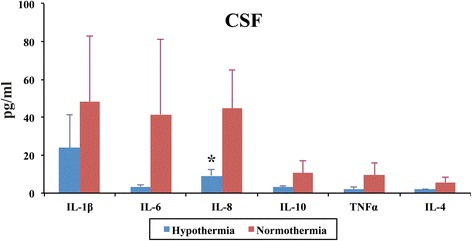
Lac/NAA was reduced at 36 h with HT compared to NT (p = 0.013 basal ganglia and p = 0.033 white matter). HT showed lower serum TNF-α from baseline to 12 h (p < 0.05). Time-matched (acquired within 5 h of each other) serum cytokine and MRS showed correlations between Lac/NAA and serum IL-1β and IL-10 (all p < 0.01). The pro/anti-inflammatory ratios IL-1β/IL-10, IL-6/IL-10, IL-4/IL-10 and IL-8/IL-10 were similar in NT and HT groups until 36 h (24 h for IL-6/IL-10); after this, 36 h pro/anti-inflammatory cytokine ratios in the serum were higher in HT compared to NT (p < 0.05), indicating a pro-inflammatory cytokine surge after rewarming in the HT group. In the CSF at 48 h, IL-8 was lower in the HT group (p < 0.05). At 48 h, CSF TNF-α correlated with Lac/NAA (p = 0.02) and CSF IL-8 correlated with white matter TUNEL positive cell death (p = 0.04).
Following cerebral HI, there was a systemic pro-inflammatory surge after rewarming in the HT group, which is counterintuitive to the putative neuroprotective effects of HT. While serum cytokines were variable, elevations in CSF inflammatory cytokines at 48 h were associated with MRS Lac/NAA and white matter cell death.
炎性细胞因子与围产期缺氧缺血(HI)的发病机制有关。低温(HT)对HI后细胞因子的影响尚不清楚。我们的目的是在仔猪窒息模型中,在常温(NT)和HT条件下评估:(i)48小时内血清细胞因子的变化;(ii)48小时时脑脊液(CSF)细胞因子水平;(iii)48小时内血清促炎/抗炎细胞因子谱;(iv)通过磁共振波谱(MRS)测量的脑损伤与脑TUNEL阳性细胞与血清细胞因子、血清促炎/抗炎细胞因子和CSF细胞因子之间的关系。
将新生仔猪随机分为NT组(n = 5)或HT组(n = 6),在HI后持续2 - 26小时。在HI前4 - 6小时、HI期间以及HI后6 - 12小时的间隔时间采集血清样本;在48小时采集CSF。测量白细胞介素(IL)-1β、-4、-6、-8、-10和肿瘤坏死因子-α(TNF-α)的浓度,并比较两组之间的促炎/抗炎状态。在基线、HI后以及24和36小时获取白质和丘脑体素的乳酸/ N - 乙酰天门冬氨酸(Lac / NAA)(氧化代谢和神经元损失的指标)。
与NT组相比,HT组在36小时时Lac / NAA降低(基底神经节p = 0.013,白质p = 0.033)。HT组从基线到12小时血清TNF-α较低(p < 0.05)。时间匹配(在彼此5小时内采集)的血清细胞因子和MRS显示Lac / NAA与血清IL-1β和IL-10之间存在相关性(所有p < 0.01)。直到36小时(IL-6 / IL-10为24小时),NT组和HT组的促炎/抗炎比值IL-1β/ IL-10、IL-6 / IL-10、IL-4 / IL-10和IL-8 / IL-10相似;在此之后,HT组血清中36小时的促炎/抗炎细胞因子比值高于NT组(p < 0.05),表明HT组复温后促炎细胞因子激增。在48小时的CSF中,HT组的IL-8较低(p < 0.05)。在48小时时,CSF TNF-α与Lac / NAA相关(p = 0.02),CSF IL-8与白质TUNEL阳性细胞死亡相关(p = 0.04)。
脑HI后,HT组复温后出现全身性促炎激增,这与HT假定的神经保护作用相反。虽然血清细胞因子变化不定,但48小时时CSF炎性细胞因子的升高与MRS Lac / NAA和白质细胞死亡有关。