Harding Amy T, Weeks Benjamin Kurt, Horan Sean A, Little Andrew, Watson Steven L, Beck Belinda Ruth
Menzies Health Institute Queensland, Griffith University, Gold Coast campus, QLD, Australia; School of Allied Health Sciences, Griffith University, Gold Coast campus, QLD, Australia.
School of Medicine, Griffith University, Gold Coast campus, QLD, Australia.
SAGE Open Med. 2017 Feb 10;5:2050312116688842. doi: 10.1177/2050312116688842. eCollection 2017.
To develop and determine convergent validity and reliability of a simple and inexpensive clinical test to quantify back extensor muscle strength.
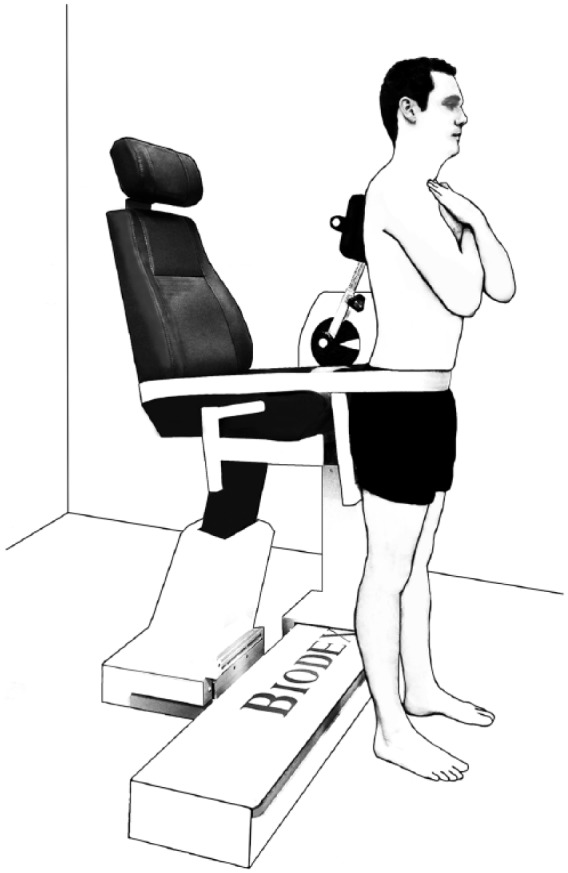
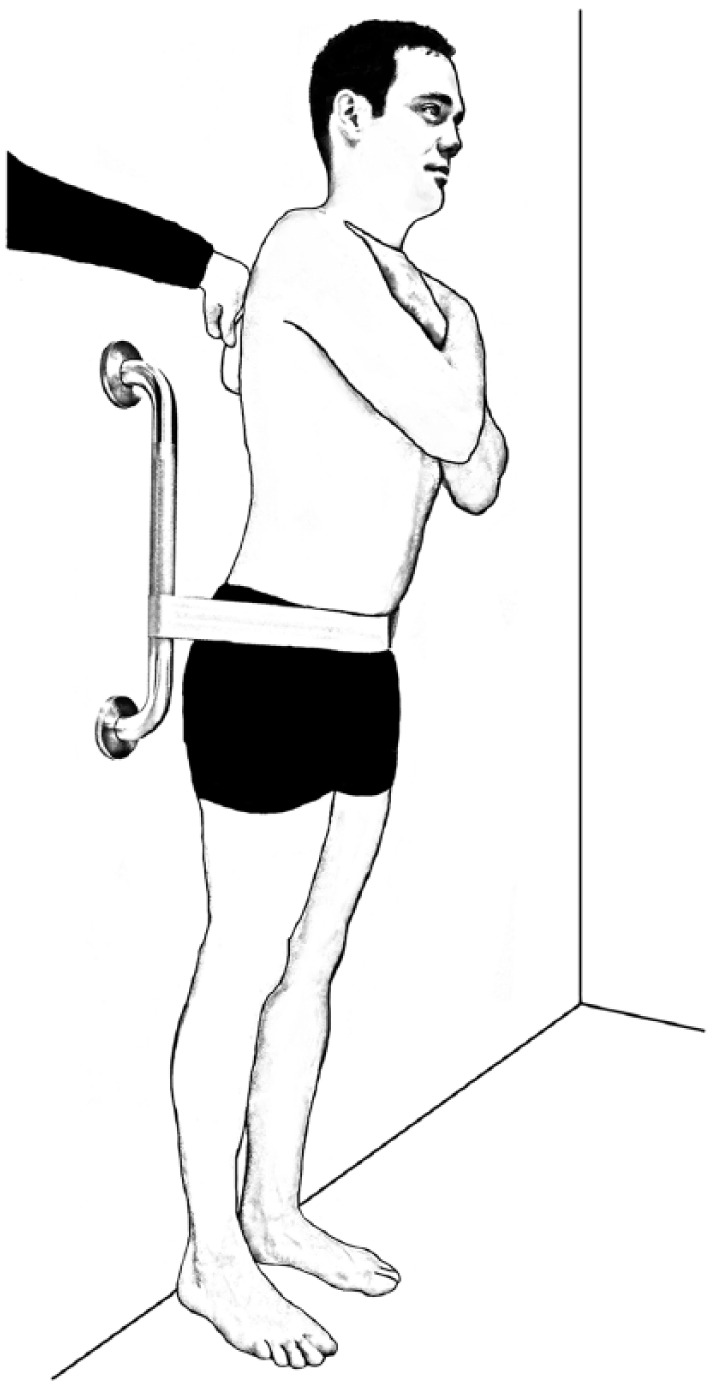
Two testing sessions were conducted, 7 days apart. Each session involved three trials of standing maximal isometric back extensor muscle strength using both the novel test and isokinetic dynamometry. Lumbar spine bone mineral density was examined by dual-energy X-ray absorptiometry. Validation was examined with Pearson correlations (). Test-retest reliability was examined with intraclass correlation coefficients and limits of agreement. Pearson correlations and intraclass correlation coefficients are presented with corresponding 95% confidence intervals. Linear regression was used to examine the ability of peak back extensor muscle strength to predict indices of lumbar spine bone mineral density and strength.
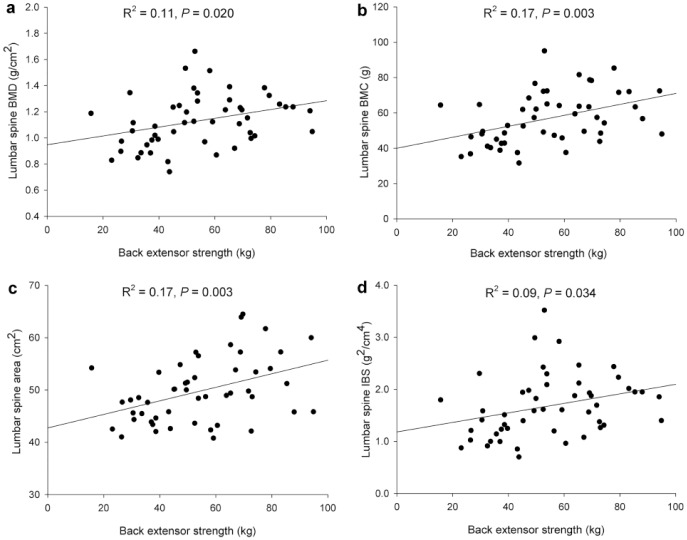
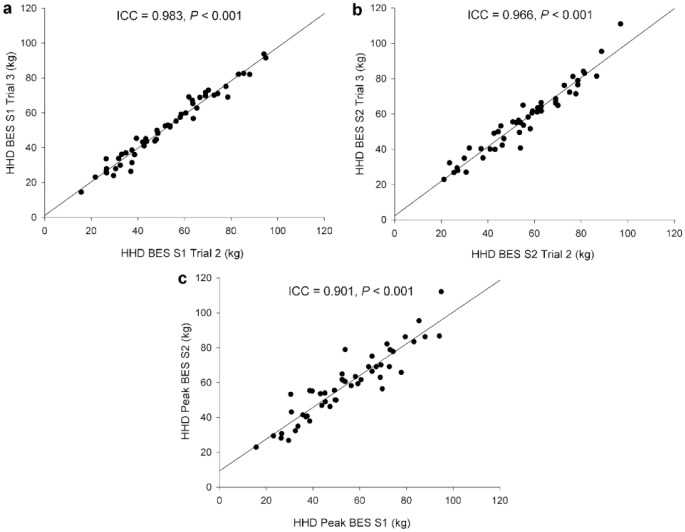
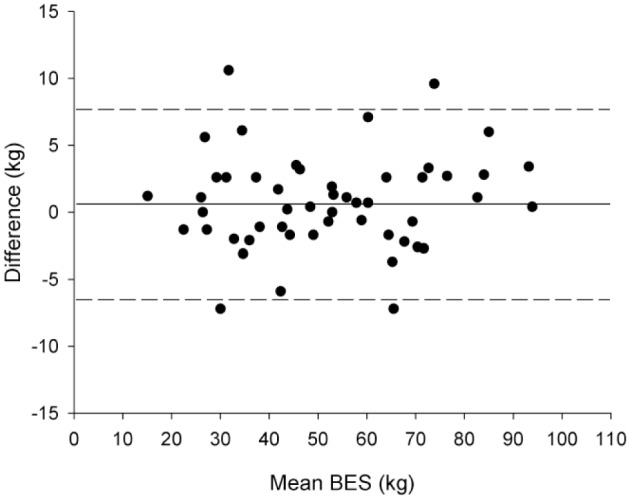
A total of 52 healthy adults (26 men, 26 women) aged 46.4 ± 20.4 years were recruited from the community. A strong positive relationship was observed between peak back extensor strength from hand-held and isokinetic dynamometry ( = 0.824, < 0.001). For the novel back extensor strength test, short- and long-term reliability was excellent (intraclass correlation coefficient = 0.983 (95% confidence interval, 0.971-0.990), < 0.001 and intraclass correlation coefficient = 0.901 (95% confidence interval, 0.833-0.943), < 0.001, respectively). Limits of agreement for short-term repeated back extensor strength measures with the novel back extensor strength protocol were -6.63 to 7.70 kg, with a mean bias of +0.71 kg. Back extensor strength predicted 11% of variance in lumbar spine bone mineral density ( < 0.05) and 9% of lumbar spine index of bone structural strength ( < 0.05).
Our novel hand-held dynamometer method to determine back extensor muscle strength is quick, relatively inexpensive, and reliable; demonstrates initial convergent validity in a healthy population; and is associated with bone mass at a clinically important site.
开发并确定一种简单且经济的临床测试方法,以量化背部伸肌力量的收敛效度和信度。
进行了两次测试,间隔7天。每次测试包括使用新型测试和等速测力法进行三次站立位最大等长背部伸肌力量测试。采用双能X线吸收法检测腰椎骨密度。通过Pearson相关性分析进行效度验证。通过组内相关系数和一致性界限分析重测信度。Pearson相关性和组内相关系数以相应的95%置信区间呈现。采用线性回归分析背部伸肌力量峰值预测腰椎骨密度和强度指标的能力。
从社区招募了52名年龄为46.4±20.4岁的健康成年人(26名男性,26名女性)。手持测力法和等速测力法测得的背部伸肌力量峰值之间存在强正相关(r = 0.824,P < 0.001)。对于新型背部伸肌力量测试,短期和长期信度均极佳(组内相关系数分别为0.983(95%置信区间,0.971 - 0.990),P < 0.001和0.901(95%置信区间,0.833 - 0.943),P < 0.001)。采用新型背部伸肌力量测试方案进行短期重复背部伸肌力量测量的一致性界限为 - 6.63至7.70 kg,平均偏差为 + 0.71 kg。背部伸肌力量可预测腰椎骨密度11%的变异(P < 0.05)和腰椎骨结构强度指数9%的变异(P < 0.05)。
我们用于测定背部伸肌力量的新型手持测力计方法快速、相对经济且可靠;在健康人群中显示出初步的收敛效度;并且与临床重要部位的骨量相关。