Institut für Theoretische Physik and IQST, Universität Ulm, Albert-Einstein-Allee 11, D-89069 Ulm, Germany.
Nat Commun. 2017 Mar 3;8:14660. doi: 10.1038/ncomms14660.
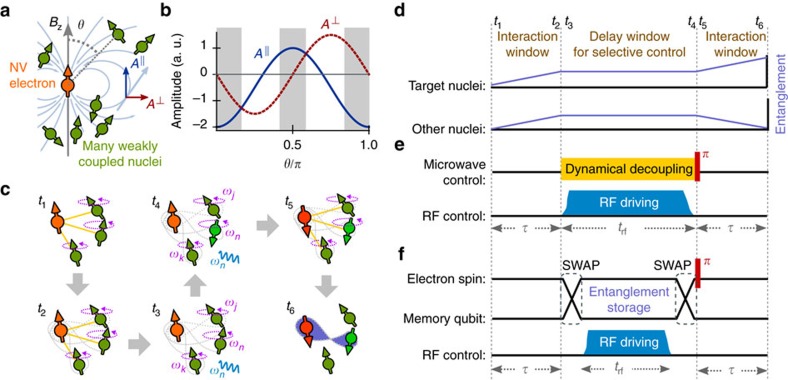
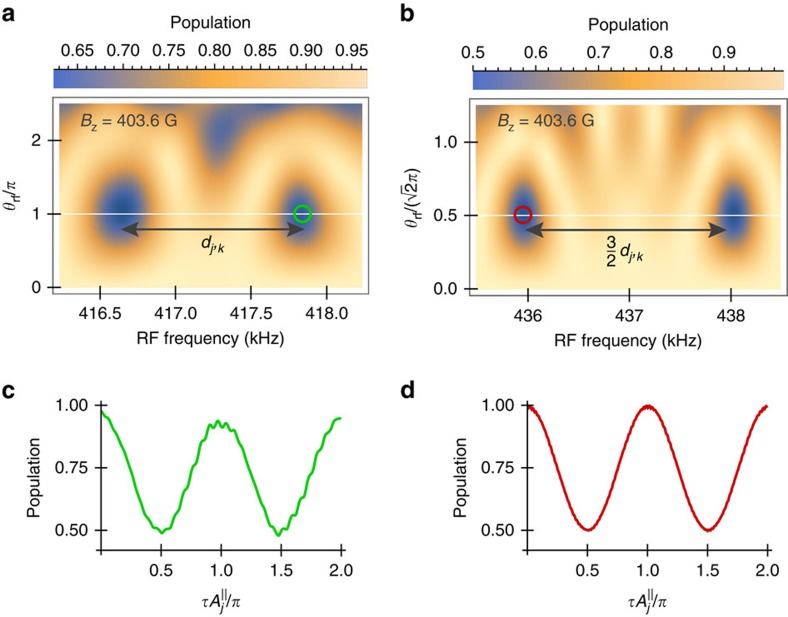
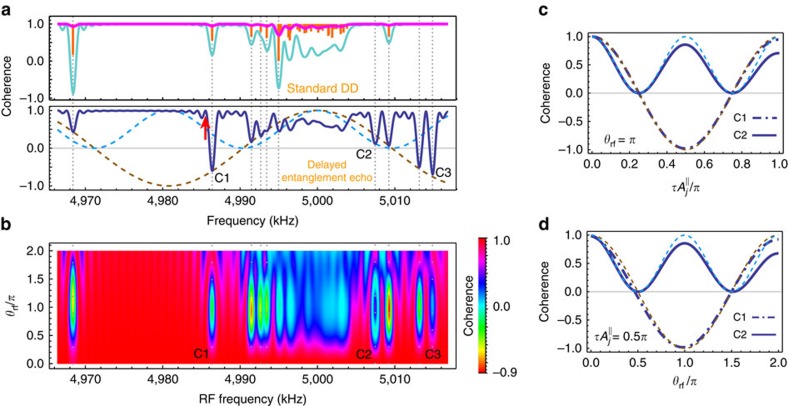
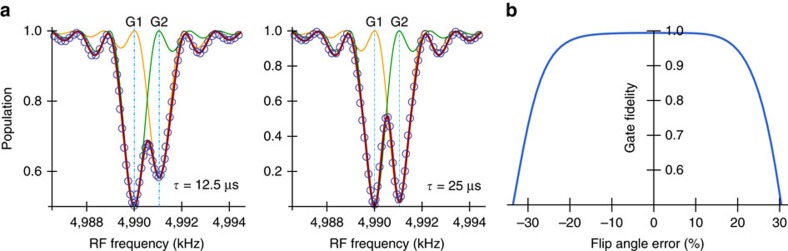
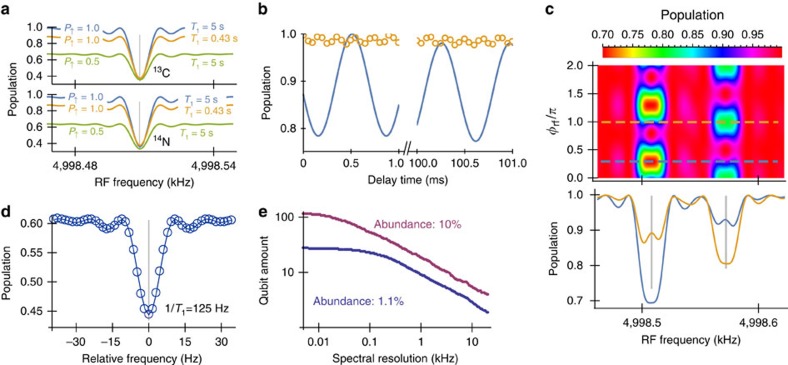
Methods to selectively detect and manipulate nuclear spins by single electrons of solid-state defects play a central role for quantum information processing and nanoscale nuclear magnetic resonance (NMR). However, with standard techniques, no more than eight nuclear spins have been resolved by a single defect centre. Here we develop a method that improves significantly the ability to detect, address and manipulate nuclear spins unambiguously and individually in a broad frequency band by using a nitrogen-vacancy (NV) centre as model system. On the basis of delayed entanglement control, a technique combining microwave and radio frequency fields, our method allows to selectively perform robust high-fidelity entangling gates between hardly resolved nuclear spins and the NV electron. Long-lived qubit memories can be naturally incorporated to our method for improved performance. The application of our ideas will increase the number of useful register qubits accessible to a defect centre and improve the signal of nanoscale NMR.
方法通过固态缺陷的单电子选择性地检测和操纵核自旋,在量子信息处理和纳米核磁共振(NMR)中起着核心作用。然而,采用标准技术,单个缺陷中心最多只能分辨出八个核自旋。在这里,我们开发了一种方法,该方法使用氮空位(NV)中心作为模型系统,显著提高了在宽频带内通过单个缺陷中心明确地、单独地检测、寻址和操纵核自旋的能力。基于延迟纠缠控制,这项结合微波和射频场的技术,我们的方法允许在几乎无法分辨的核自旋和 NV 电子之间选择性地执行稳健的高保真纠缠门。长寿命量子位存储器可以自然地纳入我们的方法中,以提高性能。我们的想法的应用将增加缺陷中心可访问的有用寄存器量子比特的数量,并提高纳米核磁共振的信号。