Sundström Johan, Bruze Gustaf, Ottosson Johan, Marcus Claude, Näslund Ingmar, Neovius Martin
From Department of Medical Sciences, Uppsala University, and Uppsala Clinical Research Center, Sweden (J.S.); Department of Medicine, Solna, Clinical Epidemiology Unit, Karolinska Institutet, Stockholm, Sweden (G.B., M.N.); Department of Surgery, Faculty of Medicine and Health, Örebro University, Sweden (J.O., I.N.); and Department of Clinical Science, Intervention and Technology, Karolinska Institutet, Stockholm, Sweden (C.M.).
Circulation. 2017 Apr 25;135(17):1577-1585. doi: 10.1161/CIRCULATIONAHA.116.025629. Epub 2017 Mar 3.
Associations of obesity with incidence of heart failure have been observed, but the causality is uncertain. We hypothesized that gastric bypass surgery leads to a lower incidence of heart failure compared with intensive lifestyle modification in obese people.
We included obese people without previous heart failure from a Swedish nationwide registry of people treated with a structured intensive lifestyle program and the Scandinavian Obesity Surgery Registry. All analyses used inverse probability weights based on baseline body mass index and a propensity score estimated from baseline variables. Treatment groups were well balanced in terms of weight, body mass index, and most potential confounders. Associations of treatment with heart failure incidence, as defined in the National Patient Register, were analyzed with Cox regression.
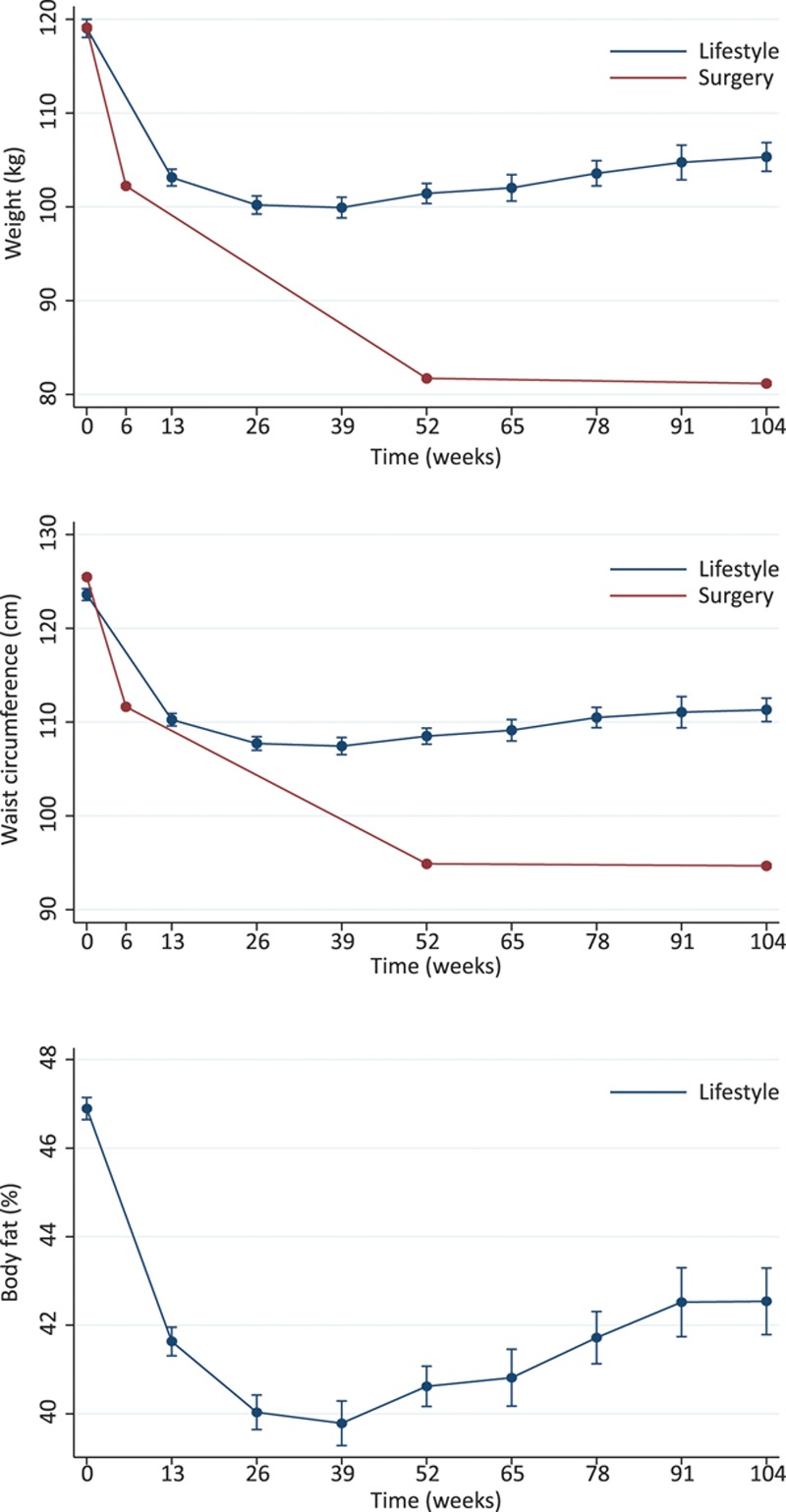
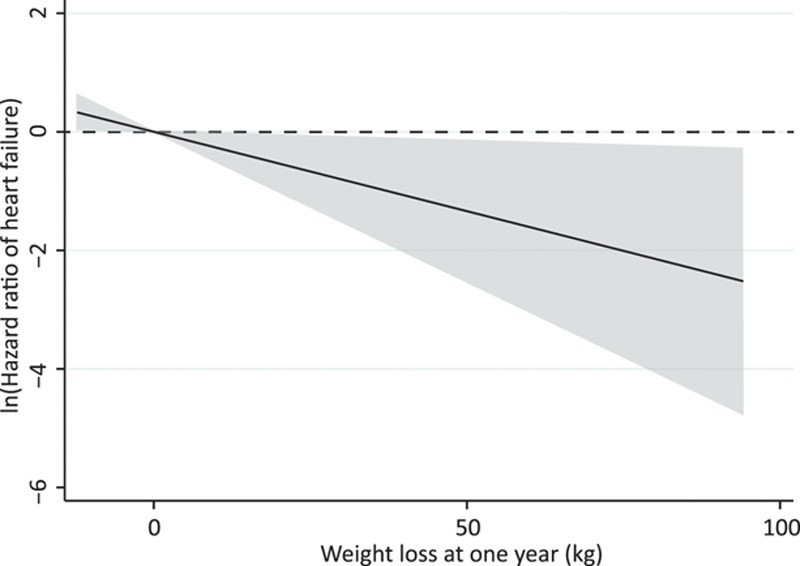
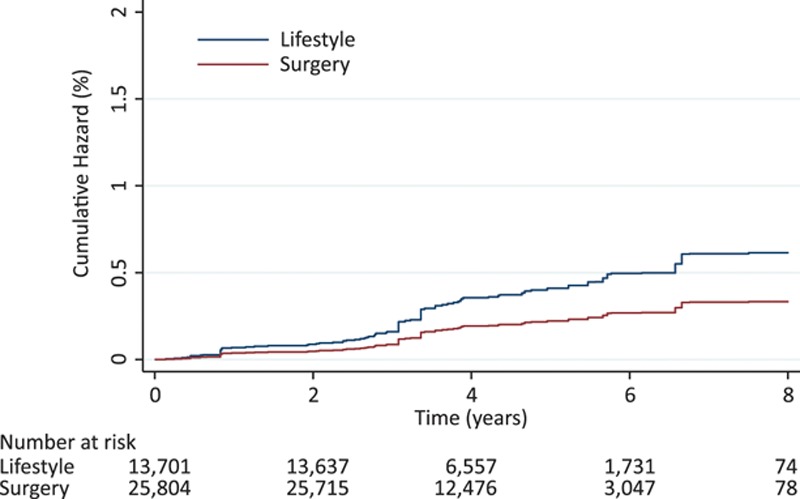
The 25 804 gastric bypass surgery patients had on average lost 18.8 kg more weight after 1 year and 22.6 kg more after 2 years than the 13 701 lifestyle modification patients. During a median of 4.1 years, surgery patients had lower heart failure incidence than lifestyle modification patients (hazard ratio, 0.54; 95% confidence interval, 0.36-0.82). A 10-kg achieved weight loss after 1 year was related to a hazard ratio for heart failure of 0.77 (95% confidence interval, 0.60-0.97) in both treatment groups combined. Results were robust in sensitivity analyses.
Gastric bypass surgery was associated with approximately one half the incidence of heart failure compared with intensive lifestyle modification in this study of 2 large nationwide registries. We also observed a graded association between increasing weight loss and decreasing risk of heart failure.
肥胖与心力衰竭发病率之间的关联已被观察到,但因果关系尚不确定。我们假设,与肥胖人群强化生活方式改变相比,胃旁路手术可降低心力衰竭的发病率。
我们纳入了瑞典全国范围内接受结构化强化生活方式计划治疗的人群登记册和斯堪的纳维亚肥胖手术登记册中既往无心力衰竭的肥胖人群。所有分析均使用基于基线体重指数和根据基线变量估计的倾向评分的逆概率权重。治疗组在体重、体重指数和大多数潜在混杂因素方面平衡良好。使用Cox回归分析治疗与国家患者登记册中定义的心力衰竭发病率之间的关联。
与13701名接受生活方式改变的患者相比,25804名接受胃旁路手术的患者在1年后平均体重多减轻了18.8kg,在2年后多减轻了22.6kg。在中位4.1年的时间里,手术患者的心力衰竭发病率低于生活方式改变患者(风险比,0.54;95%置信区间,0.36-0.82)。在两个治疗组中,1年后体重减轻10kg与心力衰竭风险比为0.77(95%置信区间,0.60-0.97)相关。敏感性分析结果稳健。
在这项对两个大型全国登记册的研究中,与强化生活方式改变相比,胃旁路手术与大约一半的心力衰竭发病率相关。我们还观察到体重减轻增加与心力衰竭风险降低之间存在分级关联。