Kakaria Kyobi S, de Bivort Benjamin L
Department of Organismic and Evolutionary Biology, Center for Brain Science, Harvard University Cambridge, MA, USA.
Front Behav Neurosci. 2017 Feb 14;11:8. doi: 10.3389/fnbeh.2017.00008. eCollection 2017.
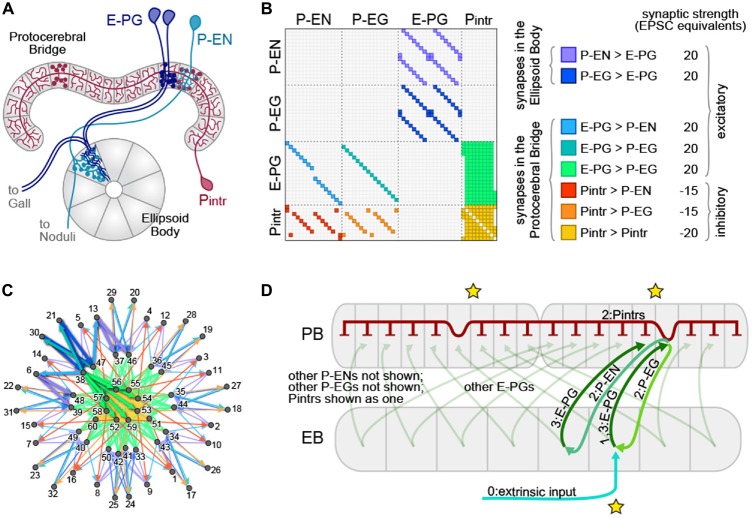
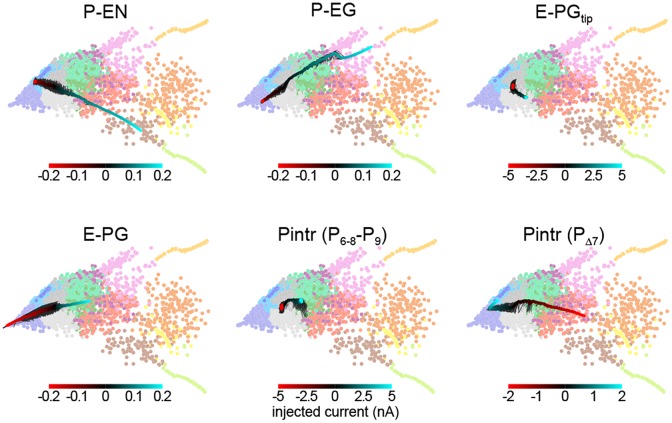
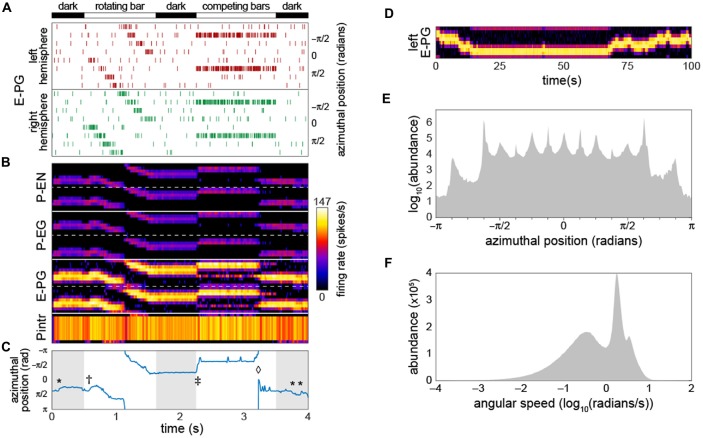
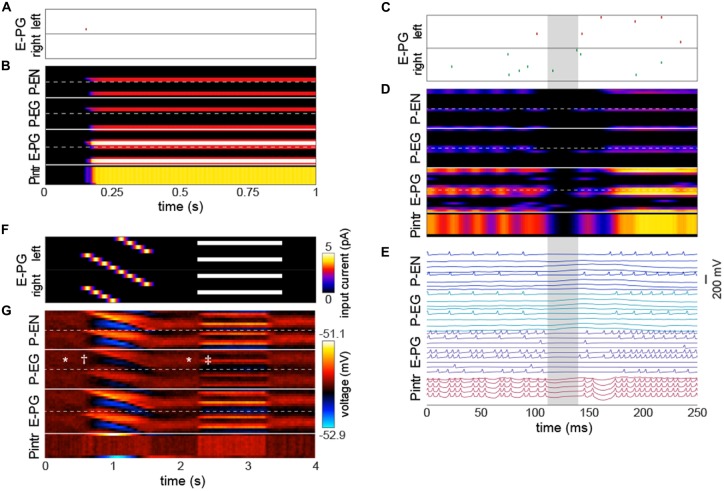
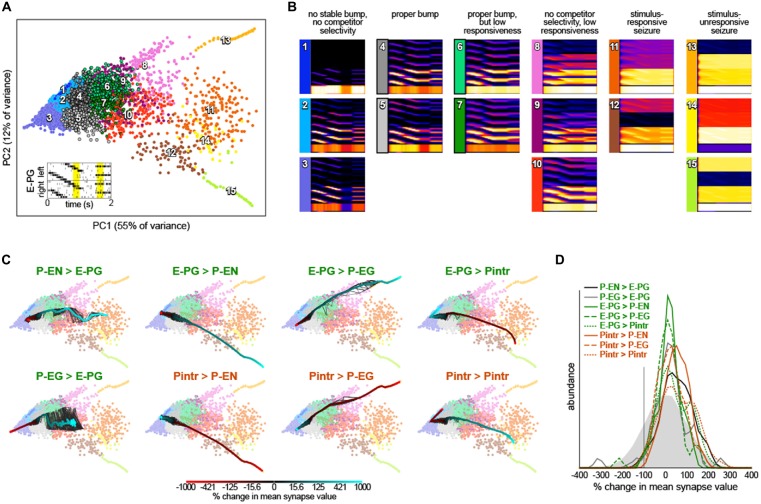
Animal navigation is accomplished by a combination of landmark-following and dead reckoning based on estimates of self motion. Both of these approaches require the encoding of heading information, which can be represented as an allocentric or egocentric azimuthal angle. Recently, Ca correlates of landmark position and heading direction, in egocentric coordinates, were observed in the ellipsoid body (EB), a ring-shaped processing unit in the fly central complex (CX; Seelig and Jayaraman, 2015). These correlates displayed key dynamics of so-called ring attractors, namely: (1) responsiveness to the position of external stimuli; (2) persistence in the absence of external stimuli; (3) locking onto a single external stimulus when presented with two competitors; (4) stochastically switching between competitors with low probability; and (5) sliding or jumping between positions when an external stimulus moves. We hypothesized that ring attractor-like activity in the EB arises from reciprocal neuronal connections to a related structure, the protocerebral bridge (PB). Using recent light-microscopy resolution catalogs of neuronal cell types in the PB (Lin et al., 2013; Wolff et al., 2015), we determined a connectivity matrix for the PB-EB circuit. When activity in this network was simulated using a leaky-integrate-and-fire model, we observed patterns of activity that closely resemble the reported Ca phenomena. All qualitative ring attractor behaviors were recapitulated in our model, allowing us to predict failure modes of the putative PB-EB ring attractor and the circuit dynamics phenotypes of thermogenetic or optogenetic manipulations. Ring attractor dynamics emerged under a wide variety of parameter configurations, even including non-spiking leaky-integrator implementations. This suggests that the ring-attractor computation is a robust output of this circuit, apparently arising from its high-level network properties (topological configuration, local excitation and long-range inhibition) rather than fine-scale biological detail.
动物导航是通过地标跟随和基于自身运动估计的航位推算相结合来完成的。这两种方法都需要对航向信息进行编码,航向信息可以表示为以环境为中心或自我为中心的方位角。最近,在果蝇中央复合体(CX)中的一个环形处理单元——椭球体(EB)中,观察到了以自我为中心坐标表示的地标位置和航向方向的钙相关信号(Seelig和Jayaraman,2015年)。这些相关信号表现出所谓环形吸引子的关键动态特性,即:(1)对外部刺激位置的响应性;(2)在没有外部刺激时的持续性;(3)当出现两个竞争刺激时锁定在单个外部刺激上;(4)以低概率在竞争刺激之间随机切换;(5)当外部刺激移动时在不同位置之间滑动或跳跃。我们假设EB中类似环形吸引子的活动源于与相关结构原脑桥(PB)的相互神经元连接。利用最近PB中神经元细胞类型的光学显微镜分辨率图谱(Lin等人,2013年;Wolff等人,2015年),我们确定了PB-EB回路的连接矩阵。当使用漏电积分发放模型模拟该网络中的活动时,我们观察到的活动模式与报道的钙现象非常相似。我们的模型再现了所有定性的环形吸引子行为,使我们能够预测假定的PB-EB环形吸引子的故障模式以及热生成或光遗传学操作的回路动态表型。即使包括非尖峰漏电积分器实现在内,在各种参数配置下都出现了环形吸引子动态。这表明环形吸引子计算是该回路的一种稳健输出,显然源于其高级网络特性(拓扑配置、局部兴奋和长程抑制)而非精细的生物学细节。