Pelossof Raphael, Fairchild Lauren, Huang Chun-Hao, Widmer Christian, Sreedharan Vipin T, Sinha Nishi, Lai Dan-Yu, Guan Yuanzhe, Premsrirut Prem K, Tschaharganeh Darjus F, Hoffmann Thomas, Thapar Vishal, Xiang Qing, Garippa Ralph J, Rätsch Gunnar, Zuber Johannes, Lowe Scott W, Leslie Christina S, Fellmann Christof
Computational Biology Program, Memorial Sloan Kettering Cancer Center, New York, New York, USA.
Tri-Institutional Training Program in Computational Biology and Medicine, New York, New York, USA.
Nat Biotechnol. 2017 Apr;35(4):350-353. doi: 10.1038/nbt.3807. Epub 2017 Mar 6.
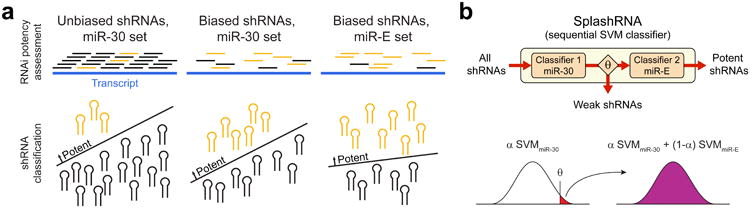
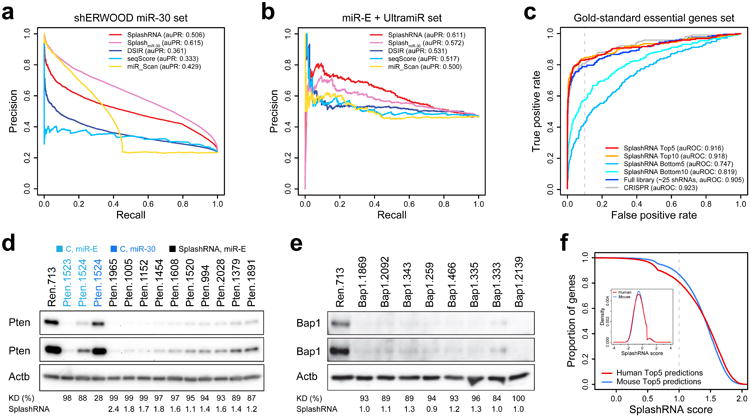
We present SplashRNA, a sequential classifier to predict potent microRNA-based short hairpin RNAs (shRNAs). Trained on published and novel data sets, SplashRNA outperforms previous algorithms and reliably predicts the most efficient shRNAs for a given gene. Combined with an optimized miR-E backbone, >90% of high-scoring SplashRNA predictions trigger >85% protein knockdown when expressed from a single genomic integration. SplashRNA can significantly improve the accuracy of loss-of-function genetics studies and facilitates the generation of compact shRNA libraries.
我们展示了SplashRNA,一种用于预测基于微小RNA的有效短发夹RNA(shRNA)的序列分类器。在已发表的数据集和新数据集上进行训练后,SplashRNA的性能优于先前的算法,能够可靠地预测给定基因的最有效shRNA。与优化的miR-E骨架相结合,当从单个基因组整合表达时,超过90%的高分SplashRNA预测可引发超过85%的蛋白质敲低。SplashRNA可以显著提高功能丧失遗传学研究的准确性,并有助于生成紧凑的shRNA文库。