Devlin H R, Au W, Foux L, Bradbury W C
Department of Microbiology, University of Toronto, Ontario, Canada.
J Clin Microbiol. 1987 Nov;25(11):2168-72. doi: 10.1128/jcm.25.11.2168-2172.1987.
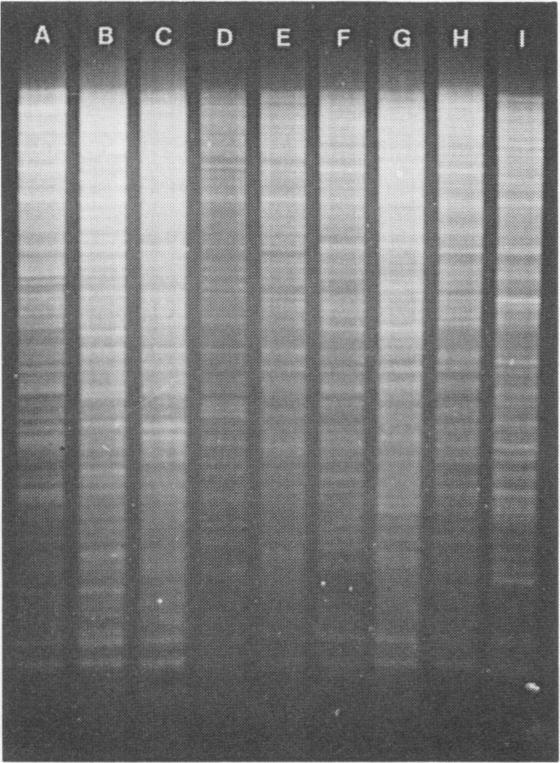
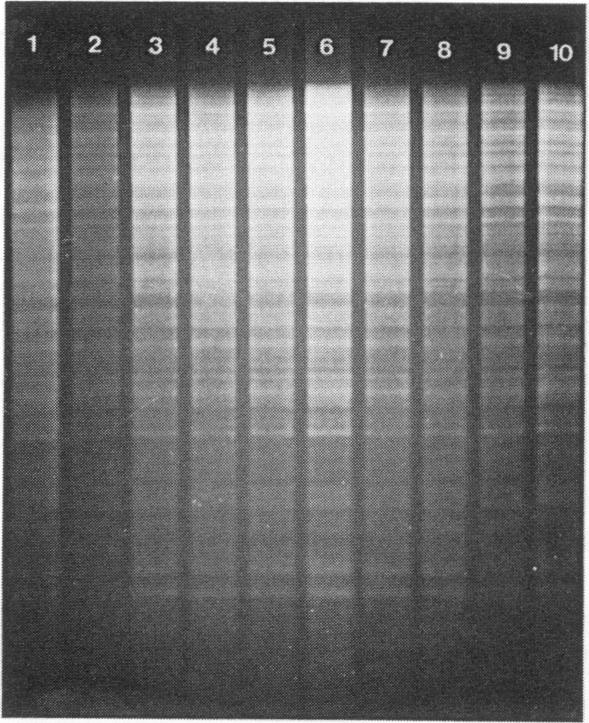
A total of 110 clinical isolates of Clostridium difficile were analyzed by agarose gel electrophoresis by using both bacterial restriction endonuclease analysis (REA) and plasmid profiles. A total of 72 isolates were divided into 12 groups according to their REA patterns. Some 38 isolates exhibited unique patterns. Pattern A occurred in 20% of isolates. Isolates with patterns B, E, and G were cytotoxin negative. The remaining groups were cytotoxin positive. Multiple isolates obtained from two stool specimens were studied to examine the variation in REA profiles found in single specimens. In these specimens no variation in REA profiles was found. The stability of C. difficile was studied by examining sequential in vitro subcultures of a single isolate and strains isolated over a 4-month period from two long-term carriers. REA patterns were stable over time, both in vitro and in vivo. Because plasmid DNA was observed in 53% of isolates, plasmid profiles alone could not be used to study the spread of C. difficile; however, they were necessary for the interpretation of REA patterns in some instances.
共对110株艰难梭菌临床分离株进行了琼脂糖凝胶电泳分析,采用细菌限制性内切酶分析(REA)和质粒图谱两种方法。根据REA模式,72株分离株被分为12组。约38株分离株呈现独特模式。模式A出现在20%的分离株中。具有模式B、E和G的分离株细胞毒素呈阴性。其余组细胞毒素呈阳性。对从两份粪便标本中获得的多个分离株进行研究,以检查单个标本中REA图谱的变化。在这些标本中未发现REA图谱有变化。通过检查单个分离株的连续体外传代培养物以及从两名长期携带者在4个月期间分离出的菌株,研究了艰难梭菌的稳定性。REA模式在体外和体内随时间均保持稳定。由于在53%的分离株中观察到了质粒DNA,仅质粒图谱不能用于研究艰难梭菌的传播;然而,在某些情况下,它们对于解释REA模式是必要的。