Hesse Raphael, Lausser Ludwig, Gummert Pauline, Schmid Florian, Wahler Anke, Schnack Cathrin, Kroker Katja S, Otto Markus, Tumani Hayrettin, Kestler Hans A, Rosenbrock Holger, von Arnim Christine A F
Department of Neurology, Ulm University, Oberer Eselsberg 45, 89081, Ulm, Germany.
Institute of Medical Systems Biology, Ulm University, Ulm, Germany.
Alzheimers Res Ther. 2017 Mar 9;9(1):17. doi: 10.1186/s13195-017-0245-y.
Alzheimer's disease (AD) is a neurodegenerative disorder, primarily affecting memory. That disorder is thought to be a consequence of neuronal network disturbances and synapse loss. Decline in cognitive function is associated with a high burden of neuropsychiatric symptoms (NPSs) such as depression. The cyclic nucleotides cyclic adenosine-3',5'-monophosphate (cAMP) and cyclic guanosine-3',5'-monophosphate (cGMP) are essential second messengers that play a crucial role in memory processing as well as synaptic plasticity and are potential therapeutic targets. Biomarkers that are able to monitor potential treatment effects and that reflect the underlying pathology are of crucial interest.
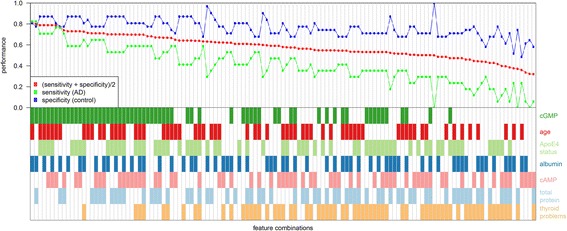
In this study, we measured cGMP and cAMP in cerebrospinal fluid (CSF) in a cohort of 133 subjects including 68 AD patients and 65 control subjects. To address the association with disease progression we correlated cognitive status with cyclic nucleotide levels. Because a high burden of NPSs is associated with decrease in cognitive function, we performed an exhaustive evaluation of AD-relevant marker combinations in a depressive subgroup.
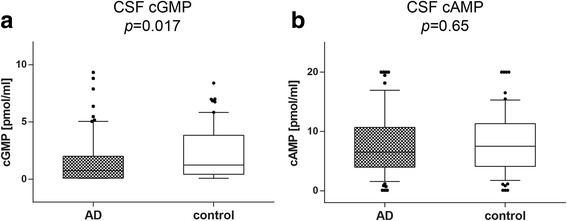
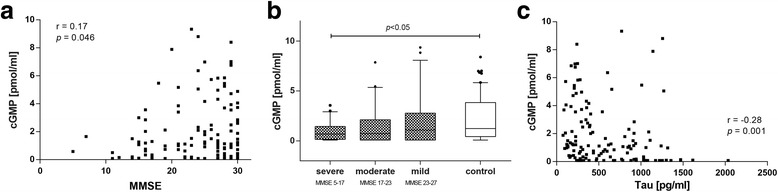
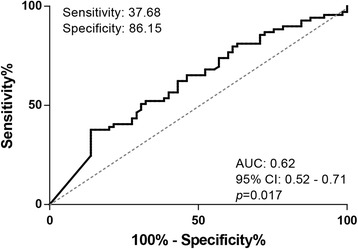
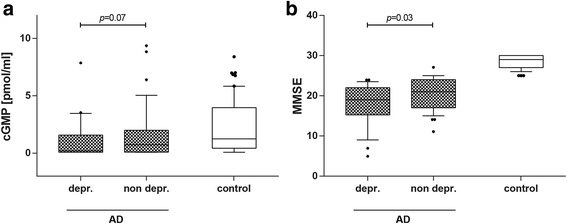
We show that cGMP, but not cAMP, levels in the CSF of AD patients are significantly reduced compared with the control group. Reduced cGMP levels in AD patients correlate with memory impairment based on Mini-Mental State Examination score (r = 0.17, p = 0.048) and tau as a marker of neurodegeneration (r = -0.28, p = 0.001). Moreover, we were able to show that AD patients suffering from current depression show reduced cGMP levels (p = 0.07) and exhibit a higher degree of cognitive impairment than non-depressed AD patients.
These results provide further evidence for an involvement of cGMP in AD pathogenesis and accompanying co-morbidities, and may contribute to elucidating synaptic plasticity alterations during disease progression.
阿尔茨海默病(AD)是一种神经退行性疾病,主要影响记忆。该疾病被认为是神经网络紊乱和突触丧失的结果。认知功能下降与诸如抑郁等神经精神症状(NPSs)的高负担相关。环核苷酸环磷酸腺苷(cAMP)和环磷酸鸟苷(cGMP)是重要的第二信使,在记忆处理以及突触可塑性中起关键作用,并且是潜在的治疗靶点。能够监测潜在治疗效果并反映潜在病理的生物标志物至关重要。
在本研究中,我们测量了133名受试者脑脊液(CSF)中的cGMP和cAMP,其中包括68名AD患者和65名对照受试者。为了探讨与疾病进展的关联,我们将认知状态与环核苷酸水平进行了相关性分析。由于NPSs的高负担与认知功能下降相关,我们在抑郁亚组中对与AD相关的标志物组合进行了详尽评估。
我们发现,与对照组相比,AD患者脑脊液中的cGMP水平显著降低,而cAMP水平未降低。AD患者中降低的cGMP水平与基于简易精神状态检查表评分的记忆损害相关(r = 0.17,p = 0.048),并且与作为神经退行性变标志物的tau相关(r = -0.28,p = 0.001)。此外,我们能够表明,目前患有抑郁症的AD患者cGMP水平降低(p = 0.07),并且与未患抑郁症的AD患者相比表现出更高程度的认知损害。
这些结果为cGMP参与AD发病机制及伴随的合并症提供了进一步证据,并且可能有助于阐明疾病进展过程中的突触可塑性改变。