Manion Maura, Andrade Bruno B, DerSimonian Rebecca, Gu Wenjuan, Rupert Adam, Musselwhite Laura W, Sierra-Madero Juan G, Belaunzaran-Zamudio Pablo F, Sanne Ian, Lederman Michael M, Sereti Irini
National Institute of Allergy and Infectious Diseases , National Institutes of Health (NIH) , Bethesda , MD , USA.
Unidade de Medicina Investigativa, Laboratório Integrado de Microbiologia e Imunorregulação, Centro de Pesquisas Gonçalo Moniz, Fundação Oswaldo Cruz, Salvador, Brazil; Multinational Organization Network Sponsoring Translational and Epidemiological Research (MONSTER) Initiative, Fundação José Silveira, Salvador, Brazil; Curso de Medicina, Faculdade de Tecnologia e Ciências (FTC), Salvador, Brazil.
J Virus Erad. 2017 Jan 1;3(1):24-33. doi: 10.1016/S2055-6640(20)30696-9.
Inflammation and coagulation biomarkers are independent predictors of morbidity and mortality in HIV-infected patients. The impact of country of residence on these biomarkers is unknown and was investigated in persons at similar stages of HIV infection.
Cryopreserved plasma specimens were analysed from 267 ART-naive patients with CD4 cell counts <100 cells/μl from Mexico (=124) and South Africa (=143). Biomarkers were compared and dimension reduction analyses were performed to highlight biosignatures according to nationality, gender and tuberculosis co-infection.
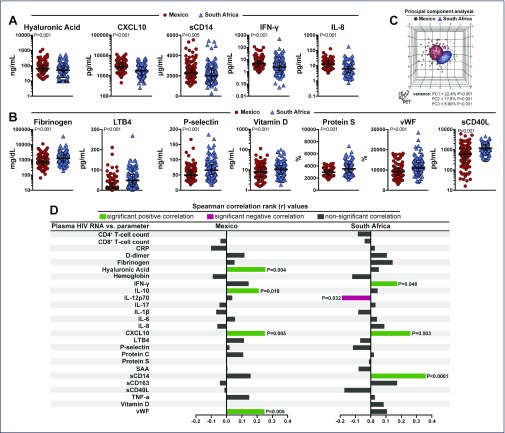
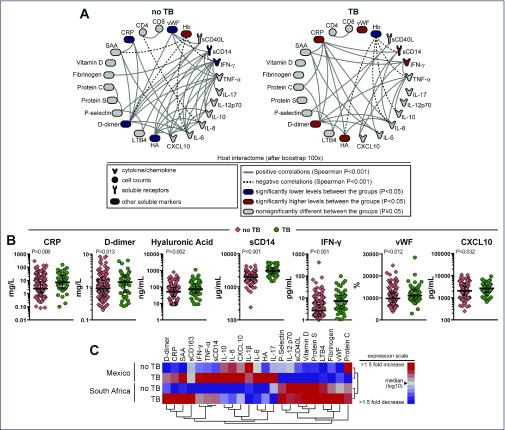
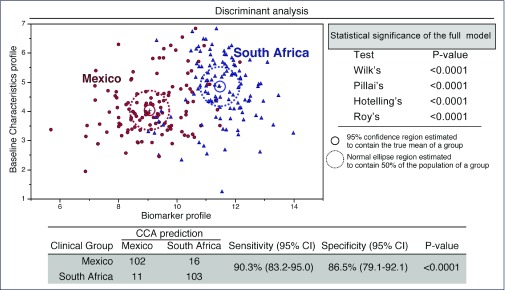
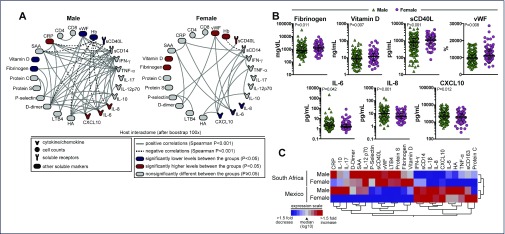
Mexican patients were significantly different from South Africans with regard to age, gender, CD4 cell count, haemoglobin, presence of AIDS-defining illness and prevalence of active tuberculosis. After adjusting for baseline characteristics, patients from Mexico had higher levels of IFN-γ, IL-8, and CXCL-10 whereas patients from South Africa had higher levels of fibrinogen, LTB4, P-selectin, protein S, and sCD40 ligand. The effect of country on the profile of biomarker expression was stronger than gender differences and tuberculosis co-infection.
Inflammation and coagulation biomarkers vary significantly by country. Further studies are needed to evaluate how these differences may contribute to HIV pathogenesis and prognosis in diverse populations and how they can be accounted for in studies using biomarkers as surrogate end points.
炎症和凝血生物标志物是HIV感染患者发病和死亡的独立预测指标。居住国对这些生物标志物的影响尚不清楚,本研究在处于相似HIV感染阶段的人群中对此进行了调查。
对来自墨西哥(=124例)和南非(=143例)的267例CD4细胞计数<100个/μl且未接受抗逆转录病毒治疗的患者的冷冻血浆标本进行分析。比较生物标志物,并进行降维分析以突出根据国籍、性别和结核合并感染情况的生物特征。
墨西哥患者与南非患者在年龄、性别、CD4细胞计数、血红蛋白、艾滋病定义疾病的存在情况和活动性结核患病率方面存在显著差异。在对基线特征进行调整后,来自墨西哥的患者IFN-γ、IL-8和CXCL-10水平较高,而来自南非的患者纤维蛋白原、LTB4、P-选择素、蛋白S和sCD40配体水平较高。国家对生物标志物表达谱的影响强于性别差异和结核合并感染情况。
炎症和凝血生物标志物因国家不同而有显著差异。需要进一步研究以评估这些差异如何可能影响不同人群中的HIV发病机制和预后,以及在将生物标志物用作替代终点的研究中如何解释这些差异。