Cronce Jessica M, Bedard-Gilligan Michele A, Zimmerman Lindsey, Hodge Kimberley A, Kaysen Debra
Department of Psychology & Behavioral Sciences, School of Medicine, University of Washington, Seattle, Washington, USA.
Obesity (Silver Spring). 2017 Apr;25(4):801-806. doi: 10.1002/oby.21809. Epub 2017 Mar 9.
Sexual-minority women are at elevated risk for obesity, as well as exposure to traumatic events. Rates of obesity are elevated in individuals with posttraumatic stress disorder (PTSD), but little is known about why this relationship exists. Behavioral mechanisms, such as eating patterns and alcohol use, are possible explanations that would be clinically useful to identify.
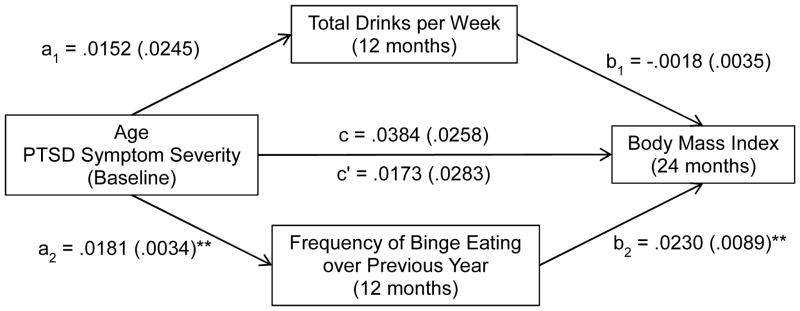
Binge eating and alcohol use were longitudinally investigated as mediators of the relationship between PTSD symptom severity and body mass index (BMI) in a large sample of young-adult, sexual-minority women (N = 425). PTSD symptom severity was assessed at baseline, binge eating and alcohol use were assessed 12 months later, and BMI was assessed 24 months after baseline.
Using a multiple mediator model, higher baseline PTSD symptom severity was found to be significantly associated with higher BMI 2 years later, operating through binge-eating behavior but not through alcohol use. Exploratory moderator analyses found that this effect was higher for those with lower baseline BMI.
Results suggest that higher PTSD symptoms are longitudinally associated with increased BMI and that binge eating behavior is one factor that explains this relationship.
性少数群体女性肥胖风险较高,且易遭受创伤性事件。创伤后应激障碍(PTSD)患者的肥胖率也较高,但这种关系存在的原因尚不清楚。饮食模式和饮酒等行为机制可能是其原因,识别这些机制具有临床实用价值。
在一大群年轻的性少数群体女性(N = 425)中,纵向研究暴饮暴食和饮酒作为PTSD症状严重程度与体重指数(BMI)之间关系的中介因素。在基线时评估PTSD症状严重程度,12个月后评估暴饮暴食和饮酒情况,基线24个月后评估BMI。
使用多重中介模型发现,较高的基线PTSD症状严重程度与2年后较高的BMI显著相关,这一关联通过暴饮暴食行为而非饮酒产生。探索性调节分析发现,对于基线BMI较低的人,这种影响更大。
结果表明,较高的PTSD症状与BMI升高存在纵向关联,暴饮暴食行为是解释这种关系的一个因素。