Soule Eric K, Maloney Sarah F, Guy Mignonne C, Eissenberg Thomas, Fagan Pebbles
Department of Psychology, Virginia Commonwealth University.
Department of African American Studies, Virginia Commonwealth University.
Psychol Addict Behav. 2017 May;31(3):343-353. doi: 10.1037/adb0000263. Epub 2017 Mar 9.
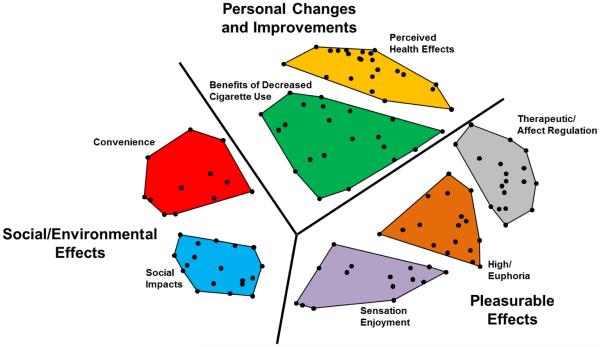
Electronic cigarette (ECIG) use is growing in popularity, but little is known about the perceived positive outcomes of ECIG use. This study used concept mapping (CM) to examine positive ECIG outcome expectancies. Sixty-three past 30-day ECIG users (38.1% female) between the ages of 18 and 64 (M = 37.8, SD = 13.3) completed a CM module. In an online program, participants provided statements that completed a prompt: "A specific positive, enjoyable, or exciting effect (i.e., physical or psychological) that I have experienced WHILE USING or IMMEDIATELY AFTER USING an electronic cigarette/electronic vaping device is. . . ." Participants (n = 35) sorted 123 statements into "piles" of similar content and rated (n = 43) each statement on a 7-point scale (1 = Definitely NOT a positive effect to 7 = Definitely a positive effect). A cluster map was created using data from the sorting task, and analysis indicated a 7 cluster model of positive ECIG use outcome expectancies: Therapeutic/Affect Regulation, High/Euphoria, Sensation Enjoyment, Perceived Health Effects, Benefits of Decreased Cigarette Use, Convenience, and Social Impacts. The Perceived Health Effects cluster was rated highest, although all mean ratings were greater than 4.69. Mean cluster ratings were compared, and females, younger adults, past 30-day cigarette smokers, users of more "advanced" ECIG devices, and nonlifetime (less than 100 lifetime cigarettes) participants rated certain clusters higher than comparison groups (ps < 0.05). ECIG users associate positive outcomes with ECIG use. ECIG outcome expectancies may affect product appeal and tobacco use behaviors and should be examined further to inform regulatory policies. (PsycINFO Database Record
电子烟的使用越来越普遍,但人们对电子烟使用所带来的预期积极效果知之甚少。本研究采用概念映射法(CM)来探究电子烟使用的积极预期结果。63名年龄在18至64岁之间(M = 37.8,标准差 = 13.3)、过去30天内使用过电子烟的用户(38.1%为女性)完成了一个概念映射模块。在一个在线程序中,参与者提供了完成以下提示的陈述:“我在使用电子烟/电子雾化设备时或使用后立即体验到的一种特定的积极、愉悦或兴奋的效果(即身体或心理上的)是……”参与者(n = 35)将123条陈述分类到内容相似的“堆”中,并(n = 43)对每条陈述进行7分制评分(1 = 绝对不是积极效果至7 = 绝对是积极效果)。利用分类任务的数据创建了一个聚类图,分析表明电子烟使用积极预期结果的7聚类模型:治疗/情绪调节、兴奋/欣快感、感官享受、感知健康影响、减少吸烟的益处、便利性和社会影响。感知健康影响聚类的评分最高,尽管所有平均评分都大于4.69。对聚类平均评分进行了比较,女性、年轻成年人、过去30天内吸烟的人、使用更“高级”电子烟设备的用户以及非终身(终身吸烟少于100支)参与者对某些聚类的评分高于对照组(p值 < 0.05)。电子烟使用者将积极结果与电子烟使用联系起来。电子烟的预期结果可能会影响产品吸引力和烟草使用行为,应进一步研究以为监管政策提供信息。(《心理学文摘数据库记录》