Teh Irvin, McClymont Darryl, Zdora Marie-Christine, Whittington Hannah J, Davidoiu Valentina, Lee Jack, Lygate Craig A, Rau Christoph, Zanette Irene, Schneider Jürgen E
Division of Cardiovascular Medicine, Radcliffe Department of Medicine, University of Oxford, Oxford, UK.
Leeds Institute of Cardiovascular & Metabolic Medicine, University of Leeds, Leeds, UK.
J Cardiovasc Magn Reson. 2017 Mar 10;19(1):31. doi: 10.1186/s12968-017-0342-x.
Diffusion tensor imaging (DTI) is widely used to assess tissue microstructure non-invasively. Cardiac DTI enables inference of cell and sheetlet orientations, which are altered under pathological conditions. However, DTI is affected by many factors, therefore robust validation is critical. Existing histological validation is intrinsically flawed, since it requires further tissue processing leading to sample distortion, is routinely limited in field-of-view and requires reconstruction of three-dimensional volumes from two-dimensional images. In contrast, synchrotron radiation imaging (SRI) data enables imaging of the heart in 3D without further preparation following DTI. The objective of the study was to validate DTI measurements based on structure tensor analysis of SRI data.
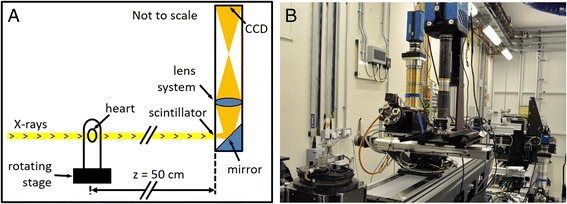
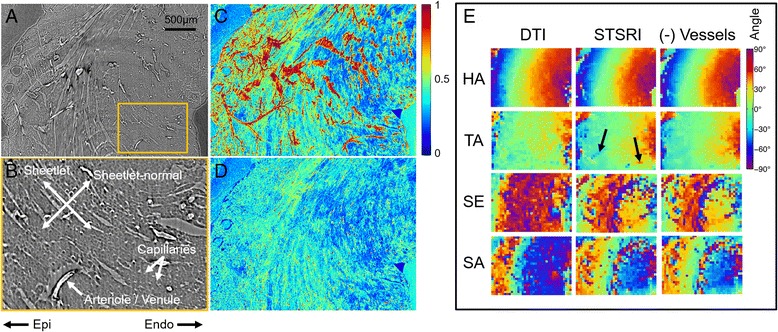
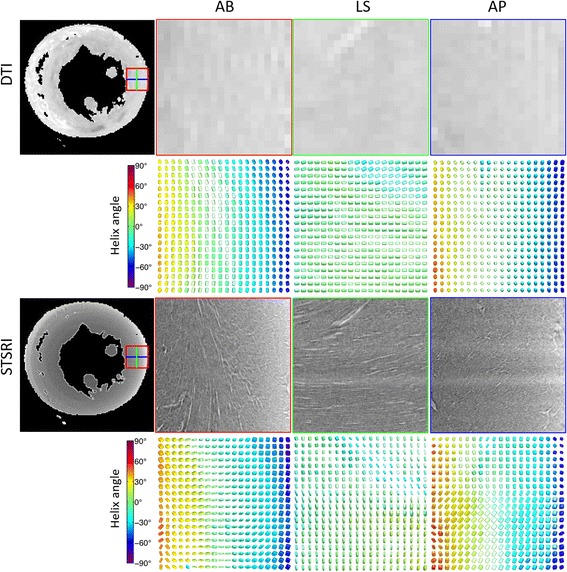
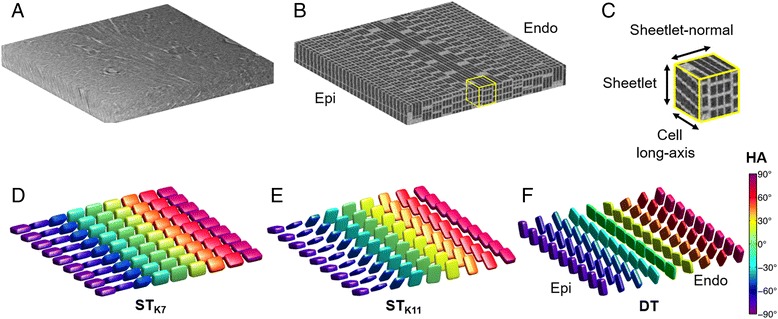
One isolated, fixed rat heart was imaged ex vivo with DTI and X-ray phase contrast SRI, and reconstructed at 100 μm and 3.6 μm isotropic resolution respectively. Structure tensors were determined from the SRI data and registered to the DTI data.
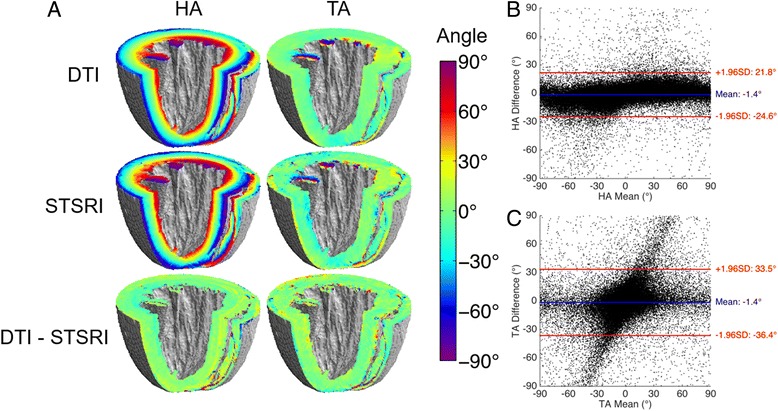
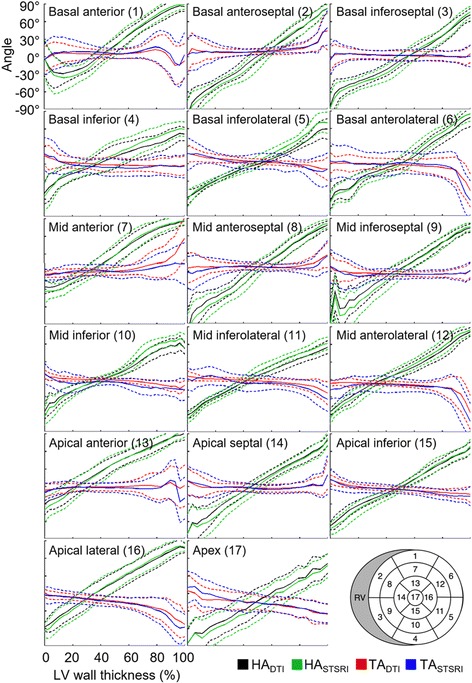
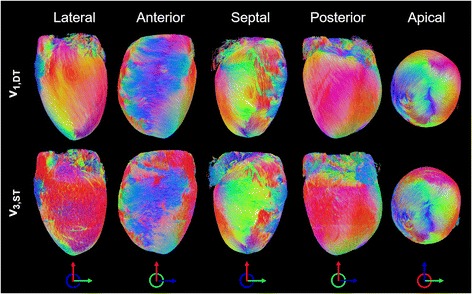
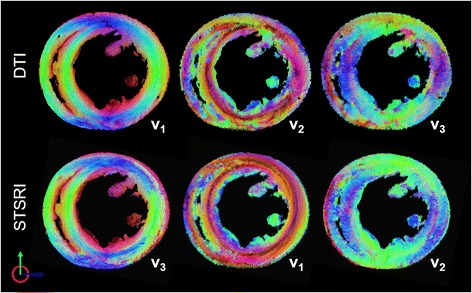
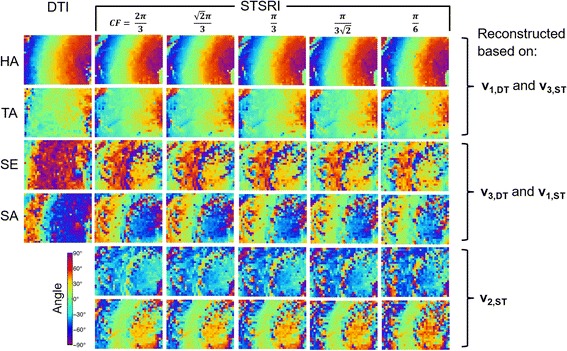
Excellent agreement in helix angles (HA) and transverse angles (TA) was observed between the DTI and structure tensor synchrotron radiation imaging (STSRI) data, where HA = -1.4° ± 23.2° and TA = -1.4° ± 35.0° (mean ± 1.96 standard deviation across all voxels in the left ventricle). STSRI confirmed that the primary eigenvector of the diffusion tensor corresponds with the cardiomyocyte long-axis across the whole myocardium.
We have used STSRI as a novel and high-resolution gold standard for the validation of DTI, allowing like-with-like comparison of three-dimensional tissue structures in the same intact heart free of distortion. This represents a critical step forward in independently verifying the structural basis and informing the interpretation of cardiac DTI data, thereby supporting the further development and adoption of DTI in structure-based electro-mechanical modelling and routine clinical applications.
扩散张量成像(DTI)被广泛用于无创评估组织微观结构。心脏DTI能够推断细胞和心肌薄片的方向,这些方向在病理条件下会发生改变。然而,DTI受多种因素影响,因此可靠的验证至关重要。现有的组织学验证存在内在缺陷,因为它需要进一步的组织处理,这会导致样本变形,在视野上通常受到限制,并且需要从二维图像重建三维体积。相比之下,同步辐射成像(SRI)数据能够在DTI之后无需进一步准备即可对心脏进行三维成像。本研究的目的是基于SRI数据的结构张量分析来验证DTI测量结果。
对一个离体固定的大鼠心脏进行体外DTI和X射线相衬SRI成像,并分别以100μm和3.6μm各向同性分辨率进行重建。从SRI数据中确定结构张量,并将其与DTI数据配准。
在DTI和结构张量同步辐射成像(STSRI)数据之间观察到螺旋角(HA)和横向角(TA)具有极好的一致性,其中HA = -1.4°±23.2°,TA = -1.4°±35.0°(左心室所有体素的平均值±1.96标准差)。STSRI证实,扩散张量的主特征向量与整个心肌中的心肌细胞长轴相对应。
我们已将STSRI用作验证DTI的一种新颖且高分辨率的金标准,能够在同一完整且无变形的心脏中对三维组织结构进行同类比较。这代表了在独立验证结构基础并为心脏DTI数据的解释提供依据方面向前迈出的关键一步,从而支持DTI在基于结构的机电建模和常规临床应用中的进一步发展和应用。