Garcia-Baccino Carolina A, Legarra Andres, Christensen Ole F, Misztal Ignacy, Pocrnic Ivan, Vitezica Zulma G, Cantet Rodolfo J C
Departamento de Producción Animal, Facultad de Agronomía, Universidad de Buenos Aires, C1417DSE, Buenos Aires, Argentina.
Instituto de Investigaciones en Producción Animal - Consejo Nacional de Investigaciones Científicas y Técnicas, Buenos Aires, Argentina.
Genet Sel Evol. 2017 Mar 10;49(1):34. doi: 10.1186/s12711-017-0309-2.
Metafounders are pseudo-individuals that encapsulate genetic heterozygosity and relationships within and across base pedigree populations, i.e. ancestral populations. This work addresses the estimation and usefulness of metafounder relationships in single-step genomic best linear unbiased prediction (ssGBLUP).
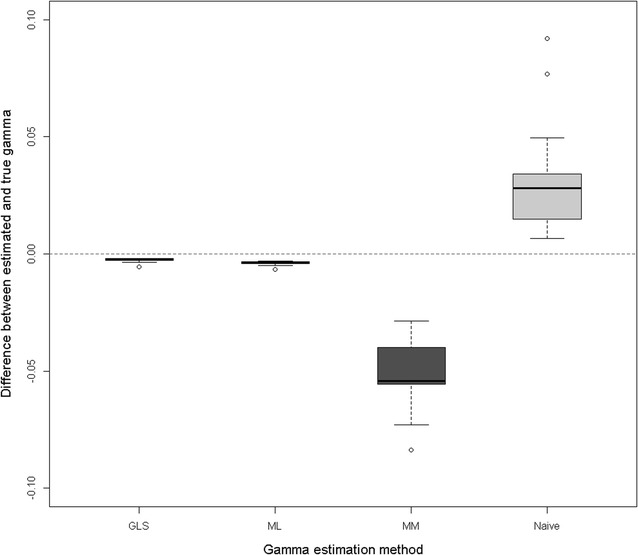
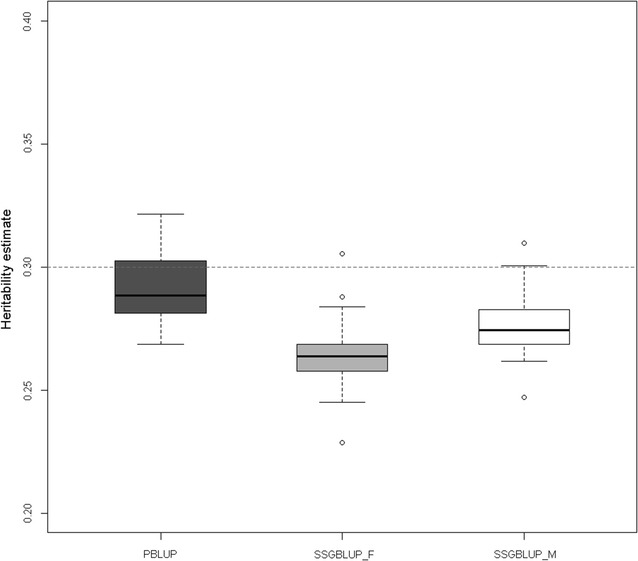
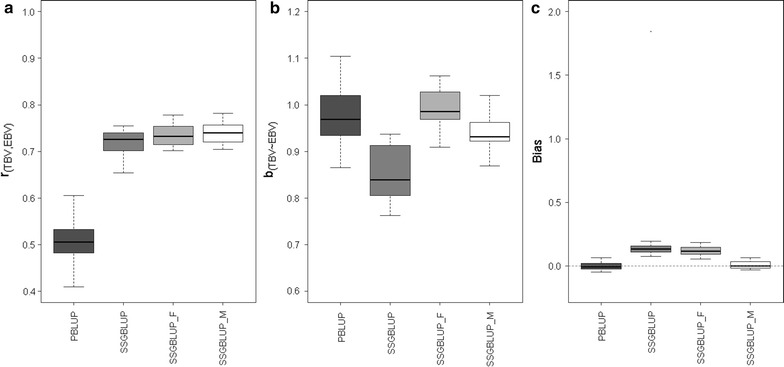
We show that ancestral relationship parameters are proportional to standardized covariances of base allelic frequencies across populations, such as [Formula: see text] fixation indexes. These covariances of base allelic frequencies can be estimated from marker genotypes of related recent individuals and pedigree. Simple methods for their estimation include naïve computation of allele frequencies from marker genotypes or a method of moments that equates average pedigree-based and marker-based relationships. Complex methods include generalized least squares (best linear unbiased estimator (BLUE)) or maximum likelihood based on pedigree relationships. To our knowledge, methods to infer [Formula: see text] coefficients from marker data have not been developed for related individuals. We derived a genomic relationship matrix, compatible with pedigree relationships, that is constructed as a cross-product of {-1,0,1} codes and that is equivalent (apart from scale factors) to an identity-by-state relationship matrix at genome-wide markers. Using a simulation with a single population under selection in which only males and youngest animals are genotyped, we observed that generalized least squares or maximum likelihood gave accurate and unbiased estimates of the ancestral relationship parameter (true value: 0.40) whereas the naïve method and the method of moments were biased (average estimates of 0.43 and 0.35). We also observed that genomic evaluation by ssGBLUP using metafounders was less biased in terms of estimates of genetic trend (bias of 0.01 instead of 0.12), resulted in less overdispersed (0.94 instead of 0.99) and as accurate (0.74) estimates of breeding values than ssGBLUP without metafounders and provided consistent estimates of heritability.
Estimation of metafounder relationships can be achieved using BLUP-like methods with pedigree and markers. Inclusion of metafounder relationships reduces bias of genomic predictions with no loss in accuracy.
元奠基者是一种伪个体,它概括了基础谱系群体(即祖先群体)内部以及跨群体的遗传杂合性和关系。本研究探讨了单步基因组最佳线性无偏预测(ssGBLUP)中元奠基者关系的估计及其用途。
我们表明,祖先关系参数与群体间基础等位基因频率的标准化协方差成比例,例如[公式:见正文]固定指数。这些基础等位基因频率的协方差可以从相关近期个体的标记基因型和谱系中估计出来。其估计的简单方法包括从标记基因型中简单计算等位基因频率,或一种使基于谱系的平均关系与基于标记的关系相等的矩估计法。复杂方法包括广义最小二乘法(最佳线性无偏估计器(BLUE))或基于谱系关系的最大似然法。据我们所知,尚未针对相关个体开发从标记数据推断[公式:见正文]系数的方法。我们推导了一个与谱系关系兼容的基因组关系矩阵,它被构建为{-1,0,1}编码的叉积,并且(除比例因子外)与全基因组标记处的同状态关系矩阵等效。在一个仅对雄性和最年轻动物进行基因分型的选择下单群体模拟中,我们观察到广义最小二乘法或最大似然法给出了祖先关系参数的准确且无偏估计(真实值:0.40),而简单方法和矩估计法存在偏差(平均估计值分别为0.43和0.35)。我们还观察到,与不使用元奠基者的ssGBLUP相比,使用元奠基者的ssGBLUP进行基因组评估在遗传趋势估计方面偏差更小(偏差为0.01而非0.12),导致育种值估计的过度离散程度更低(0.94而非0.99)且同样准确(0.74),并提供了一致的遗传力估计值。
可以使用类似BLUP的方法结合谱系和标记来估计元奠基者关系。纳入元奠基者关系可减少基因组预测的偏差且不损失准确性。