National Institute of Infectious Diseases Evandro Chagas, Laboratory of Clinical Epidemiology, Oswaldo Cruz Foundation, Av. Brasil, 4036 sala 201 A - Manguinhos, Rio de Janeiro, CEP: 21040-361, Brazil.
Oswaldo Cruz Institute, Instituto Oswaldo Cruz - Pavilhão Hélio e Peggy Pereira, Flavivirus Laboratory, Oswaldo Cruz Foundation, Avenida Brasil, 4365, Manguinhos, Rio de Janeiro, CEP: 21040-900, Brazil.
BMC Infect Dis. 2017 Mar 11;17(1):204. doi: 10.1186/s12879-017-2306-z.
Dengue is an acute febrile illness considered the major arboviral disease in terms of morbidity, mortality, economic impact and dissemination worldwide. Brazil accounts for the highest notification rate, with circulation of all four dengue serotypes. The NS1 antigen is a dengue highly conserved specific soluble glycoprotein essential for viral replication and viability that can be detected 0 to 18 days from the onset of fever (peak first 3 days). It induces a strong humoral response and is known as a complement-fixing antigen. Lower NS1 test sensitivity occurs in secondary dengue infections probably due to immune complex formation impairing antigen detection by ELISA.
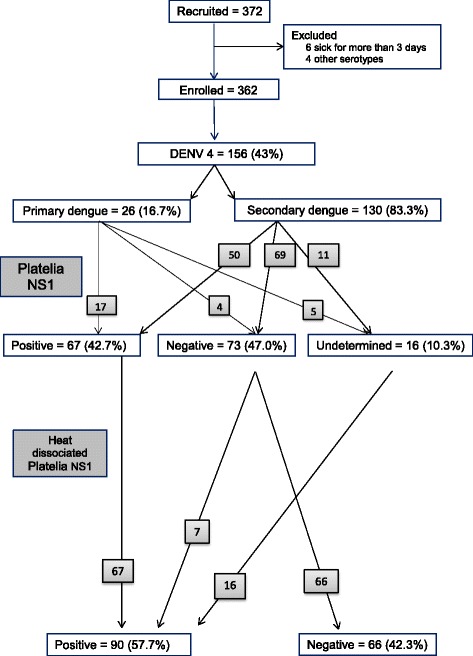
We compared the sensitivity of NS1 ELISA in heat dissociated and non-dissociated samples from 156 RT-PCR confirmed acute dengue-4 cases from 362 prospectively enrolled patients.
Secondary infections accounted for 83.3% of cases. NS1 ELISA was positive in 42.5% and indeterminate in 10.2% of dengue-4 cases. After heat dissociation, 7 negative and 16 indeterminate samples turned positive, increasing the overall test sensitivity to 57.7%.
Although it is time consuming and requires the use of specific laboratory equipment, NS1 ELISA combined with heat dissociation could be a slightly better alternative for triage in suspected dengue cases.
登革热是一种急性发热性疾病,就发病率、死亡率、经济影响和全球传播而言,被认为是主要的虫媒病毒病。巴西的通报率最高,存在所有四种登革热血清型的循环。NS1 抗原是一种高度保守的登革热特异性可溶性糖蛋白,对病毒复制和存活至关重要,可在发热后 0 至 18 天(发病首 3 天内)检测到。它诱导强烈的体液免疫反应,被称为补体结合抗原。在继发感染中,NS1 检测的敏感性较低,可能是由于免疫复合物的形成,从而通过 ELISA 检测到抗原的能力受损。
我们比较了 156 例经逆转录聚合酶链反应(RT-PCR)确诊的急性登革热 4 型病例(来自 362 例前瞻性入组患者)的热解离和未解离样本中 NS1 ELISA 的敏感性。
继发感染占病例的 83.3%。42.5%的登革热 4 型病例 NS1 ELISA 阳性,10.2%的病例 NS1 ELISA 不确定。热解离后,7 个阴性和 16 个不确定的样本转为阳性,总体检测敏感性提高至 57.7%。
尽管耗时且需要使用特定的实验室设备,但 NS1 ELISA 结合热解离可能是疑似登革热病例分诊的略好选择。