Brown N A, Liu C R, Wang Y F, Garcia C R
Department of Pediatrics, University of California, Los Angeles School of Medicine 90024.
J Virol. 1988 Mar;62(3):962-9. doi: 10.1128/JVI.62.3.962-969.1988.
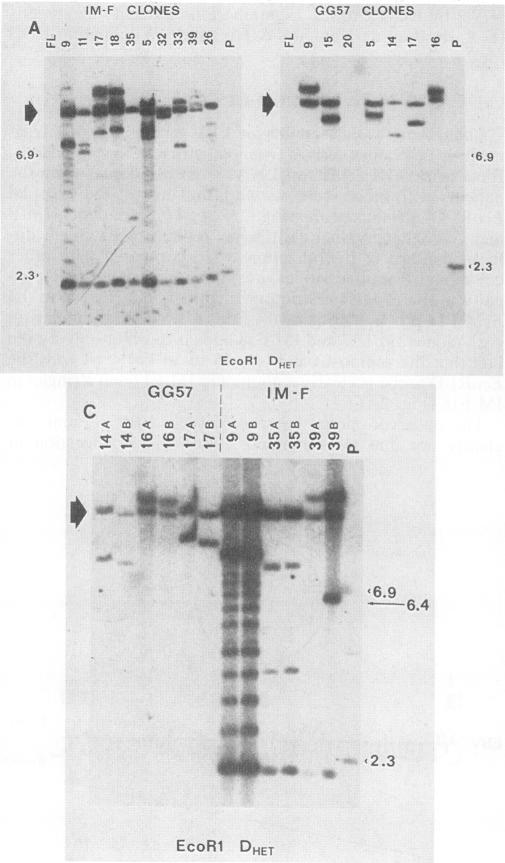
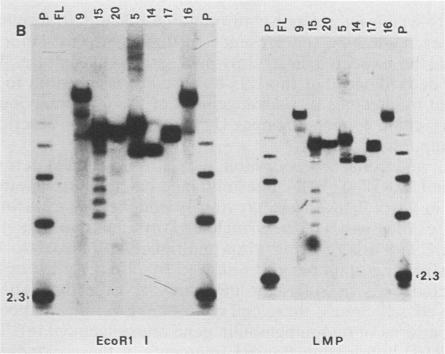
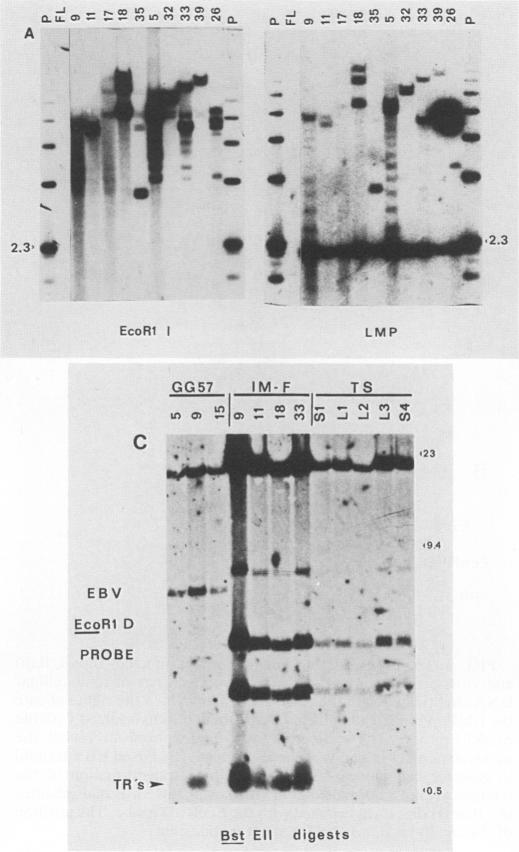
We analyzed 17 B-cell lineages cloned from two patients with infectious mononucleosis and found that different B-cell lineages exhibited notable variation in the length of the fused Epstein-Barr virus (EBV) terminal region on intracellular EBV episomes. EBV termini in different B-cell clones from the same person differed by as many as 15 to 20 reiterations of the ca. 500-base-pair terminal repeat sequence. In contrast, analysis of seven B-cell lineages cloned from a patient with a fatal, oligoclonal lymphoma revealed that three of the cell clones had the same-sized EBV terminal region. These three clones had previously been shown, by immunoglobulin gene analysis, to be metastatic daughter cells descended from a common progenitor. Similarity of the EBV terminal regions in the three daughter clones suggested that EBV infected the progenitor cell before proliferation and metastasis. Individual, EBV-infected cells from a single individual showed sufficient heterogeneity in their EBV termini to allow use of terminal fragment size as a clonal marker in studies addressing the contribution of EBV to the clonal pathogenesis of tumors with which this virus has been associated.
我们分析了从两名传染性单核细胞增多症患者身上克隆得到的17个B细胞谱系,发现不同的B细胞谱系在细胞内EB病毒(EBV)附加体上融合的EBV末端区域长度上表现出显著差异。同一个人的不同B细胞克隆中的EBV末端,其约500个碱基对的末端重复序列的重复次数相差多达15至20次。相比之下,对一名患有致命性寡克隆淋巴瘤患者克隆得到的7个B细胞谱系进行分析发现,其中三个细胞克隆具有相同大小的EBV末端区域。通过免疫球蛋白基因分析,先前已证明这三个克隆是源自共同祖细胞的转移性子代细胞。三个子代克隆中EBV末端区域的相似性表明,EBV在增殖和转移之前就感染了祖细胞。来自单个个体的单个EBV感染细胞在其EBV末端表现出足够的异质性,从而能够在研究EBV对与该病毒相关的肿瘤克隆发病机制的贡献时,将末端片段大小用作克隆标记。