Amor Antonio J, Serra-Mir Mercè, Martínez-González Miguel A, Corella Dolores, Salas-Salvadó Jordi, Fitó Montserrat, Estruch Ramón, Serra-Majem Lluis, Arós Fernando, Babio Nancy, Ros Emilio, Ortega Emilio
Lipid Clinic, Department of Endocrinology and Nutrition, Institut d'Investigacions Biomèdiques August Pi Sunyer (IDIBAPS), Hospital Clínic, University of Barcelona, Spain.
Centro de Investigación Biomédica en Red Fisiopatología de la Obesidad y Nutrición (CIBEROBN), Instituto de Salud Carlos III (ISCIII), Madrid, Spain.
J Am Heart Assoc. 2017 Mar 13;6(3):e004803. doi: 10.1161/JAHA.116.004803.
The usefulness of cardiovascular disease (CVD) predictive equations in different populations is debatable. We assessed the efficacy of the Framingham-REGICOR scale, validated for the Spanish population, to identify future CVD in participants, who were predefined as being at high-risk in the PREvención con DIeta MEDiterránea (PREDIMED) study-a nutrition-intervention primary prevention trial-and the impact of adherence to the Mediterranean diet on CVD across risk categories.
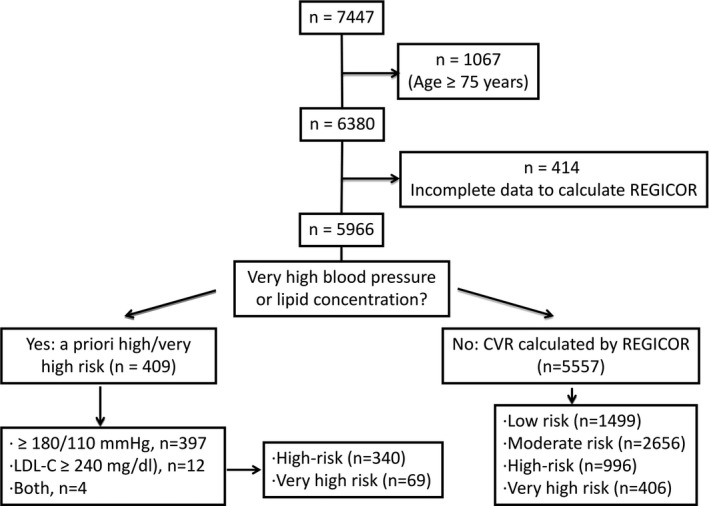
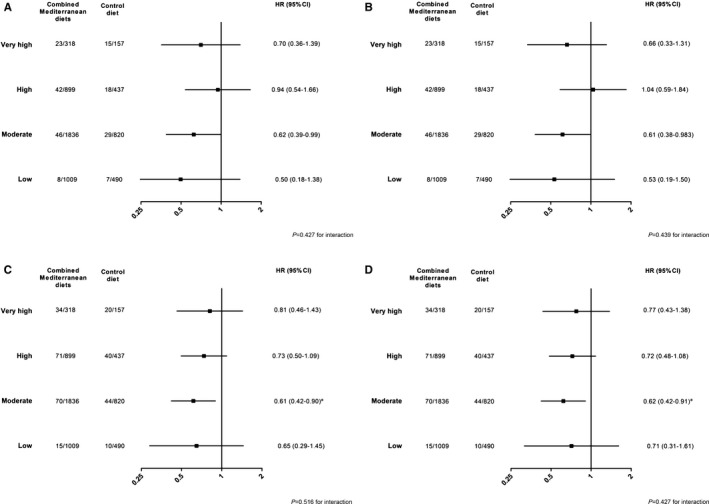
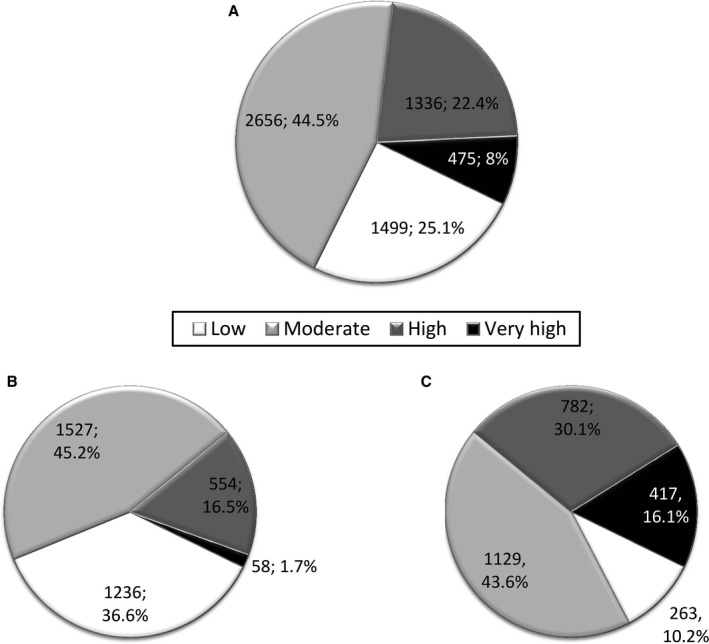
In a post hoc analysis, we assessed the CVD predictive value of baseline estimated risk in 5966 PREDIMED participants (aged 55-74 years, 57% women; 48% with type 2 diabetes mellitus). Major CVD events, the primary PREDIMED end point, were an aggregate of myocardial infarction, stroke, and cardiovascular death. Multivariate-adjusted Cox regression was used to calculate hazard ratios for major CVD events and effect modification from the Mediterranean diet intervention across risk strata (low, moderate, high, very high). The Framingham-REGICOR classification of PREDIMED participants was 25.1% low risk, 44.5% moderate risk, and 30.4% high or very high risk. During 6-year follow-up, 188 major CVD events occurred. Hazard ratios for major CVD events increased in parallel with estimated risk (2.68, 4.24, and 6.60 for moderate, high, and very high risk), particularly in men (7.60, 13.16, and 15.85, respectively, versus 2.16, 2.28, and 3.51, respectively, in women). Yet among those with low or moderate risk, 32.2% and 74.3% of major CVD events occurred in men and women, respectively. Mediterranean diet adherence was associated with CVD risk reduction regardless of risk strata (>0.4 for interaction).
Incident CVD increased in parallel with estimated risk in the PREDIMED cohort, but most events occurred in non-high-risk categories, particularly in women. Until predictive tools are improved, promotion of the Mediterranean diet might be useful to reduce CVD independent of baseline risk.
URL: http://www.Controlled-trials.com. Unique identifier: ISRCTN35739639.
心血管疾病(CVD)预测方程在不同人群中的实用性存在争议。我们评估了针对西班牙人群验证的弗雷明汉-REGICOR量表在识别参与者未来发生CVD方面的效能,这些参与者在预防地中海饮食(PREDIMED)研究(一项营养干预初级预防试验)中被预先定义为高危人群,以及坚持地中海饮食对不同风险类别的CVD的影响。
在一项事后分析中,我们评估了5966名PREDIMED参与者(年龄55 - 74岁,57%为女性;48%患有2型糖尿病)基线估计风险的CVD预测价值。主要CVD事件是PREDIMED的主要终点,包括心肌梗死、中风和心血管死亡的总和。使用多变量调整的Cox回归计算主要CVD事件的风险比以及地中海饮食干预在不同风险分层(低、中、高、非常高)中的效应修正。PREDIMED参与者的弗雷明汉-REGICOR分类为25.1%低风险、