Kobayashi Toshiyuki, Yokokawa Hirohide, Fujibayashi Kazutoshi, Haniu Tomomi, Hisaoka Teruhiko, Fukuda Hiroshi, Naito Toshio
Toshiyuki Kobayashi, Department of General Medicine, Zama General Hospital, Kanagawa 252-0011, Japan.
World J Cardiol. 2017 Feb 26;9(2):174-181. doi: 10.4330/wjc.v9.i2.174.
To investigate the association between carotid atherosclerosis and cystatin C (CysC) and to determine the optimal CysC cut-off value.
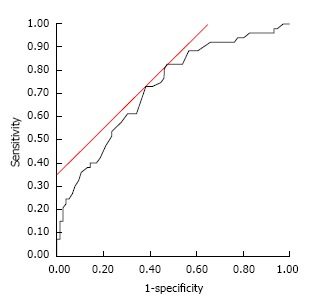
One hundred twenty-eight subjects were included in this study. Atherosclerosis was defined as a maximum carotid plaque thickness (MCPT) of greater than 2 mm. A receiver operating characteristic curve analysis was used to determine the diagnostic value of serum CysC for atherosclerosis. The subjects were divided into two groups according to the CysC cut-off value. We screened for diabetes, hypertension, dyslipidemia, smoking status, alcohol consumption, and exercise behavior. The association between atherosclerosis and CysC levels was assessed using multivariate analysis.
The subjects were then divided into two groups according to the CysC cut-off value (0.73 mg/L). The median age of the high CysC group was 72 years (85% males), whereas that of the low CysC group was 61 years (63% males). The CysC levels were significantly correlated with Cr and estimated glomerular filtration rate (eGFR) values. Body-mass index, visceral fat area, hypertension, diabetes mellitus, and MCPT were significantly higher in the high CysC group than in the low CysC group. Furthermore, the eGFR was significantly lower in the high CysC group. Regarding lifestyle habits, only the exercise level was lower in the high CysC group than in the low CysC group. Multivariate analysis, adjusted for age and sex, revealed that high CysC levels were significantly associated with an MCPT of ≥ 2 mm (odds ratio: 2.92; 95%CI: 1.13-7.99).
Higher CysC levels were associated with an MCPT of ≥ 2 mm. The CysC cut-off value of 0.73 mg/L appears to aid in the diagnosis of atherosclerosis.
研究颈动脉粥样硬化与胱抑素C(CysC)之间的关联,并确定CysC的最佳截断值。
本研究纳入了128名受试者。动脉粥样硬化定义为最大颈动脉斑块厚度(MCPT)大于2mm。采用受试者工作特征曲线分析来确定血清CysC对动脉粥样硬化的诊断价值。根据CysC截断值将受试者分为两组。我们筛查了糖尿病、高血压、血脂异常、吸烟状况、饮酒情况和运动行为。使用多变量分析评估动脉粥样硬化与CysC水平之间的关联。
然后根据CysC截断值(0.73mg/L)将受试者分为两组。高CysC组的中位年龄为72岁(男性占85%),而低CysC组的中位年龄为61岁(男性占63%)。CysC水平与肌酐和估算肾小球滤过率(eGFR)值显著相关。高CysC组的体重指数、内脏脂肪面积、高血压、糖尿病和MCPT均显著高于低CysC组。此外,高CysC组的eGFR显著更低。关于生活习惯,只有高CysC组的运动水平低于低CysC组。在对年龄和性别进行校正的多变量分析中,发现高CysC水平与MCPT≥2mm显著相关(比值比:2.92;95%置信区间:1.13 - 7.99)。
较高的CysC水平与MCPT≥2mm相关。0.73mg/L的CysC截断值似乎有助于动脉粥样硬化的诊断。