Coelho Lara E, Ribeiro Sayonara R, Japiassu Andre M, Moreira Ronaldo I, Lara Priscila C, Veloso Valdilea G, Grinsztejn Beatriz, Luz Paula M
Instituto Nacional de Infectologia Evandro Chagas, Fundação Oswaldo Cruz (FIOCRUZ), Rio de Janeiro, Brazil.
J Acquir Immune Defic Syndr. 2017 Aug 1;75(4):e90-e98. doi: 10.1097/QAI.0000000000001352.
The 30-day readmission rate is an indicator of the quality of hospital care and transition to the outpatient setting. Recent studies suggest HIV infection might increase the risk of readmission although estimates of 30-day readmission rates are unavailable among HIV-infected individuals living in middle/low-income settings. Additionally, factors that may increase readmission risk in HIV-infected populations are poorly understood.
Thirty-day readmission rates were estimated for HIV-infected adults from the Instituto Nacional de Infectologia Evandro Chagas/Fiocruz cohort in Rio de Janeiro, Brazil, from January 2007 to December 2013. Cox regression models were used to evaluate factors associated with the risk of 30-day readmission.
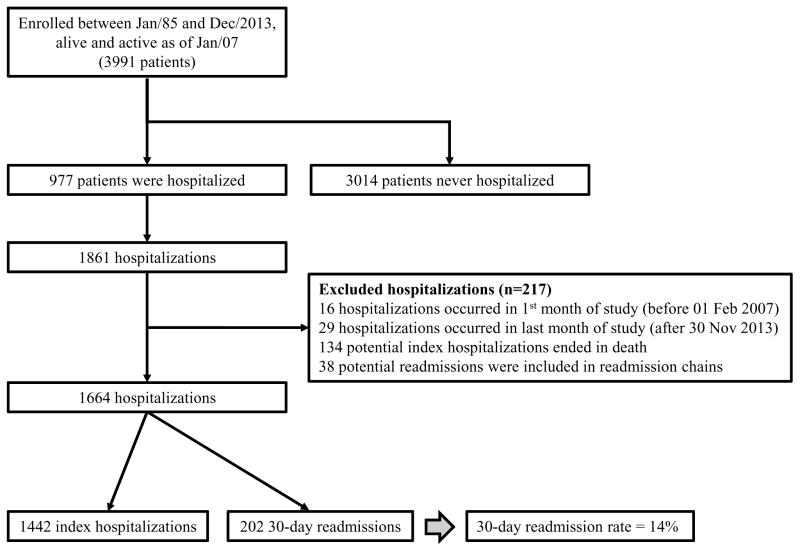
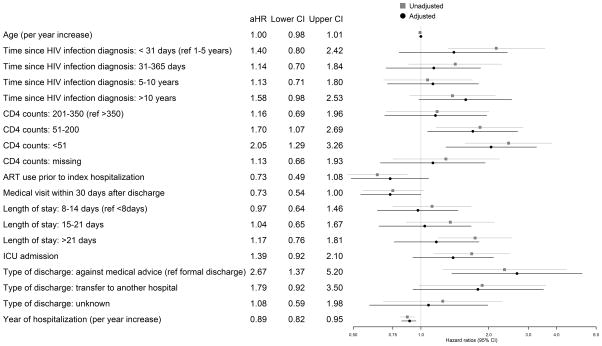
Between January 2007 and December 2013, 3991 patients were followed and 1861 hospitalizations were observed. The estimated 30-day readmission rate was 14% (95% confidence interval: 12.3 to 15.9). Attending a medical visit within 30 days after discharge (adjusted hazard ratio [aHR] = 0.73, P = 0.048) and being hospitalized in more recent calendar years (aHR = 0.89, P = 0.002) reduced the risk of 30-day readmission. In contrast, low CD4 counts (51-200 cells/mm³: aHR = 1.70, P = 0.024 and ≤ 50 cells/mm³: aHR = 2.05, P = 0.003), time since HIV infection diagnosis ≥10 years (aHR = 1.58, P = 0.058), and leaving hospital against medical advice (aHR = 2.67, P = 0.004) increased the risk of 30-day readmission.
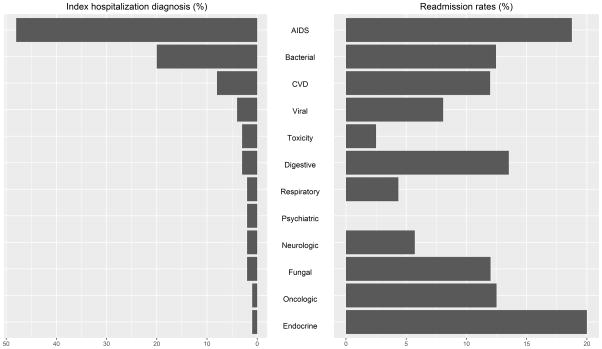
Patients with advanced HIV/AIDS are most at risk of readmission and should be targeted with prevention strategies to reduce this risk. Efforts to reduce discharge against medical advice and to promote early postdischarge medical visit would likely reduce 30-day readmission rates in our population.
30天再入院率是医院护理质量及向门诊环境过渡情况的一项指标。近期研究表明,艾滋病毒感染可能会增加再入院风险,不过,在中低收入环境下生活的艾滋病毒感染者中,尚无30天再入院率的相关估计数据。此外,艾滋病毒感染人群中可能增加再入院风险的因素也鲜为人知。
对2007年1月至2013年12月期间巴西里约热内卢埃万德罗·查加斯国家传染病研究所/奥斯瓦尔多·克鲁兹基金会队列中的艾滋病毒感染成人进行30天再入院率估计。采用Cox回归模型评估与30天再入院风险相关的因素。
2007年1月至2013年12月期间,对3991例患者进行了随访,观察到1861次住院情况。估计的30天再入院率为14%(95%置信区间:12.3至15.9)。出院后30天内就诊(调整后风险比[aHR]=0.73,P=0.048)以及在最近几个日历年住院(aHR=0.89,P=0.002)可降低30天再入院风险。相比之下,低CD4细胞计数(51 - 200个细胞/mm³:aHR=1.70,P=0.024;≤50个细胞/mm³:aHR=2.05,P=0.003)、自艾滋病毒感染诊断后时间≥10年(aHR=1.58,P=0.058)以及违反医嘱出院(aHR=2.67,P=0.004)会增加30天再入院风险。
晚期艾滋病毒/艾滋病患者再入院风险最高,应针对其采取预防策略以降低这种风险。努力减少违反医嘱出院情况并促进出院后早期就诊可能会降低我们研究人群的30天再入院率。