Hygum Thomas L, Fobian Dannie, Kamilari Maria, Jørgensen Aslak, Schiøtt Morten, Grosell Martin, Møbjerg Nadja
Section for Cell Biology and Physiology, Department of Biology, University of Copenhagen Copenhagen, Denmark.
Centre for Social Evolution, Department of Biology, University of Copenhagen Copenhagen, Denmark.
Front Physiol. 2017 Feb 28;8:95. doi: 10.3389/fphys.2017.00095. eCollection 2017.
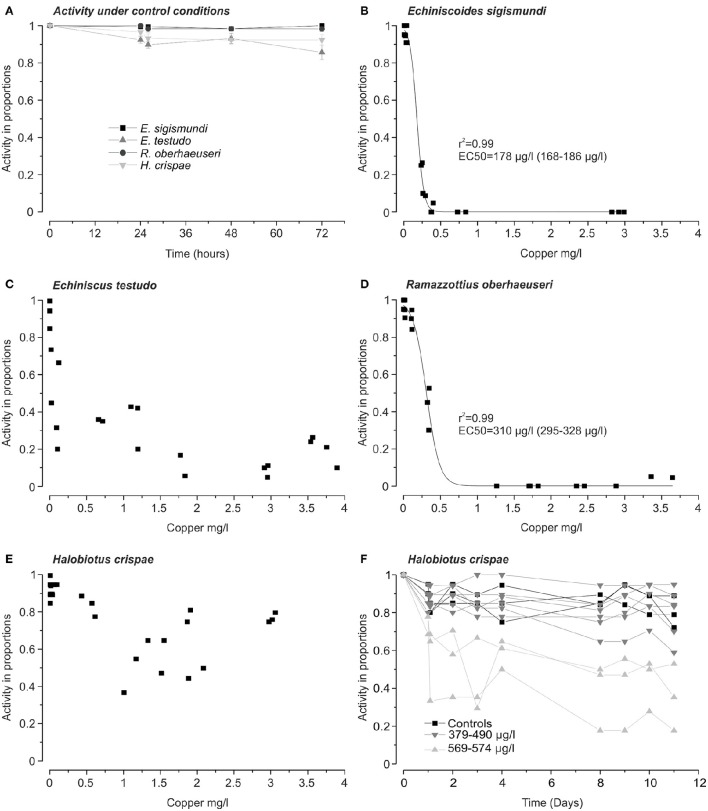
Tardigrades are microscopic aquatic animals renowned for their tolerance toward extreme environmental conditions. The current study is the first to investigate their tolerance toward heavy metals and we present a novel tardigrade toxicant tolerance assay based on activity assessments as a measure of survival. Specifically, we compare tolerance toward copper in four species representing different evolutionary lineages, habitats and adaptation strategies, i.e., a marine heterotardigrade, , a limno-terrestrial heterotardigrade, , a limno-terrestrial eutardigrade, , and a marine eutardigrade, . The latter was sampled at a time of year, when the population is predominantly represented by aberrant P1 cysts, while the other species were in normal active states prior to exposure. Based on volume measurements and a general relation between body mass and copper tolerance, expected tardigrade EC50 values were estimated at 0.5-2 μg l. Following 24 h of exposure, tolerance was high with no apparent link to lineage or habitat. EC50s (95% CI), 24 h after exposure, were estimated at 178 (168-186) and 310 (295-328) μg l, respectively, for and , whereas and were less affected. Highest tolerance was observed in with a ± . activity of 77 ± 2% ( = 3) 24 h after removal from ~3 mg l copper, suggesting that tardigrade cysts have increased tolerance toward toxicants. In order to identify putative tolerance related genes, an transcriptome was searched for key enzymes involved in osmoregulation, antioxidant defense and copper metabolism. We found high expression of Na/K ATPase and carbonic anhydrase, known targets for copper. Our transcriptome, furthermore, revealed high expression of antioxidant enzymes, copper transporters, ATOX1, and a Cu-ATPase. In summary, our results indicate that tardigrades express well-known key osmoregulatory enzymes, supporting the hypothesis that copper inhibits sodium turnover as demonstrated for other aquatic organisms. Tardigrades, nevertheless, have high tolerance toward the toxicant, which is likely linked to high expression of antioxidant enzymes and an ability to enter dormant states. Tardigrades, furthermore, seem to have a well-developed battery of cuproproteins involved in copper homeostasis, providing basis for active copper sequestering and excretion.
缓步动物是微小的水生动物,以其对极端环境条件的耐受性而闻名。当前的研究首次调查了它们对重金属的耐受性,并且我们提出了一种基于活动评估作为生存衡量指标的新型缓步动物毒物耐受性测定方法。具体而言,我们比较了代表不同进化谱系、栖息地和适应策略的四个物种对铜的耐受性,即一种海洋异缓步动物、一种淡水陆生异缓步动物、一种淡水陆生真缓步动物和一种海洋真缓步动物。后者是在一年中的某个时间采样的,此时种群主要由异常的P1囊肿组成,而其他物种在暴露前处于正常活跃状态。基于体积测量以及体重与铜耐受性之间的一般关系,预计缓步动物的半数有效浓度(EC50)值估计为0.5 - 2微克/升。暴露24小时后,耐受性较高,与谱系或栖息地没有明显关联。暴露24小时后的半数有效浓度(95%置信区间),对于[物种1]和[物种2]分别估计为178(168 - 186)微克/升和310(295 - 328)微克/升,而[物种3]和[物种4]受影响较小。在[物种4]中观察到最高的耐受性,从约3毫克/升的铜溶液中取出24小时后,其活动率为77 ± 2%(n = 3),这表明缓步动物囊肿对毒物的耐受性有所提高。为了鉴定假定的耐受性相关基因,在一个[物种名称]转录组中搜索参与渗透调节、抗氧化防御和铜代谢的关键酶。我们发现了已知的铜作用靶点钠钾ATP酶和碳酸酐酶的高表达。此外,我们的转录组还揭示了抗氧化酶、铜转运蛋白、ATOX1和一种铜ATP酶的高表达。总之,我们的结果表明,缓步动物表达了众所周知的关键渗透调节酶,支持了铜抑制钠周转的假设,这在其他水生生物中也有证明。然而,缓步动物对毒物具有高耐受性,这可能与抗氧化酶的高表达以及进入休眠状态的能力有关。此外,缓步动物似乎拥有一系列参与铜稳态的发达的铜蛋白,为铜的主动螯合和排泄提供了基础。