Burrows Tracy, Hides Leanne, Brown Robyn, Dayas Christopher V, Kay-Lambkin Frances
Faculty of Health and Medicine, University of Newcastle, Callaghan NSW 2308, Australia.
Centre for Youth Substance Abuse Reserach, School of Psychology, University of Queensland, St Lucia 4072, Australia.
Nutrients. 2017 Mar 15;9(3):285. doi: 10.3390/nu9030285.
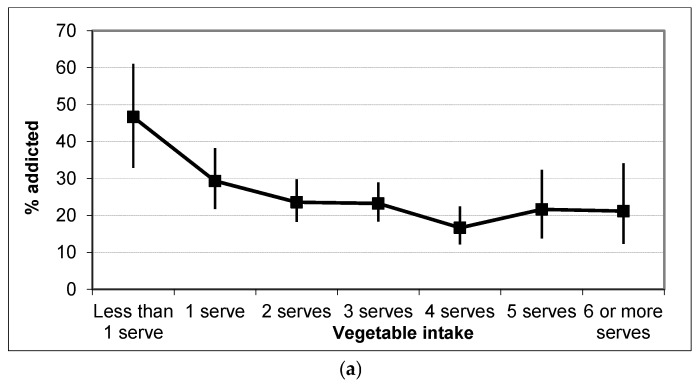
Increased obesity rates, an evolving food supply and the overconsumption of energy dense foods has led to an increase in research exploring addictive eating behaviours. This study aimed to investigate food addiction in a sample of Australian adults using the revised Yale Food Addiction Survey (YFAS) 2.0 tool and how it is associated with dietary intake, personality traits and mental health issues. Australian adults were invited to complete an online survey that collected information including: demographics, dietary intake, depression, anxiety, stress and personality dimensions including impulsivity, sensation seeking, hopelessness and anxiety sensitivity. A total of 1344 individuals were recruited with the samples comprising 75.7% female, mean age 39.8 ± 13.1 years (range 18-91 years) and body mass index BMI 27.7 ± 9.5. Food addiction was identified in 22.2% of participants using the YFAS 2.0 tool, which classified the severity of food addiction as "mild" in 0.7% of cases, "moderate" in 2.6% and "severe" in 18.9% of cases. Predictors of severe food addiction were female gender (odds ratio (OR) 3.65 95% CI 1.86-7.11) and higher levels of soft drink OR 1.36 (1.07-1.72), confectionary consumption and anxiety sensitivity 1.16 (1.07-1.26). Overall people with "severe" (OR 13.2, 5.8-29.8) or extremely severe depressive symptoms (OR 15.6, range 7.1-34.3) had the highest odds of having severe food addiction. The only variable that reduced the odds of having severe food addiction was vegetable intake. The current study highlights that addictive food behaviours are associated with a complex pattern of poor dietary choices and a clustering with mental health issues, particularly depression.
肥胖率上升、食物供应不断变化以及高能量密度食物的过度消费,导致了对成瘾性饮食行为的研究增多。本研究旨在使用修订后的耶鲁食物成瘾量表(YFAS)2.0工具,调查澳大利亚成年人样本中的食物成瘾情况,以及它与饮食摄入、人格特质和心理健康问题之间的关联。邀请澳大利亚成年人完成一项在线调查,该调查收集的信息包括:人口统计学信息、饮食摄入、抑郁、焦虑、压力以及人格维度,包括冲动性、寻求刺激、绝望和焦虑敏感性。共招募了1344名个体,样本中女性占75.7%,平均年龄39.8±13.1岁(范围18 - 91岁),体重指数(BMI)为27.7±9.5。使用YFAS 2.0工具在22.2%的参与者中识别出食物成瘾,其中0.7%的病例将食物成瘾严重程度分类为“轻度”,2.6%为“中度”,18.9%为“重度”。重度食物成瘾的预测因素为女性性别(优势比(OR)3.65,95%置信区间1.86 - 7.11)以及较高的软饮料摄入量(OR 1.36,1.07 - 1.72)、糖果消费量和焦虑敏感性(1.16,1.07 - 1.26)。总体而言,患有“重度”(OR 13.2,5.8 - 29.8)或极其重度抑郁症状(OR 15.6,范围7.1 - 34.3)的人患重度食物成瘾的几率最高。唯一能降低重度食物成瘾几率的变量是蔬菜摄入量。当前研究强调,成瘾性饮食行为与不良饮食选择的复杂模式以及与心理健康问题(尤其是抑郁症)的聚集有关。