Food and Health Programme, Institute of Food Research, Norwich Research Park, Norwich, UK.
Analytical Sciences Unit, Institute of Food Research, Norwich Research Park, Norwich, UK.
Mol Nutr Food Res. 2017 Sep;61(9). doi: 10.1002/mnfr.201600992. Epub 2017 Apr 12.
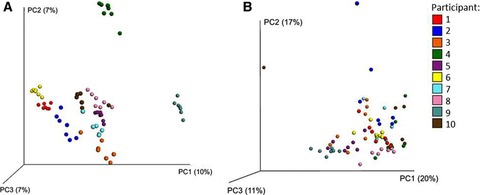
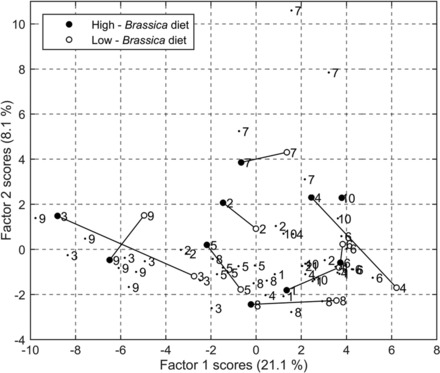
We examined whether a Brassica-rich diet was associated with an increase in the relative abundance of intestinal lactobacilli and sulphate-reducing bacteria (SRB), or alteration to the composition of the gut microbiota, in healthy adults.
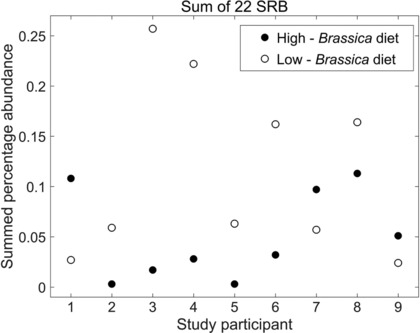
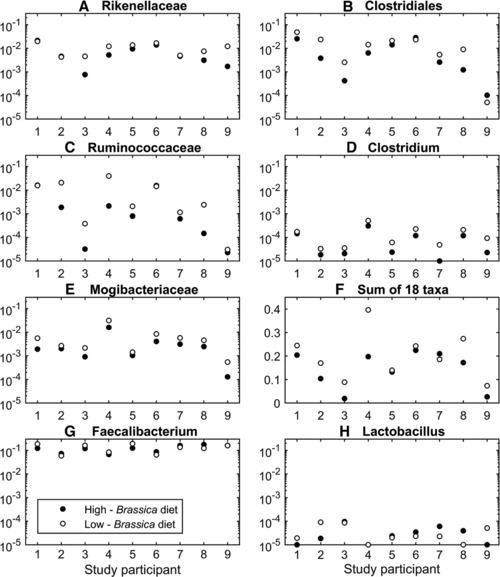
A randomised crossover study was performed with ten healthy adults who were fed a high- and a low-Brassica diet for 2-wk periods, with a 2-wk washout phase separating the diets. The high-Brassica diet consisted of six 84 g portions of broccoli, six 84 g portions of cauliflower and six 300 g portions of a broccoli and sweet potato soup. The low-Brassica diet consisted of one 84 g portion of broccoli and one 84 g portion of cauliflower. Faecal microbiota composition was measured in samples collected following 2-wk Brassica-free periods (consumption of all Brassica prohibited), and after each diet, whereby the only Brassica consumed was that supplied by the study team. No significant changes to the relative abundance of lactobacilli were observed (p = 0.8019). The increased consumption of Brassica was associated with a reduction in the relative abundance of SRB (p = 0.0215), and members of the Rikenellaceae, Ruminococcaceae, Mogibacteriaceae, Clostridium and unclassified Clostridiales (p < 0.01).
The increased consumption of Brassica vegetables was linked to a reduced relative abundance of SRB, and therefore may be potentially beneficial to gastrointestinal health.
本研究旨在探讨富含 Brassica 的饮食是否与肠道乳酸菌和硫酸盐还原菌(SRB)相对丰度增加,或肠道微生物群落组成改变有关,纳入的研究对象均为健康成年人。
本研究采用随机交叉设计,纳入 10 名健康成年人,他们分别食用高 Brassica 和低 Brassica 饮食 2 周,两种饮食之间用 2 周洗脱期隔开。高 Brassica 饮食包括 6 份 84 克的西兰花、6 份 84 克的菜花和 6 份 300 克的西兰花和红薯汤。低 Brassica 饮食包括 1 份 84 克的西兰花和 1 份 84 克的菜花。在 Brassica 禁食 2 周后(禁止摄入所有 Brassica)和每种饮食结束后收集粪便样本,以评估肠道微生物群落组成。研究期间,仅允许研究团队提供 Brassica 供成年人食用。研究结果显示,乳酸菌相对丰度无显著变化(p = 0.8019)。然而, Brassica 摄入量的增加与 SRB 相对丰度的降低相关(p = 0.0215),以及属于拟杆菌科、瘤胃球菌科、毛螺旋菌科、梭菌科和未分类梭菌目(p < 0.01)的细菌丰度降低相关。
增加 Brassica 蔬菜的摄入与 SRB 相对丰度的降低有关,因此可能对胃肠道健康有益。